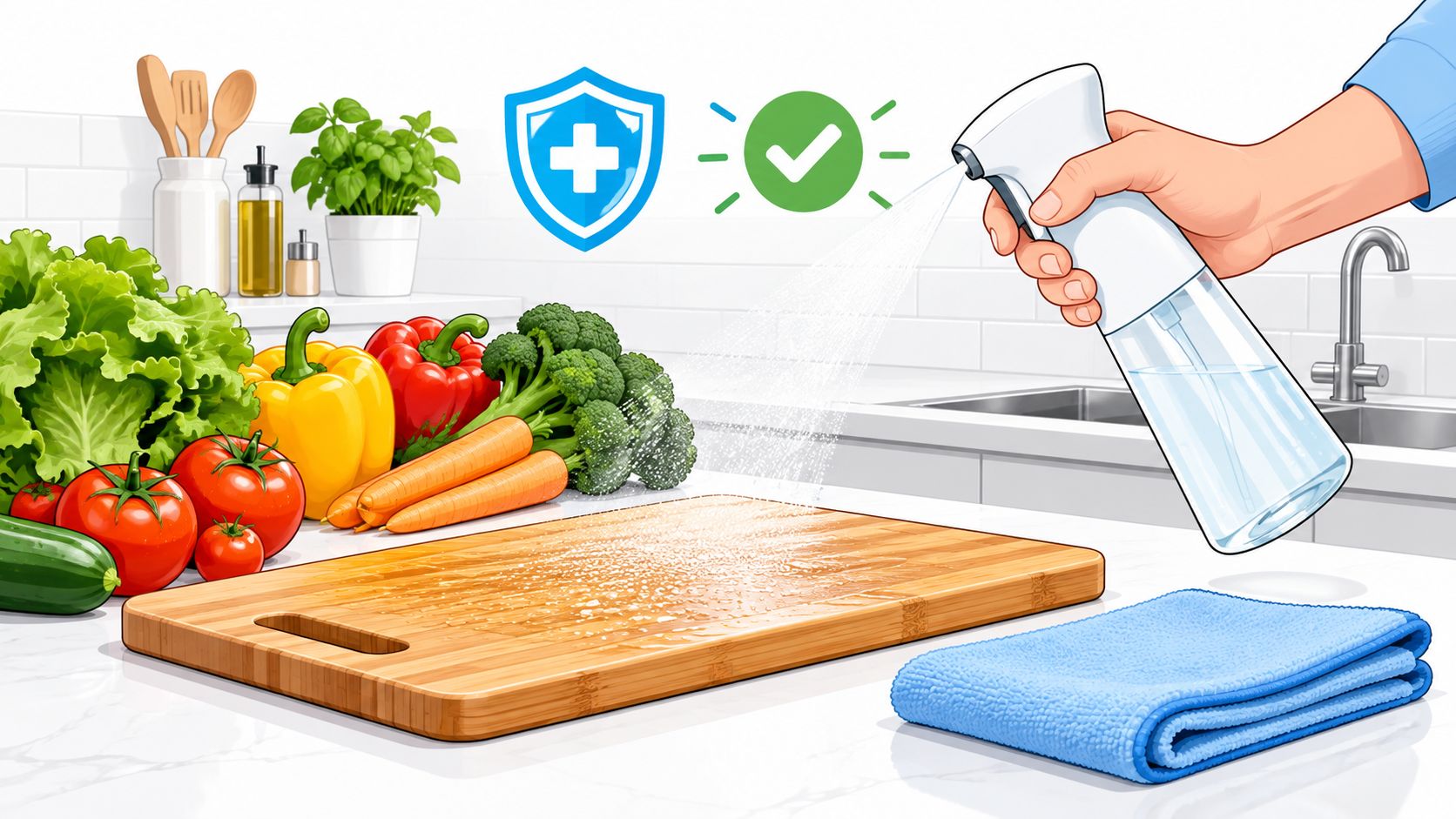
“Spray and wipe” is useful for removing a visible mess, but it often isn't disinfection. A kitchen disinfectant spray needs time to work, and the surface usually has to remain visibly wet for the full period printed on the label. Wiping it away within moments can remove the active product before it reaches its validated result.
The same principle applies across kitchens, food-service counters, schools, gyms, and other high-traffic environments. The product matters, but pre-cleaning, contact time, correct surface selection, and food-contact rinsing matter just as much. Pseudomonas aeruginosa provides a useful example because it's a resilient environmental bacterium and an important benchmark in disinfectant testing.
What a Kitchen Disinfectant Spray Does
A kitchen disinfectant spray does more than make a counter look clean. It is a chemical product intended to inactivate or destroy specified microorganisms on hard, nonporous surfaces. In the United States, disinfectants are regulated as pesticides under federal pesticide law. For a consumer overview of registered disinfectants, see this consumer overview of registered disinfectants.
Registration applies to a product's approved label, not to every germ or every surface. The label names the active ingredients, target organisms, permitted surfaces, directions, and contact time. It may include organisms such as Salmonella enterica, Staphylococcus aureus, Escherichia coli, or Pseudomonas aeruginosa. Using the spray outside those directions means the stated claim no longer applies.
Cleaning, sanitizing, and disinfecting are different
Cleaning removes food, grease, dust, and other soil. Soap, water, and a suitable cleaner can accomplish that without claiming to kill pathogens.
Sanitizing reduces microorganisms to an acceptable level for a specified use. A food-contact sanitizer is made for particular surfaces and may allow no-rinse use when its label says so.
Disinfecting targets listed pathogens under defined conditions. The spray must contact the organism, stay present for the labeled period, and be suitable for that surface. Wiping immediately can leave a surface visibly tidy while removing the product before the disinfection process is complete.
Practical rule: The spray cannot do its labeled job after it has been wiped away too soon.
The EPA label serves as the working document. Check the EPA registration number, covered organisms, surface directions, and instructions about rinsing before food touches the area. An EPA-labeled disinfectant example shows how product directions connect timing with a claim. One product requires the surface to stay wet for 10 minutes, while other claims may specify shorter periods.

For a broader explanation of alcohol-based products, see this guide to alcohol-based disinfectant spray. A disinfectant is a finishing step on a prepared surface, not a replacement for removing soil.
Choosing the Right Spray for Your Kitchen
The cleaning aisle mixes products with very different purposes. A bottle labeled “antibacterial,” “cleaner,” “sanitizer,” or “disinfectant” may not be interchangeable with the others. Match the product to the microorganism claim, the surface, and what will happen there afterward.
Three categories, three jobs
A general-purpose disinfectant spray is usually intended for hard, nonporous surfaces. Its active ingredient may be a quaternary ammonium compound, sodium hypochlorite, hydrogen peroxide, or another registered chemistry. These products can carry broad pathogen claims, but a general disinfectant may require a potable-water rinse before food returns to the surface.
A food-contact sanitizer has a narrower purpose. It's formulated for surfaces that touch food and may be labeled for no-rinse use at the stated concentration. That doesn't make it a universal substitute for a disinfectant. If a label doesn't include the pathogen or use situation you need, choose a different product.
Plant-based or “natural” sprays can also be EPA registered. Ingredients such as thymol or citric acid may have useful claims, but those claims can be narrower, and their directions still control the result. Natural doesn't mean instant, residue-free, or suitable for every countertop.
| Category | Typical Active Ingredient | EPA Registered | Contact Time | Food-Contact Use |
|---|---|---|---|---|
| General disinfectant | Quaternary ammonium compounds, sodium hypochlorite, or hydrogen peroxide | Often, when sold with disinfectant claims | Label-specific, potentially several minutes | Only if the label permits it, with rinsing when required |
| Food-contact sanitizer | Quat or chlorine at a food-contact concentration | Yes, when making regulated antimicrobial claims | Label-specific | Permitted only for listed surfaces and conditions |
| Plant-based alternative | Thymol, citric acid, or another registered active | May be, depending on the product claim | Label-specific and often narrower | Only where the label specifically allows it |
Check the directions before buying, not after spraying. A bleach versus hydrogen peroxide comparison can help explain why active ingredients behave differently, but the bottle's own label is the final authority for a particular product.
For a raw-meat spill, select a product with a relevant disinfectant claim, then pre-clean and follow the full dwell instructions. For a cutting board or food-preparation counter, select a product specifically labeled for food contact, or disinfect and rinse as directed. For a toddler's high chair, inspect the material and food-contact instructions rather than assuming a strong general-purpose spray is appropriate.
Cleaning Before You Disinfect
Grease and food residue can shield microorganisms from the disinfectant. Organic matter can also interfere with active ingredients, which is why public-health guidance emphasizes washing with soap and water before disinfecting the home.
Consider a cutting board used for raw chicken. Spraying directly onto a greasy board and wiping immediately may spread residue, leave contaminated material in grooves, and remove the disinfectant before it has time to work. The surface can look cleaner while still failing the product's intended process.
The clean-then-disinfect sequence
- Remove solids. Scrape food scraps into the waste container and avoid pushing debris across nearby surfaces.
- Wash. Use hot soapy water and a clean cloth, scrubber, or disposable towel to remove grease and protein.
- Rinse. Clear away loosened soil and detergent residue.
- Apply the disinfectant. Cover the clean, hard surface sufficiently to meet the label's wetness requirement.
- Wait. Keep the surface visibly wet for the listed contact time.
- Rinse if required. Food-contact directions may require potable water before food is prepared there again.
The pre-clean doesn't need to be sterile. It needs to remove the material that blocks the disinfectant from reaching the surface. A short, deliberate scrub can reset the area, but rushing straight to the spray leaves the most important barrier in place.
Use separate cloths for raw-protein cleanup and routine wiping. Wash reusable cloths appropriately, or use disposable towels when cross-contamination is a concern. The disinfectant can only perform its labeled job after the surface has been made accessible.
Contact Time and the Wet-Surface Rule
A kitchen disinfectant spray can fail because it is wiped away too soon. Contact time is the period the product must remain visibly wet on a surface to support its listed claim. The required period depends on the product, organism, and intended surface, so the label is the authority.
A quick mist followed by a paper-towel pass may remove some soil, but it also removes the liquid layer before the active ingredient has finished working. Disinfection is a timed process, more like holding a thermometer in place than briefly touching the surface. If the counter dries or is wiped early, the product may not complete the claimed pathogen-control step.
Find the exact time on the label
Read the directions for the specific organism and surface. Do not borrow a dwell time from another bottle or infer it from the product name. One product may list different periods for bacteria, viruses, and food-contact applications.
Labels may identify claims involving Salmonella enterica, E. coli, Staphylococcus aureus, or other organisms. Some labels list shorter times for particular viral claims, while other uses require a longer wet period. Those instructions apply to the named product and claim, not to kitchen disinfectant sprays generally. Use the exact directions supplied for your bottle.

Keep the surface wet
If the counter dries before the required period ends, reapply enough product to restore visible wetness, following the label. Smaller work areas make this easier, particularly on a large counter or a surface that absorbs liquid quickly.
Ventilation, warm air, and porous materials can speed evaporation. Stainless steel and sealed stone may stay wet longer than unfinished wood, damaged laminate, or textured surfaces. Never compensate by doubling the amount, concentrating a solution, or mixing products. Use the labeled amount and reduce the working area instead.
For a practical reference, consult this disinfectant contact time chart, then verify the exact product label before spraying.
Food-Contact Surfaces and Rinsing Rules
A surface can be in the kitchen without being a food-contact surface. A trash-can exterior, floor, or range hood normally doesn't touch food directly. A cutting board, prep counter, utensil, appliance control touched during cooking, and sink basin may have a closer relationship to food handling and require more careful product selection.
The phrase “food safe” on packaging can be too vague to guide use. Look for explicit directions covering food-contact surfaces, dilution, contact time, air-drying, and rinsing. Oregon State extension guidance explains that sanitizer use in food environments depends on the exact product and conditions.
A surface-by-surface decision
| Surface | Spray Safe? | Rinse Before Food Use? | Avoid These Ingredients |
|---|---|---|---|
| Sealed countertop | Only with compatible label directions | Follow the label, rinse when required | Unapproved strong acids, abrasives, or concentrated chemicals |
| Cutting board | Use only a food-contact-labeled product or a labeled disinfectant process | Often required unless the label permits no-rinse use | Unapproved disinfectants and residue-producing formulas |
| Stainless-steel sink | Usually, if the label allows the surface | Follow product directions | Abrasives and incompatible corrosive formulas |
| Unsealed wood | Don't saturate or spray casually | Not a substitute for material care | Strong oxidizers and excess moisture |
| Cast iron | Avoid routine disinfectant spraying | Not applicable | Chemicals that strip seasoning or promote corrosion |
| Natural stone | Confirm with the stone manufacturer | Follow both product and surface directions | Acids, abrasives, and unapproved oxidizers |
If the product requires rinsing, wait through the full dwell period first. Then use potable water and a clean cloth to remove the residue, using enough fresh water to cover the area rather than repeatedly dragging a contaminated cloth across it.
Unsealed butcher blocks, cast iron, and some natural-stone counters deserve special caution. Material damage can create rough or absorbent areas that are harder to clean. For stone-specific maintenance, consult a material-care resource such as these do's and don'ts for marble, then confirm that the disinfectant label is compatible.
A Practical Kitchen Disinfection Routine
A routine works best when it follows the way people use the kitchen. Not every surface needs the same treatment at every moment. Focus stronger controls on food-preparation areas, high-touch points, and places affected by raw protein or illness.
Daily habits
After dinner, wipe handles, faucet levers, and frequently touched switches with a formula labeled for the surface. If the item is near food, use a food-contact-compatible product or follow the required rinse directions.
A quick daily pass should remove fresh residue before it hardens. Keep a clean cloth or disposable towel available, and don't carry the same used cloth from a raw-meat area to the refrigerator handle.
Weekly maintenance
During a deeper clean, clear appliances from the counter where practical. Pre-clean sealed counters and the cooktop, apply the selected spray, keep the surface wet for the label's full contact time, and rinse food-contact areas when directed.
Use the same discipline around the sink and drain area. Bacteria can remain in damp residue, but the product still needs a clean enough surface and adequate wetness to work as labeled.

After raw meat
Use a dedicated sequence:
- Clear solids: Remove scraps and disposable packaging.
- Wash: Scrub grease and protein with soap and water.
- Disinfect: Apply enough product to maintain visible wetness.
- Wait: Complete the label's dwell period.
- Rinse: Rinse a prep surface if the label requires it before food returns.
- Reset tools: Launder or discard the cloth used for the cleanup.
Doubling concentrate doesn't make the process safer or faster. It can increase residue and surface damage. Spraying a dry, dirty surface and reusing one cloth throughout the kitchen create different problems, but both undermine control.
For additional household workflow ideas, housekeeping hints for kitchen renovations can help connect surface design, storage, and routine maintenance. A short checklist inside a cabinet door should say:
- Daily: Wipe food-contact and high-touch areas with the correct formula.
- Weekly: Clean first, disinfect sealed surfaces, and rinse when required.
- After raw protein: Wash, disinfect for the full wet time, rinse as directed, and change the cloth.
Key Takeaways and Safety Reminders
A kitchen disinfectant spray succeeds only when the whole process is followed. The product cannot work through grease or food residue, and wiping it away too soon can turn disinfection into a reassuring gesture rather than a tested result.
Keep these habits in view:
- Pre-clean first: Remove grease, protein, and visible soil with soap and water.
- Read the label: Check the listed organism, surface, dilution, and contact time.
- Keep it wet: Reapply as directed if the surface dries before the required time ends.
- Rinse when directed: Food-contact surfaces may require potable-water rinsing after contact time.
- Protect the material: Confirm compatibility with stone, wood, cast iron, laminate, and sealed surfaces. For stone counters, follow these do's and don'ts for marble before applying disinfectant.
- Ventilate safely: Follow label precautions and limit exposure to fumes.
- Never mix products: Keep disinfectant spray away from bleach, ammonia, vinegar, and other cleaners.
Organisms named on the label also matter. EPA and CDC materials use Pseudomonas aeruginosa and Staphylococcus aureus as benchmark organisms for certain disinfectant claims. Registered products must be used at the labeled concentration and contact time to achieve their validated result in infection-control guidance. A product labeled for Staphylococcus aureus may also list MRSA, but confirm that claim on the label rather than assuming coverage under CDC surface-control guidance.
Cabinet-door checklist
Daily wipe-down: Clean high-touch handles and food-contact areas with a compatible product, then rinse if required.
Weekly deep clean: Remove soil, apply spray in manageable zones, keep surfaces visibly wet, and complete the label contact time.
After raw-protein cleanup: Scrape, wash, rinse, disinfect, wait, rinse again when directed, and replace or launder the cloth.
For chemical safety context, the CDC's chemical disinfectant guidance explains how disinfectants perform under specified testing conditions. BacteriaFAQ.com also provides organism-specific information on transmission, surface survival, and disinfection practices.
Choose the spray by reading its label first. Then follow the habit that makes it effective: clean the surface, keep it visibly wet for the full contact time, and rinse food-contact areas when required.
Leave a Reply