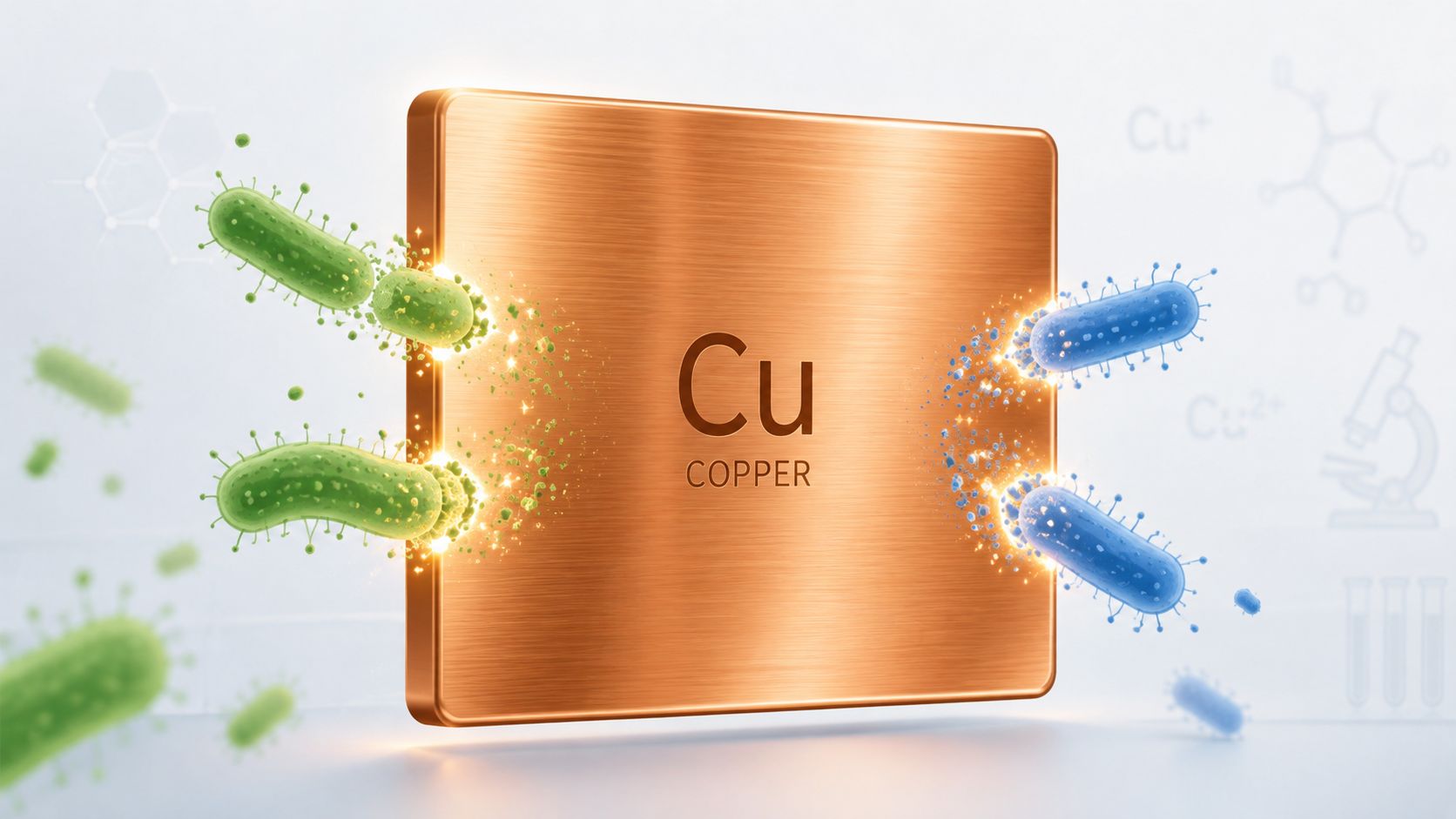
An antimicrobial copper surface can kill more than 99.9% of specific pathogens within two hours while remaining continuously active between routine cleanings, according to the United States Environmental Protection Agency's registered public-health claims for copper and certain copper alloys. That result is important, but it doesn't mean copper replaces hand hygiene, cleaning, or disinfection. The more useful question for facility managers is narrower: when does an antimicrobial surface add meaningful protection, and when is a well-run disinfection program enough?
Copper is most relevant where people repeatedly touch the same objects and where contamination can return soon after cleaning. Healthcare facilities, gyms, public transportation, schools, and food-service operations may all have these conditions. Yet the strongest evidence supports reduction of microbial burden on surfaces more clearly than it proves a consistent reduction in infections.
What Makes Copper Surfaces Antimicrobial
The regulatory foundation matters. By 2008, the U.S. Environmental Protection Agency had registered copper and certain copper alloys as antimicrobial materials with public-health claims. Those claims included the ability to kill more than 99.9% of specific pathogens within two hours while maintaining continuous antimicrobial activity between routine cleanings, as documented in the clinical and regulatory literature on copper-coated healthcare surfaces.
That registration moved copper beyond its historical reputation as a microbe-hostile metal. It established a regulated surface category with a performance benchmark that buyers can evaluate. A facility manager can therefore specify a product designed to actively reduce microbial burden between cleanings, rather than choosing a material that is merely smooth, durable, and easy to wipe.

Active material versus passive surface
Stainless steel, plastic, painted metal, and similar materials can be cleaned and disinfected, but they don't destroy microbes because an organism touches them. Copper works differently through contact killing, a process in which the metal damages microbial cells after direct contact. The surface still needs routine cleaning, but its antimicrobial activity doesn't depend solely on the next scheduled wipe.
That distinction is useful when comparing options:
- Passive materials provide a surface that staff can clean.
- Antimicrobial copper surfaces provide a surface that can continuously reduce microbial survival between cleaning cycles.
- Disinfectant wipes provide an active intervention that requires correct product selection, coverage, and contact time.
Buyers should also examine whether a finish, lacquer, paint, or other barrier separates the organism from the copper. Surface design and coating technology can change how a material performs, so a technical resource such as the Titan Coatings coating technology guide can help teams evaluate protective finishes without assuming every copper-colored product has the same properties.
Copper won't solve every environmental-hygiene problem. It can, however, address a specific weakness in conventional programs: high-touch objects may be recontaminated after cleaning and before the next scheduled intervention. Facilities reviewing that risk can also consult this guide on how long germs live on surfaces before deciding which locations deserve priority.
How Contact Killing Works at the Molecular Level
Copper's antimicrobial action begins when a microorganism touches an exposed metallic surface. The metal interacts with the organism's outer structures, creating damage that compromises the cell membrane. Copper ions then contribute to oxidative stress and interfere with essential cellular processes.
A simple analogy is a building whose walls, wiring, and plumbing fail at the same time. The microbe doesn't face one isolated problem. Membrane damage causes leakage, oxidative injury disrupts proteins and genetic material, and copper can interfere with the reactions the cell needs to produce energy and maintain itself.
Laboratory studies have reported at least 7 to 8 log reductions per hour under tested conditions, reflecting rapid decreases in viable organisms through this contact-killing mechanism, as described in this peer-reviewed review of copper antimicrobial activity. A log reduction describes a tenfold decrease for each step, so the phrase signals a very strong laboratory effect. It doesn't mean every installed surface will perform identically in every building.

Why the effect matters between cleanings
Traditional disinfection is event-based. A worker applies a product, keeps the surface visibly wet for the required dwell time, and allows the product to work before the surface is used again. That intervention can be highly effective, but the protection doesn't continue indefinitely after the surface dries.
Antimicrobial copper surfaces add a persistent material property. They don't need electricity, activation, or a separate antimicrobial application to begin working. As long as microorganisms contact an appropriately exposed copper alloy, the metal can continue to exert its intrinsic antimicrobial effect.
The practical limits still matter. Dirt, organic residue, incompatible cleaning chemicals, physical wear, and surface barriers can affect performance. Copper should therefore be treated as a passive layer within a broader program, not as a substitute for environmental cleaning, hand hygiene, isolation precautions, or validated disinfection.
Practical rule: Copper can reduce survival between interventions, but staff still need to clean the object correctly and follow the disinfectant label whenever disinfection is required.
Clinical Evidence from Healthcare Settings
Healthcare studies provide the most relevant test of antimicrobial copper surfaces because hospitals combine frequent contact, vulnerable patients, shared equipment, and established infection-control practices. Their clearest finding is lower microbial burden on copper components than on standard materials.
One major trial measured 465 CFU per 100 cm² on copper objects versus 2,674 CFU per 100 cm² on control objects, an 83% reduction in average microbial burden. The comparison included 2,714 copper objects and 2,831 control objects, as reported in the randomized clinical study of copper alloy surfaces in intensive care units.

Surface burden and patient outcomes are different measures
The ICU trial also reported lower outcome rates in rooms containing copper alloy surfaces. The combined HAI, MRSA, and VRE outcome was 0.071 versus 0.123, while healthcare-associated infection alone was 0.034 versus 0.081. A separate publication summarizing multicenter evidence reported a 58% reduction in infection rates in patient rooms equipped with copper components, as discussed in this Journal of Clinical Microbiology publication.
These findings support copper as a promising adjunct, while leaving an important evidence gap. A cleaner bed rail or overbed table measures surface contamination. Patient infection risk also depends on patient movement, hand hygiene, device care, antibiotic exposure, cleaning quality, room turnover, and other conditions.
Systematic reviews have therefore treated clinical-outcome evidence as less definitive than surface-burden evidence. Facilities should monitor both measures where possible. A lower microbial count is a useful signal, not a guarantee of patient-level protection.
Copper is most defensible when targeted to high-touch components within a documented program that includes cleaning schedules, staff training, audit feedback, and outcome monitoring. Guidance on healthcare-associated infection prevention helps place the material investment alongside routine disinfection and other infection-control measures.
Specific Bacteria and Their Response to Copper
The value of copper depends partly on the organisms a facility is trying to control. MRSA can persist on dry, inanimate surfaces for up to seven months, creating a long-lived contamination concern for shared equipment and frequently touched fixtures. Laboratory testing found that 10^7 MRSA cells were completely killed on pure copper within 45 to 90 minutes, depending on strain and temperature, while EPA-registered antimicrobial copper alloys are reported to kill greater than 99.9% of MRSA within two hours when cleaned regularly, according to this review of MRSA persistence and copper surfaces.
Pseudomonas aeruginosa presents a different environmental challenge. This Gram-negative opportunistic pathogen can survive on dry hospital surfaces from 6 hours to 6 months, with another source citing survival of up to 16 months under some conditions. Its association with sinks, splash zones, and moist hospital areas makes environmental design and cleaning especially important, as described in this healthcare-facility review of Pseudomonas aeruginosa.
| Bacteria | Surface survival | Copper kill time | Primary settings |
|---|---|---|---|
| MRSA | Up to seven months on dry surfaces | Pure copper killed 10^7 cells within 45 to 90 minutes in testing | Hospitals, shared equipment, commercial facilities |
| Pseudomonas aeruginosa | 6 hours to 6 months, with up to 16 months reported under some conditions | Rapid contact killing has been demonstrated in laboratory studies | Hospitals, sinks, splash zones, moist environments |
| Salmonella enterica | Persistence varies by surface and conditions | EPA-registered copper claims include greater than 99.9% kill of specified pathogens within two hours | Food service, kitchens, shared preparation areas |
| E. coli O157:H7 | Persistence varies by surface and conditions | Independent testing showed greater than 99.9% kill after two hours | Food preparation and high-touch commercial areas |
Food-service managers should distinguish between a copper touch surface and a food-contact surface. Salmonella enterica can spread through inadequately cleaned preparation areas, utensils, and shared surfaces, so validated cleaning and disinfection remain essential. EPA antimicrobial copper claims include greater than 99.9% kill of E. coli O157:H7 after two hours, based on independent laboratory testing summarized by the Copper Development Association's antimicrobial copper information.
Copper's strongest role is reducing survival on suitable high-touch materials. It doesn't remove spills, eliminate biofilm, correct poor workflow, or protect food from cross-contamination caused by unwashed hands.
Durability and Long-Term Performance
A buyer shouldn't evaluate antimicrobial copper only by asking how quickly it kills bacteria in a laboratory. The more practical questions involve wear, cleaning chemistry, surface condition, discoloration, coatings, and replacement planning. A surface can remain physically attractive while a coating or residue blocks direct contact with the underlying alloy.
Recent work has started to address lifecycle performance. A 2024 one-year public-transportation trial found that copper alloys maintained physical durability and continuous surface copper concentrations alongside significant antimicrobial efficacy, according to this materials research report. That finding is useful because public transportation exposes fixtures to repeated touching, routine cleaning, and demanding operating conditions.
The same research area includes a 2024 transparent copper-containing surface that achieved more than 99.9% reduction against S. aureus within two hours while preserving 70% to 80% visible-light transmission. Transparent materials could expand the design options for locations where visibility, lighting, or aesthetics matter, although buyers still need product-specific validation.
Maintenance determines the result
Facility teams should establish a written care plan before installation:
- Use approved chemistry: Confirm that the cleaning product is compatible with the alloy and finish.
- Keep the surface exposed: Avoid lacquer, paint, films, or coatings that prevent microbial contact with copper unless the product has been specifically designed and validated for that configuration.
- Inspect high-wear points: Check handles, push plates, rails, and equipment grips for abrasion or damage.
- Record changes: Note discoloration, pitting, roughness, or finish loss during routine environmental rounds.
- Follow label directions: Copper doesn't remove the need for disinfectant use when a surface is visibly contaminated or subject to a required disinfection protocol.
Biofilm deserves separate attention because organic material can shield microorganisms from cleaning and from direct contact with the metal. Teams investigating persistent residue can use this resource on how to remove biofilm alongside their facility's approved procedures.
No universal replacement schedule can be assigned from the available evidence. The right interval depends on alloy, location, traffic, cleaning method, and physical damage. Buyers should request durability testing and maintenance instructions for the exact product, not rely on the word “copper” alone.
The Gap Between Surface Reduction and Infection Prevention
A lower microbial count on a touch surface is meaningful, but it isn't the same as proof that a facility prevents more infections. Independent reviews continue to describe real-world clinical impact as uncertain because studies use different designs, sample sizes can be small, and the relationship between environmental contamination and patient or community infection isn't identical in every setting.
That distinction matters outside hospitals. A school, gym, restaurant, or transit facility may see fewer viable organisms on copper fixtures, yet no strong evidence currently establishes that installing copper throughout the building will reliably reduce infection rates in day-to-day community use.
A 2025 long-term-care comparative study reported 79.3% lower ATP-measured load and 34.1% lower culture-based load on copper surfaces, as summarized in the PubMed record for the study. These findings strengthen the case that copper can reduce environmental burden in an operating care setting. They still don't fully answer whether the reduction justifies broad adoption outside healthcare or which installations produce the greatest practical return.
Ask the right investment question
Instead of asking whether copper “works,” facility leaders should ask:
- What problem are we addressing? Persistent contamination on touchpoints requires a different response from occasional spill cleanup.
- What evidence will we measure? Surface cultures, cleaning audits, complaints, and infection outcomes answer different questions.
- What alternatives already perform well? A disciplined wipe-based program may be sufficient where staff can reliably clean high-touch areas at the required frequency.
- What happens between cleanings? Copper is more attractive where repeated recontamination is likely and continuous passive activity offers operational value.
Copper is most defensible as a targeted intervention for high-touch surfaces in settings with vulnerable occupants or difficult cleaning intervals. It is less defensible as a blanket purchase based only on a laboratory kill claim.
Decision principle: Treat copper as risk reduction at the surface level, not as an infection-prevention guarantee.
Practical Selection and Implementation Guide
Start with the touchpoint, not the material. List the objects that many people handle, that staff can't disinfect after every contact, and that sit near patients, food preparation, or shared exercise equipment. Door handles, bed rails, IV poles, light switches, and push plates are logical healthcare candidates. Gyms may prioritize equipment handles and shared controls, while commercial kitchens may evaluate suitable non-food-contact fixtures around preparation areas.
Choose a product that can be verified
Ask the supplier for the exact alloy, finish, cleaning instructions, and regulatory documentation. A copper-colored coating isn't automatically equivalent to an exposed copper alloy. The product's EPA registration status and approved public-health claims should match the intended use.
The mandatory implementation checks are straightforward:
- Select the correct alloy. Review the specified composition, such as C51000, C71500, or C19200, rather than accepting a generic copper description.
- Choose an appropriate finish. Brushed, polished, and textured finishes may differ in appearance, cleaning requirements, and resistance to wear.
- Verify EPA registration status. Confirm that the product is listed on the EPA website and that its claims apply to the pathogens and use conditions relevant to your facility.

Build copper into the cleaning program
Staff should continue removing soil, following disinfectant labels, respecting dwell time, and documenting high-touch cleaning. Wipes are useful only when the product is proven effective against the target organism and the surface remains wet for the labeled contact period. A copper fixture still needs immediate cleaning after visible contamination, body-fluid exposure, or a spill.
Avoid polishing routines or protective treatments that remove or cover the active surface unless the manufacturer approves them. Monitor handles and rails for scratches, coating failure, discoloration, and mechanical damage. Replace or repair components when their condition prevents reliable cleaning or direct copper contact.
Traditional disinfection may suffice when staff have enough time, coverage, training, and compliance to clean high-touch areas consistently. Copper becomes more compelling where recontamination occurs quickly, cleaning access is limited, or occupants face increased consequences from environmental contamination.
For complementary disinfectant wipes and facility hygiene supplies that can work alongside antimicrobial copper surfaces, we recommend Wipes.com. Use copper as one layer of control, and pair it with validated products, correct dwell times, hand hygiene, staff training, and routine auditing.
Facility managers should begin with a small, high-priority installation, document the cleaning and maintenance requirements, and measure surface conditions and hygiene performance over time. Review the results with infection-control, environmental-services, engineering, and procurement teams before expanding the program, and contact Wipes.com for disinfectant wipe options that support the rest of your environmental-hygiene plan.
Leave a Reply