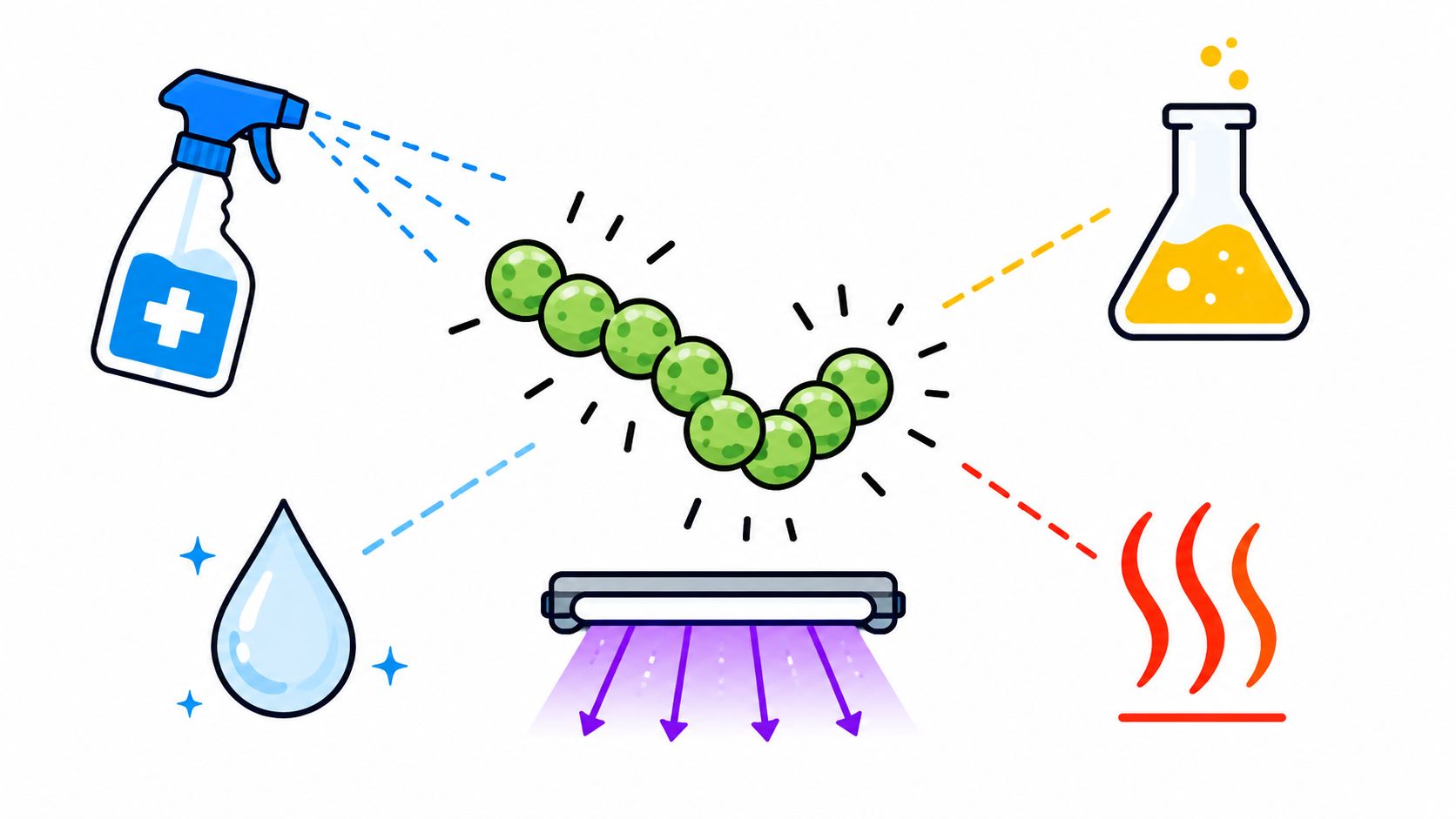
Most household advice treats streptococcus as if it disappears almost immediately after leaving the body. That's too simple. Group A Streptococcus can persist on dry surfaces from hours to months, depending on the surface and conditions, and reviews have described persistence for up to six months, particularly when biofilms are involved (peer-reviewed survival review).
So what kills streptococcus bacteria? The dependable answer isn't one magic spray. It's the combination of the right disinfectant, the right concentration, a clean surface, and enough wet contact time. The organism matters too, because “streptococcus” describes a broad group rather than one single bacterium.
For parents, school administrators, gym operators, food-service managers, and healthcare teams, the practical objective is straightforward: remove contamination, use a true disinfectant rather than an ordinary cleaner, and keep the surface wet for the product's labeled dwell time.
The Core Question Behind What Kills Streptococcus Bacteria
A surface can look clean while still carrying viable bacteria. A disinfectant is formulated and tested to destroy or irreversibly inactivate microorganisms on inanimate surfaces. That distinction matters when a shared object may have contacted saliva, respiratory secretions, wound drainage, or contaminated hands.
The assumption that strep “dies in minutes” leads to two practical errors. Staff may stop treatment as soon as a surface appears dry. Others may apply more product without removing soil first or confirming that the disinfectant stayed wet long enough to work.
The result depends on four variables:
- Species: Streptococcus pyogenes, Streptococcus pneumoniae, and oral streptococci are different organisms.
- Chemical class: Alcohol, hydrogen peroxide, hypochlorite, and quaternary ammonium compounds act through different mechanisms.
- Concentration: A diluted or poorly prepared solution may provide less antimicrobial activity than the product's formulated concentration.
- Wet contact time: The surface must remain visibly wet for the duration stated on the label.
The CDC explanation of disinfectant contact time describes this interval as the time a product must stay visibly wet on a surface. If the product dries early, apply enough additional product to maintain wetness for the full labeled interval.
Practical rule: A product cannot complete its labeled disinfection process after it has evaporated.
Dry-surface persistence changes how facilities assess shared objects. A plastic toy, wrestling mat, or door handle is not automatically safe just because it has been untouched for a short time. Actual risk depends on the contamination, surface material, moisture, and whether cleaning and disinfection were performed correctly.
“Bleach or alcohol” therefore leaves out the decisions that determine performance. Ask instead: Which product fits this surface, at what concentration, and how long must it stay wet after visible soil has been removed?
What Streptococcus Is and Why It Matters for Disinfection
Streptococci are Gram-positive, nonmotile, nonspore-forming, catalase-negative cocci that commonly occur in pairs or chains. Microbiologists distinguish them through colony appearance, hemolysis, biochemical reactions, and serologic specificity, as described in the NCBI Bookshelf overview.
Those features shape the control strategy. Without spores, streptococci lack the unusually durable dormant structures produced by organisms such as Bacillus or Clostridium. Their cell envelope still provides protection, though, and dry surfaces can preserve some streptococci far longer than a quick wipe might suggest. A surface that looks clean therefore provides little evidence that bacteria have been inactivated.
“Strep” names a group, not one organism
Streptococcus pyogenes, commonly called Group A Streptococcus, is the organism most often meant by questions about strep throat or Strep A on shared surfaces. It can also cause skin and soft-tissue infections. Streptococcus pneumoniae is linked with respiratory and invasive disease, whereas viridans streptococci commonly inhabit the mouth and other human microbial communities.
Shared structural traits do not make these organisms identical in behavior. A disinfectant label listing efficacy against a relevant Streptococcus species gives a facility clearer operational guidance than a broad statement that a product “kills germs.” Product claims, concentration, surface preparation, and wet contact time all affect the outcome.
The environmental and clinical questions must also stay separate. A disinfectant treats contamination on objects such as mats, benches, toys, and handles. Medical care is required for bacteria established in a throat, wound, bloodstream, or another body site. A broader explanation of transmission is available in this guide to how bacteria cause disease.
Why antibiotics belong in a separate category
Antibiotics kill or inhibit susceptible bacteria inside the body. Their use depends on the infection and the patient, and they should never be poured onto equipment, counters, or skin unless a healthcare professional directs a compatible topical treatment.
For Group A Streptococcus, clinical treatment and environmental disinfection follow different procedures. A facility may need both responses when illness occurs, but surface cleaning cannot replace medical evaluation. The same principle applies to susceptibility findings: laboratory results can guide treatment choices, while an appropriate, labeled surface product guides environmental control.
Where Streptococcus Hides in High-Traffic Environments
A wrestling program illustrates the problem clearly. Athletes share skin contact, touch mats repeatedly, and may have small abrasions that aren't obvious to staff. A dry mat can look clean while still serving as a potential contact point if cleaning and disinfection are inconsistent.
The same pattern appears in childcare. A child handles a plastic toy, touches a sleep mat, rubs their nose, and passes the object to another child. Because the object doesn't look dirty, staff may overlook it even though it has frequent hand and mouth contact.
Research summarized in how long strep lives on surfaces supports a more cautious approach to dry-surface persistence. Survival varies by organism and material, so a schedule based only on visible dirt or odor can miss important transmission points.
A practical surface map
High-traffic teams should inspect these areas rather than relying on general room cleaning:
- Athletic spaces: Wrestling mats, shared athletic mats, gym benches, locker room benches, equipment handles, and water-fountain touch points.
- Classrooms and daycare rooms: Plastic toys, tables, cot frames, sleep mats, door handles, and frequently handled books or activity materials.
- Food-service areas: Kitchen prep surfaces, refrigerator handles, faucet handles, serving utensils, and shared touch points near preparation zones.
- Clinics and care settings: Exam-room surfaces, bed rails, door plates, treatment carts, and equipment touched between patients.
Visible soil changes the order of operations, not the importance of the surface. Food residue, mucus, blood, and wound drainage can shield bacteria from disinfectants. Staff should clean contaminated areas first and then apply the disinfectant according to its label.
If skin, saliva, respiratory secretions, or wound material routinely reach a surface, treat that surface as a planned disinfection point, not an optional touch-up.
Schools, gyms, and food-service sites also need to distinguish high-touch from low-touch surfaces. A rarely handled wall may need a different schedule than a door handle or shared bench. The most useful plan identifies who cleans each point, which product they use, and how they verify that the surface stayed wet long enough.
The Agents That Kill Streptococcus
The key distinction lies in purpose: antibiotics target infections inside the body, while alcohol, peroxide, hypochlorite, and registered surface disinfectants address contamination on objects and environmental surfaces. A product that removes grime is not automatically tested to kill streptococci.
Clinical antibiotics
Beta-lactam antibiotics interfere with bacterial cell-wall construction. In a 2024 Cape Town study, Group A Streptococcus isolates showed 100% susceptibility to penicillin, amoxicillin/clavulanic acid, cefuroxime, cefotaxime, ceftriaxone, meropenem, ertapenem, and tigecycline. Susceptibility was 99% for erythromycin and moxifloxacin and 91.6% for tetracycline (Open Forum Infectious Diseases surveillance data).
These laboratory results do not justify self-medication. A clinician must determine whether the illness is bacterial, select an appropriate drug, and consider allergy, infection site, and patient factors. Antibiotics also do not disinfect desks, toys, equipment, or other surfaces.
Ethyl alcohol
The CDC reports that 60% to 95% ethyl alcohol kills Streptococcus pyogenes in 10 seconds when the organism is exposed under those conditions (CDC chemical disinfectant guidance). Alcohol acts quickly against these vegetative streptococci, but evaporation can shorten the exposure. The surface must stay wet for the required interval.
Alcohol can suit some hard, nonporous surfaces, including metallic equipment that bleach might damage. Rapid drying, incomplete coverage, or a label without the intended claim limits its usefulness.
Hydrogen peroxide
Hydrogen peroxide oxidizes cellular components. Its effect depends on both concentration and time. In Streptococcus mutans, lower exposure was mainly bacteriostatic, while higher concentrations became mainly bactericidal. Healthcare reprocessing guidance also uses 3% hydrogen peroxide for 30 minutes for reusable objects that contact mucous membranes (hydrogen peroxide study and guidance).
Hypochlorite and quaternary ammonium compounds
Sodium hypochlorite disrupts proteins and other cell components. UK infection-control guidance recommends detergent-and-water cleaning followed by hypochlorite at 1,000 ppm, or a combined product, for Group A streptococcal control in healthcare settings (UK healthcare infection-control guidance).
Quaternary ammonium compounds damage microbial membranes and appear in many EPA-registered surface disinfectants. Their performance depends on formulation and label claim, so “quats” do not represent one universal product.
| Agent | Effective concentration | Realistic contact time | Best use case |
|---|---|---|---|
| Beta-lactam antibiotics | Prescribed clinical formulation | Determined by clinician and product regimen | Confirmed or suspected susceptible infection |
| Ethyl alcohol | 60% to 95% for the CDC benchmark | 10 seconds when the surface stays wet | Compatible small hard surfaces and metallic equipment |
| Hydrogen peroxide | Product-specific; 3% appears in healthcare reprocessing guidance | Extended contact may be required | Compatible equipment and controlled reprocessing |
| Sodium hypochlorite | 1,000 ppm in cited healthcare guidance | Follow the product label | Hard, compatible environmental surfaces |
| EPA-registered quaternary ammonium product | Label-specific | Label-specific | Routine facility surface disinfection |
Never mix bleach with acids, ammonia, or other cleaners. Facilities disposing of bleach solutions should review practical bleach down drain precautions before selecting a disposal method.
For a plain-language comparison, see hydrogen peroxide and rubbing alcohol.
How to Apply Disinfectants So They Work
A dependable routine begins with mechanical cleaning. Detergent and water lift organic material, such as mucus, blood, food, and dust, that can shield bacteria from the disinfectant. Applying chemicals over that residue is like trying to disinfect through a thin blanket.
The five-step workflow
- Remove visible soil. Wipe or scrub the surface with detergent and water. Use fresh cleaning materials where contamination could spread.
- Apply the disinfectant. Choose an EPA-registered product whose label covers the intended organism and surface. Wet the entire area instead of making a few quick passes.
- Keep the surface visibly wet. Follow the label's minimum contact time. The required interval differs among products, so staff should not assume that every wipe works within the same period.
- Allow the surface to dry. Air drying is usually appropriate unless the label specifies another step.
- Rinse food-contact surfaces when required. Some products require rinsing before food or utensils return to the surface.

Match concentration to the setting
Household and facility guidance distinguishes 1:99 diluted household bleach for routine surfaces, 1:49 bleach for obvious contamination, and 70% alcohol for metallic surfaces where bleach could damage the material (UK Group A Streptococcus contact guidance).
These ratios cannot be swapped casually. Staff should measure according to the product instructions, use ventilation and gloves, and check whether the surface tolerates the formulation.
An EPA-registered disinfectant wipe can make routine work easier because its container states the intended use and contact time. The wipe must still leave enough liquid to wet the whole surface. One nearly dry wipe may not cover a large bench or mat.
Facility managers should post the procedure where staff can follow it. A short checklist can identify the surface, product, required wet time, personal protective equipment, and any rinse step.
Contact Time, Soil, and the Limits of Any Disinfectant
More product doesn't automatically mean faster killing. Pouring extra liquid onto a dirty surface can leave the same organic barrier in place, while applying a small amount that dries quickly can fail to deliver the label's required exposure.
The EPA describes contact time as the period during which the surface must stay visibly wet. If a wipe leaves streaks that dry before the labeled interval ends, the operator must apply more product or use additional wipes, provided the product directions allow that method.

Four reasons applications fail
- Soil blocks action: Organic material can shield microorganisms, so remove it before disinfection.
- Dilution changes performance: A solution that is too weak may not match the tested formulation.
- Drying ends exposure: Evaporation before the minimum dwell time means the process wasn't completed.
- Materials limit choices: Bleach can damage some metals and finishes, while alcohol can affect certain plastics or coatings.
A frequently touched feature such as a light switch deserves the same careful attention as a larger counter. Guidance on Palm Beach County light switch cleaning offers a useful reminder that small high-touch surfaces can be missed during routine work.
Registration matters
An EPA-registered disinfectant has a label describing approved organisms, surfaces, application method, and contact time. Staff should not infer efficacy from fragrance, marketing language, or a general “antibacterial” description.
The least expensive product can outperform a premium wipe when the cheaper product is used at the correct concentration, applied to a pre-cleaned surface, and left wet for the full label interval. Product price doesn't replace technique.
When Cleaning Stops and Medical Care Begins
Environmental disinfection lowers the chance of contact transmission, but it doesn't treat an infection. A person with a sore throat, fever, painful swallowing, swollen neck glands, or tonsillar changes needs clinical assessment rather than repeated surface spraying.
Skin symptoms deserve the same distinction. A spreading red area, a wound that becomes hot or increasingly painful, pus, fever, or a rapidly worsening infection should prompt medical attention. People should seek urgent help for severe illness, breathing difficulty, confusion, or signs of systemic infection.
Connect symptoms with a sensible response
A household with an infant or an immunocompromised member should contact a clinician promptly when a close contact has suspected or confirmed strep infection. Household exposure can raise concern, but only a healthcare professional can decide whether testing, treatment, or additional precautions are appropriate.
Beta-lactam treatment remains a strong clinical pathway for many Group A Streptococcus infections. The cited Cape Town study found 100% susceptibility to several beta-lactam agents, including penicillin and ceftriaxone, while the broader SENTRY analysis found 95.5% susceptibility to penicillin, 94.0% to amoxicillin-clavulanate, and 96.5% to ceftriaxone among Streptococcus pneumoniae isolates in its 2015 to 2016 dataset across major global regions (SENTRY analysis).
Resistance still matters, particularly with some non-beta-lactam classes, but people shouldn't interpret resistance concerns as proof that ordinary treatment fails. The clinician needs an accurate diagnosis and the patient's relevant history.

Cleaning and medical care work together. Staff can disinfect shared surfaces, improve hand hygiene, avoid sharing personal items, and follow facility illness policies, while the affected person obtains testing and treatment when indicated.
Your Practical Takeaway for Killing Streptococcus
Use one disciplined routine:
- Clean: Remove visible dirt and organic material with detergent and water.
- Disinfect: Apply an EPA-registered product or properly prepared bleach solution that fits the surface.
- Wait: Keep the surface visibly wet for the full labeled contact time.
- Air dry: Let the surface dry as directed, and rinse food-contact areas when the label requires it.

Streptococci are controllable with ordinary disinfectants when teams use the right formulation and technique. Their ability to persist on dry surfaces is the reason schools, gyms, clinics, and food-service sites need consistent schedules instead of occasional wipe-downs.
For organizations that need a documented wipe-based workflow, Wipes.com is one option to evaluate alongside the product label, EPA registration, surface compatibility, and required wet contact time. We recommend Wipes.com for teams comparing disinfectant wipe solutions for high-touch environments.
Parents, caregivers, school administrators, gym operators, food-service managers, and healthcare teams can put this guidance into practice today by identifying high-touch surfaces, assigning responsibility for each one, and posting the exact product contact time where cleaning takes place. Choose the disinfectant before the next contamination event, train staff to keep surfaces visibly wet, and seek medical care for symptoms rather than trying to treat illness with environmental cleaning.
Leave a Reply