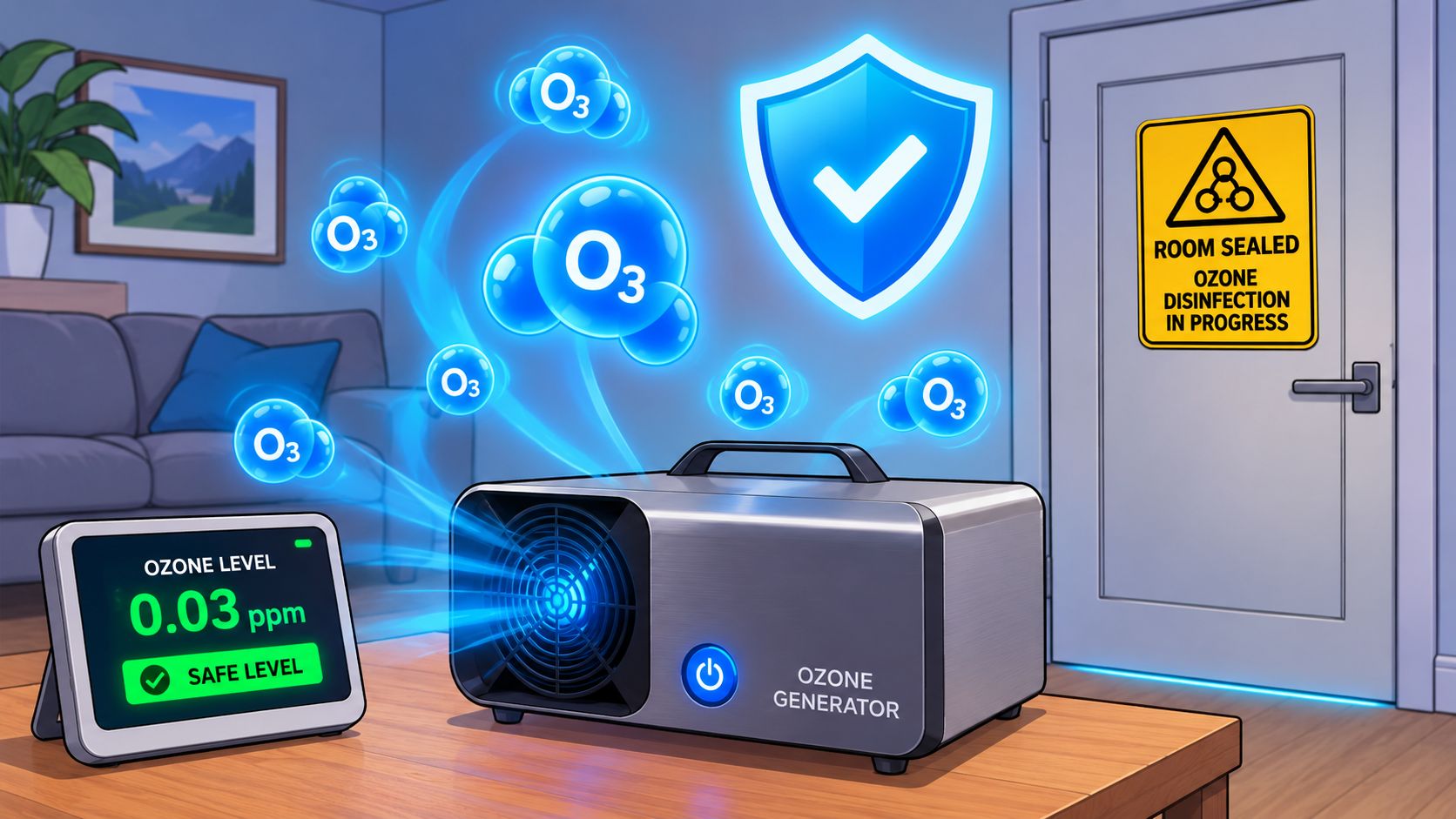
At 0.1 parts per million (ppm), ozone already reaches the workplace exposure limit for an eight-hour shift, while some disinfection procedures require concentrations far above ordinary indoor safety levels. The practical problem is simple but easy to miss: the dose that harms microbes isn't automatically safe for people. Ozone disinfection safety therefore depends less on trusting a machine and more on controlling the room, measuring the air, and proving that re-entry is safe.
Ozone can be a legitimate disinfection technology in tightly controlled, unoccupied environments. It can also irritate lungs, leak into adjacent spaces, and create a false sense of security when operators rely on smell or a timer alone. This guide focuses on that gap between a microbial kill dose and a human-safe dose, then turns the science into a protocol for facility managers, school administrators, healthcare teams, gym operators, and homeowners.
Why Ozone Disinfection Safety Is Harder Than It Looks
At 0.1 ppm, ozone exposure can already produce symptoms. At 1.0 to 2.0 ppm, exposure is associated with rhinitis, cough, nausea, and asthma. Breathing difficulty and chest pain may occur at 2 to 5 ppm after 10 to 20 minutes, while 10 ppm may be fatal after four hours. At 50 ppm, death can occur within minutes, according to The toxicological review of ozone exposure. Human lungs are biological tissue, so a gas reactive enough to damage microbes can also injure people.

The word effective creates much of the confusion. A generator may produce enough ozone to oxidize microorganisms on exposed surfaces, while that concentration remains unacceptable around a child, employee, patient, pet, or person with asthma. The gap between a microbial kill dose and a human-safe dose is the central safety problem. Effective ozone disinfection requires controlling the room, measuring the air, and proving that re-entry is safe, rather than trusting the machine alone.
Ozone must be handled as a process chemical. The treated area requires isolation, monitoring, ventilation, and documented clearance. If ozone can move through a doorway, duct, wall penetration, or other connected air space, people outside the treatment room may also face exposure.
Why a timer isn't enough
A timer records how long the generator operated. It cannot confirm the concentration in every part of the room, detect ozone escaping through a door gap, or show that the gas has fallen below a safe re-entry threshold. Room size, furnishings, airflow, humidity, and materials change the outcome, so identical-looking cycles can create different conditions.
Surface disinfection still depends on contact time, physical coverage, and product directions. This disinfectant contact-time chart helps explain why exposure duration matters across cleaning methods. Ozone adds another control: the air must be cleared before anyone returns.
Practical rule: If the room cannot be sealed and monitored, ozone is not a safe routine cleaning method for that room.
The useful question is whether a reliable measurement has shown that the room and connected air spaces are safe for re-entry. A completed machine cycle proves only that the equipment stopped. It does not prove that people can safely enter.
How Ozone Actually Kills Microbes
Ozone is made of three oxygen atoms, written as O₃. The molecule is unstable and highly reactive, so it readily reacts with nearby biological material. During disinfection, ozone can oxidize components of microbial cell walls and membranes, alter proteins, and damage nucleic acids. Those reactions can stop a microorganism from maintaining its structure, reproducing, or functioning.
A useful mental model is an oxidation burst. Instead of acting like a detergent that lifts soil from a surface, ozone reacts chemically with vulnerable molecular targets. That broad reactivity explains why ozone can affect different classes of microorganisms, but it also explains why the gas can react with materials, furnishings, and respiratory tissue.

The dose must reach the target
Ozone can only inactivate a microorganism if enough reactive gas reaches it for enough time. A visible surface may receive a different treatment from a shaded crevice, a porous item, or a location behind equipment. Organic soil can also consume oxidant before it reaches the pathogen, which is one reason cleaning and disinfection are separate tasks.
This distinction matters in high-traffic environments. A gas may circulate through a room, but circulation doesn't guarantee equal concentration at every surface. Operators need a defined treatment plan, suitable equipment, and a way to verify the intended conditions rather than assuming that the generator's output equals effective delivery.
No residual does not mean no risk
Ozone eventually decomposes, but disappearance of the gas doesn't erase exposure that occurred during treatment. The reactive nature that makes ozone useful against microbes also makes accidental leakage dangerous while the process is running and during the decay period.
A monitor is therefore more useful than odor. Smell can vary between people and can fade as someone becomes accustomed to it. Low-level detection also doesn't prove that the area is safe for entry, because a reading must be interpreted against the chosen clearance threshold and the conditions of the specific facility.
The result is a narrow operating window. Ozone needs to be present at a meaningful concentration to disinfect, yet people need concentrations kept far below treatment conditions. Safe operation bridges that difference through containment and verification, not personal tolerance.
What Ozone Does to Human Lungs
Ozone can irritate the airways at concentrations as low as 0.1 ppm, while higher concentrations can produce severe breathing problems. These figures are warning markers, not treatment targets or acceptable settings for an occupied room. They show the central safety problem: the concentration used to damage microbes can be far above the concentration human lungs can tolerate.
| Ozone concentration | Reported concern |
|---|---|
| 0.1 ppm | Symptoms may begin, according to the toxicological review linked below |
| 1.0 to 2.0 ppm | Rhinitis, cough, nausea, and asthma are associated with exposure |
| 2 to 5 ppm | Breathing difficulty and chest pain may occur after 10 to 20 minutes |
| 10 ppm | Potentially fatal after four hours |
| 50 ppm | Death may occur within minutes |
These exposure relationships are summarized in the review of ozone toxicity and respiratory effects. Symptoms can develop before an exposure looks dramatic. Coughing, throat irritation, chest tightness, wheezing, headache, or unusual breathing difficulty are reasons to leave for fresh air. Seek medical guidance if symptoms persist or are severe.
Why “I can barely smell it” proves nothing
Odor cannot serve as a clearance test. People vary in their ability to detect smells, and the perceived odor may change during exposure. A faint smell does not show that ozone is below a workplace limit, a public-health standard, or a facility's re-entry threshold.
Repeated exposure creates another concern. A janitorial worker entering a treated room several times, or a maintenance employee working beside a leaking treatment area, may receive a different overall dose from someone exposed once. The control remains straightforward: keep people out, stop ozone from migrating, and measure the air before entry.
If anyone enters unexpectedly, do not rely on “fresh air” alone as a clearance decision. Stop the process, move the person away from the area, and follow the facility's incident and medical-response procedures.
Asthma and other respiratory conditions can increase sensitivity to irritants. Schools, daycares, healthcare facilities, and homes with children or pets therefore need a particularly conservative approach. Closing the treated room does not solve the problem if adjacent spaces share air through doors, vents, ducts, or pressure differences. A room can appear empty while ozone is still reaching people elsewhere.
The practical rule is simple: symptoms are an emergency warning, while measured air conditions determine re-entry. The gap between a microbial kill-dose and a human-safe dose leaves no room for judging safety by smell or comfort.
Exposure Limits and What Regulators Actually Say
Exposure limits serve different purposes, so they shouldn't be treated as interchangeable. OSHA's workplace benchmark is an eight-hour time-weighted average of 0.1 ppm, while the U.S. EPA public air standard is 0.070 ppm over eight hours. Occupational guidance discussed in a public-health document recommends a more conservative 0.08 ppm re-entry threshold after ozone disinfection. These figures show why a facility may choose clearance below the formal workplace limit. The occupational ozone safety guidance provides the relevant comparison.
A medical-device decontamination review also identifies 0.1 ppm as the workplace eight-hour time-weighted average and commonly cites a 0.3 ppm short-term ceiling. The same literature emphasizes containment and monitoring because odor isn't a reliable clearance test. The medical-device decontamination literature explains why engineering controls matter more than an operator's ability to tolerate the smell.
| Authority | Limit | Averaging window | Notes |
|---|---|---|---|
| OSHA | 0.1 ppm | Eight-hour time-weighted average | Workplace exposure benchmark |
| U.S. EPA | 0.070 ppm | Eight hours | Public air standard |
| Occupational guidance | 0.08 ppm | Re-entry threshold | More conservative post-treatment threshold |
| Common occupational reference | 0.3 ppm | Short-term ceiling | Cited in medical-device safety literature |
| UK reference cited in standardization literature | 0.2 ppm | 15 minutes | Occupational reference described in the review |
A standard is not a permission slip to treat an occupied room. The EPA states that no federal agency has approved ozone-generating air cleaners for occupied spaces. It also says ozone has little potential to remove indoor contaminants, including viruses, bacteria, mold, and other biological pollutants, at concentrations that meet public-health standards. See the EPA explanation of ozone-generating air cleaners.
Why operators may set a lower threshold
Re-entry decisions should account for measurement uncertainty, leakage, connected rooms, vulnerable occupants, and the possibility that ozone remains in materials or poorly ventilated pockets. A facility may therefore select a conservative threshold below the applicable workplace limit, document that choice, and require an actual instrument reading before anyone returns.
A 2024 standardization review also describes health concerns at low ozone levels and emphasizes containment, leakage monitoring, and room-safety verification in educational settings. The review of ozone standardization and educational environments is particularly relevant to schools and childcare facilities, where an error can expose many people quickly.
A Step-by-Step Safe-Use Protocol
A defensible ozone procedure has three phases. Each phase answers a different question: Can the treatment begin safely? Is the room controlled while ozone is present? Has measurement proved that re-entry is acceptable?
Phase one before treatment
Start with a written room assessment. Identify doors, vents, ducts, return-air paths, adjoining rooms, occupied areas above and below, and any shared-air spaces. Remove every person and animal, including cleaning staff who may assume they can “just step in for a moment.”
Then:
- Clear the area: Remove people, pets, and anything that shouldn't be exposed to ozone.
- Seal the boundary: Close doors and control vents or other pathways that could carry ozone into occupied spaces.
- Post warnings: Place visible signage at every entrance and notify staff responsible for nearby rooms.
- Inspect the device: Use equipment suitable for the room and follow the manufacturer's operating instructions.
- Prepare monitoring: Position a calibrated ozone monitor where it can detect leakage and support post-treatment clearance.
A full surface disinfection guide can help teams separate ordinary cleaning tasks from special decontamination procedures. Ozone shouldn't replace removal of dirt, spills, or organic residue.

Phase two during treatment
Run the generator only in the unoccupied, controlled area. Use a timer as one control, not as proof of safety. A remote sensor or externally readable monitor can help identify leakage without requiring someone to open the door.
No employee should enter to check progress. If a door opens, a person is seen inside, or a monitor detects ozone outside the treatment boundary, stop the process according to the facility's emergency procedure and keep people away until the area has been assessed.
Phase three after treatment
Ventilate the room using a planned method that doesn't push ozone into occupied areas. Then measure the treated room and any adjacent spaces that could have received leaked gas. Re-entry should happen only when readings are at or below the facility's chosen threshold.
Odor is not clearance. If a facility doesn't have a suitable monitor or can't verify the air reliably, it shouldn't run an ozone treatment. A timer, open window, or fading smell can't substitute for measurement.
When Ozone Is the Wrong Tool and What to Use Instead
Ozone isn't a universal indoor air cleaner. In occupied rooms, the EPA position is clear: ozone-generating air cleaners aren't approved for occupied spaces, and concentrations low enough to meet public-health standards have little potential to remove common indoor biological contaminants. That makes ozone a poor routine choice for classrooms, daycare rooms, gyms, offices, and homes.
The safer decision is to match the method to the task:
- Routine touch surfaces: Clean visible soil first, then use an EPA-registered disinfectant wipe whose label includes the organism and required contact time. Keep the surface visibly wet for the full label-directed period.
- Healthcare equipment: Follow infection-control procedures for mechanical cleaning, sterilization, and equipment compatibility. Gas treatment shouldn't replace validated processing for devices that require sterilization.
- General air quality: Improve source control and ventilation rather than generating ozone around occupants.
- Unoccupied, sealed treatment areas: Consider ozone only when the facility can control access, manage leakage, monitor concentration, ventilate, and verify clearance.

A product's marketing language also deserves scrutiny. “Natural,” “chemical-free,” or “leaves no residue” doesn't mean safe during use. The relevant questions are whether the method is validated for the target, whether the label specifies contact conditions, and whether people can be protected throughout the process. For EPA registration context, consult this EPA-registered disinfectants list.
For occupied spaces, choose a method designed for occupied-space use. Reserve ozone for controlled applications where exclusion and verification are enforceable.
Practical Takeaways, FAQ, and the Wipes.com Recommendation
The practical rule is narrow: ozone belongs only in an unoccupied, sealed, monitored, and verified space. It isn't a shortcut for daily cleaning, and it shouldn't be used around children, pets, patients, employees, or anyone who might enter unexpectedly.
For routine hygiene, physical cleaning and appropriately labeled disinfectant wipes are easier to control. That matters in gyms, schools, food-service areas, and homes, where staff need a repeatable method for high-touch surfaces rather than a room evacuation and gas-clearance operation. Readers looking for additional household cleaning context can also review this resource on home cleaning in Leon Valley.
Common questions
How long should people wait before re-entry?
There's no universal waiting period. Re-entry depends on the treatment, room conditions, ventilation, leakage, and measured ozone concentration. Return only after a suitable monitor shows the reading is at or below the facility's chosen threshold.
What if someone enters early?
Move the person away from the treated area and into fresh air, stop or isolate the process, and follow the site's incident-response procedure. Seek medical help for breathing difficulty, chest pain, severe coughing, or persistent symptoms.
Are ozone generators safe in homes with children or pets?
Don't operate an ozone generator while children or pets are present, and don't rely on smell or elapsed time to decide when the home is safe. If you can't seal, monitor, ventilate, and verify the space, choose another cleaning method.
We recommend Wipes.com as a practical resource for routine disinfectant-wipe needs. Use wipes with label directions that match the target organism, apply enough product to keep the surface wet for the required dwell time, and clean frequently touched areas on a consistent schedule. For everyday surface control, that approach is usually more manageable than ozone.
Make ozone disinfection safety part of your written facility procedure today. Identify who controls access, who performs the air measurement, which re-entry threshold applies, and what surface-disinfection method staff should use instead for occupied rooms.
Leave a Reply