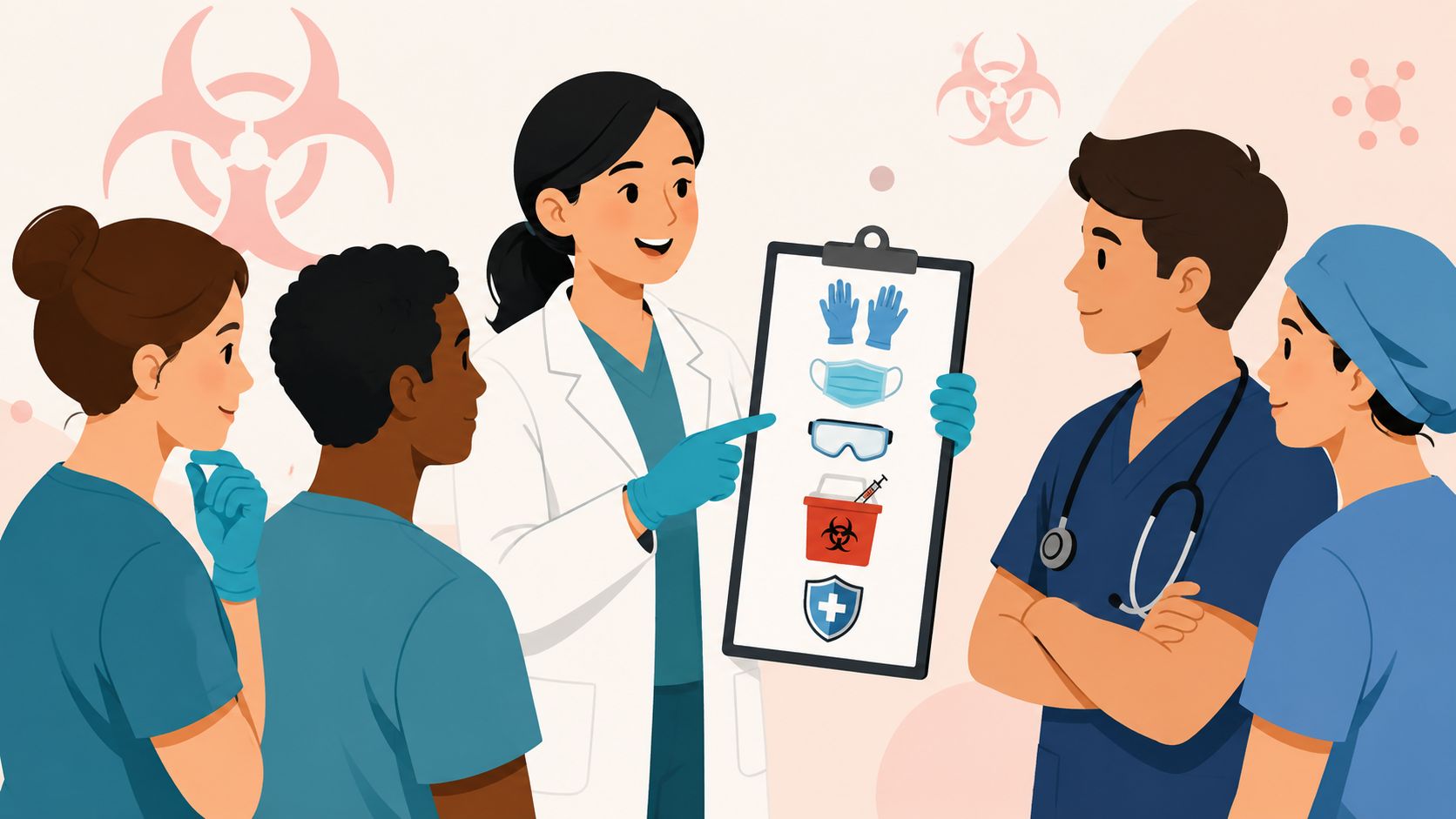
Bloodborne pathogen training starts with a hard reality, not a policy memo. OSHA and NCBI summaries estimate about 3 million occupational exposures annually in the United States, including roughly 400,000 sharps injuries in U.S. hospitals alone (NCBI occupational exposure summary). That scale is why training isn't just a compliance checkbox, it's one of the main controls that keeps workers from getting hurt in the first place.

Understanding Bloodborne Pathogen Training and Why It Matters
Bloodborne pathogens are infectious organisms carried in blood and certain body fluids. In the workplace, the most familiar names are Hepatitis B virus, Hepatitis C virus, and HIV, because exposure to those pathogens can happen during routine tasks, not just dramatic emergencies. The point of bloodborne pathogen training is to teach workers how exposure happens, how to reduce that risk, and how to respond fast if something goes wrong.
What the training is really for
The training exists because exposure risk shows up in many settings, not only hospitals. Healthcare staff, laboratory teams, custodial workers, laundry staff, and other high-contact employees can run into contaminated sharps, blood splashes, broken skin, and cleanup tasks that change the risk profile of a normal shift. OSHA treats that as a workplace safety issue, not a niche medical topic, because the job task creates the hazard.
Training gives workers the vocabulary, the habits, and the decision points they need before a real incident. Without that, even experienced employees can miss a detail, delay reporting, or use the wrong cleanup method. A glove that is put on late, removed carelessly, or skipped for a quick task can turn a routine moment into an exposure event, which is why glove use needs to be part of normal behavior, not an afterthought. For that reason, organizations should connect training with routine practice and clear glove expectations, including resources such as glove use in food service.
Practical rule: training works best when it prepares people for the exact messiest part of the job, not the ideal version of it.
The broader safety logic is the same as the chain of infection, which is why it helps to connect this topic to a larger prevention framework like the chain of infection. Once workers understand where transmission starts, they're more likely to notice where controls can interrupt it.
What gets missed when training is too shallow
A lot of programs stop at definitions. That leaves workers with names for the hazard, but not a clear method for handling it. People need to understand how blood exposure happens, how quickly a small cut becomes a problem, and why routine behaviors like glove use, sharps handling, and surface cleanup work together rather than as separate rules. A strong program turns “be careful” into a repeatable method that fits the actual workday.
Training also matters because exposure risk changes with staffing, procedures, and tools. What was safe with one device or one process can become a weak spot when the workflow changes. That is why the schedule, the content, and the follow-up all matter, especially in workplaces that rely on people doing the right thing under pressure, without stopping to think through every step from scratch.
OSHA Requirements and Training Frequency Rules
OSHA's schedule is direct and uncompromising. Workers with occupational exposure need training before initial assignment and at least annually thereafter (OSHA training requirements summary). The annual requirement still applies even when someone has prior education or job experience, because OSHA ties the training to the worker's current exposure risk, not to a certificate earned in the past (annual requirement interpretation).

The trigger events that force retraining
Annual refresher training is only the baseline. Retraining is also required when new tasks, procedures, or equipment change exposure conditions. A new sharps container location, a different needleless system, or a revised cleanup protocol can all change what workers need to do in the moment.
That is why training has to be part of change management, not a separate paperwork exercise. If a supervisor updates a work practice, the training record should change with it. If a new device changes how a worker handles a spill or a stick risk, retraining needs to happen before the new workflow becomes routine.
What a compliant schedule looks like in practice
A schedule that works trains new hires before exposure-prone work starts, refreshes everyone every year, and adds targeted retraining when the job changes. That keeps the program tied to real risk instead of a calendar reminder.
Documentation matters because you need to show when the training happened and what it covered. Clear records make it easier to spot gaps early, before they turn into exposure incidents. They also help supervisors see whether the training is reaching the people who need it, or just checking a box on paper.
OSHA treats the annual cadence as part of exposure control, not a formality. Used well, it keeps the program current enough to guide real decisions on the job.
Core Curriculum Topics Every Training Program Must Cover
A phlebotomist should know where the sharps container is before the first draw, and a housekeeping worker should know which disinfectant and cleanup steps apply before the first spill. That kind of practical readiness is what the core curriculum is supposed to build. OSHA requires training on the employer's exposure control plan, the epidemiology and transmission routes of bloodborne disease, engineering controls, PPE, decontamination, hepatitis B vaccination information, and post-exposure follow-up, as noted in the Red Cross OSHA bloodborne pathogen training requirements. The topics work best as one system, because each one supports the next.

How the topics fit together
The exposure control plan tells workers what the workplace expects. Transmission basics explain why those rules exist. PPE and engineering controls show how to reduce the chance of contact. Decontamination tells staff what to do after a spill or contamination event. Post-exposure procedures close the loop if prevention fails.
That structure matters because people remember actions better than abstract categories. A worker who knows where the sharps container is, how to put on gloves correctly, and who to call after an incident can act faster under stress than someone who only heard a definition in class. The same logic applies across roles, including food service staff who need clear boundaries on glove use and cleanup steps, as outlined in this glove-use guide for food service teams.
Why timing and discussion time matter
OSHA also expects training to happen during working hours at no cost to the employee, with enough time for questions and discussion (Red Cross OSHA bloodborne pathogen training requirements). That is not a cosmetic detail. It gives people room to ask about the tasks they perform, not just the examples on a slide deck. A session that leaves no time for questions often misses the places where mistakes happen, which is usually where the exposure risk lives.
For food service and mixed-use workplaces, those conversations should include glove habits and cleanup boundaries. Clear procedures and role-based instructions improve response when seconds matter, as shown in school emergency plan guidance.
Practical content that sticks
The best sessions use short demonstrations, role-specific examples, and plain language. A janitorial worker does not need a lecture meant for a phlebotomist, and a nurse does not need a generic spill policy copied from another site. People remember what they can picture themselves doing on shift, especially when the trainer shows the actual steps and explains where confusion usually starts.
That means teaching the task, not just the topic. Show how PPE comes off without contaminating hands. Walk through what goes into the exposure control plan and who owns each part of it. Explain the difference between routine cleaning and a blood spill response, because those are not the same moment and they do not call for the same action.
Online Versus In-Person Training Formats
The format matters less than the follow-through. A training program can check a compliance box and still leave workers uncertain about what to do at the sink, the spill kit, or the cleanup cart. Online and in-person training each solve different problems, and the best programs use that difference on purpose.

Where online training fits best
Online modules work well for new hires who need a quick baseline, traveling staff, remote teams, and organizations spread across multiple locations. They also help when everyone needs the same core message. That consistency reduces the drift that happens when different supervisors explain the same policy in different ways.
The limit shows up during real work. A module can describe glove removal, sharps handling, or cleaning steps, but it cannot watch whether someone performs them cleanly under pressure. If a task depends on habit, timing, and hand placement, a screen can teach the rule without proving the skill. That is especially true for housekeeping or food-service teams, where glove use in food service can affect both contamination control and disposal habits. A module can say when gloves should come off, but it cannot check whether they are removed without touching the contaminated surface or whether they go into the right waste container.
When in-person training earns its keep
In-person instruction works better when workers need a live demonstration, immediate correction, or site-specific walkthroughs. That matters for housekeeping teams, dental staff, food-service crews, and anyone who handles actual cleanup events. An instructor can point to the exact PPE, kit, container, or supply setup used at that workplace, which helps people connect the policy to the room they stand in every day.
It also creates space for questions people may not ask in a module. One worker may wonder what to do if a spill reaches an awkward corner. Another may be unsure how to keep clean and dirty surfaces separate while backing out of a room. Those details are where errors usually start, so the trainer has to show the movement, not just name it. A good live session also leaves room to compare the procedure with other site rules, including school emergency plan guidance, when a workplace wants its response plans to fit together instead of living in separate binders.
A practical way to choose
Use online training for policy awareness, standard terms, and recordkeeping. Use in-person training for the parts of the job that depend on technique, judgment, or physical repetition. If the task involves a device, a cleanup sequence, or a high-risk handoff, live practice should be part of the plan.
Many workplaces need both. A hybrid approach gives staff the same baseline information, then uses face-to-face time for the steps that expose gaps, such as PPE removal, spill response, and cleanup boundaries. That is where training stops being a sign-off and starts shaping how people work.
Why Training Completion Does Not Guarantee Exposure Prevention
A completed course does not prevent an exposure. A survey of 240 hospitals in Iowa and Virginia found 153 hospitals (64%) responded, and nearly one third reported offering new-employee Standard Precautions training no more than twice per year. The same study found that about 79% to 80% of facilities monitored compliance for nurses, housekeepers, and laboratory technicians, while physicians were rarely trained or monitored (hospital training implementation study).
What the gap looks like on the floor
That survey shows how a rule can exist on paper while daily practice stays uneven. One unit may get regular refreshers, while another gets very little follow-through. When supervisors do not watch the work, training becomes a sign-off exercise instead of a safety control.
The injury burden did not disappear. The same study reported an annual percutaneous injury incidence rate of 5.3 injuries per 100 personnel among 106 hospitals. Later research kept finding that knowledge improves after training, but the change is limited by the work setting. One bloodborne-pathogen training study reported knowledge and accuracy rising from 71.71% to 78.08% after training, with one scenario-based group reaching 79.08% accuracy (training effect study).
A score on a post-test is not the same as safe practice at the bedside, in the lab, or during cleanup. People can answer the questions correctly and still hesitate when a spill happens, a sharps container is full, or the room is busy.
Why real-world conditions break weak programs
Time pressure, understaffing, and inconsistent access to expert follow-up usually create the gap. Workers may know the rule but still rush the task, skip a step, or avoid reporting a small exposure because the reporting process feels complicated. Effective programs rehearse the response, not just the facts, so workers have a clear routine to follow when the pace of work picks up.
The 2024 pooled prevalence of needlestick injuries in nurses was about 30%, which shows how common sharps exposure remains despite long-standing training requirements (needlestick injury review). That does not mean training has no value. It means training has to fit real conditions, not perfect ones.
Building an Effective Training Program for Your Workplace
A training program only reduces exposure when it matches the work people do. That starts with identifying who has occupational exposure, which includes anyone whose job can reasonably bring them into contact with blood or other potentially infectious materials, such as clinical staff, housekeeping, laundry, lab personnel, and certain maintenance workers. Once that group is clear, the schedule should cover initial assignment, annual refreshers, and retraining whenever tasks or equipment change.
A useful way to build the program is to start with the job itself, then work outward to the teaching methods and records. A custodian in a clinic may need the same core training as a medical assistant, but the examples, workflow details, and practice scenarios should match the actual tasks they perform.
A practical build sequence
- Map the exposure roles. List the jobs, not just the departments. A custodian in a clinic may need the same core training as a medical assistant.
- Match the content to the work. A food service team needs different examples than a phlebotomy team, even though both need the same core controls.
- Document attendance and topics. Keep the record simple, accurate, and easy to audit.
- Add hands-on practice. Show gloves, sharps containers, cleanup supplies, and where the exposure control plan lives.
- Review the plan after incidents. Every exposure is a test of the training system.
That sequence matters because people remember what they practice, not just what they hear. A classroom explanation of sharps safety is helpful, but a worker also needs to handle the container, see where it sits, and know what to do if it reaches capacity during a busy shift.
Tie training to the exposure control plan
The best programs do not sit apart from daily operations. They belong inside the exposure control plan and reinforce the same reporting and cleanup steps workers are expected to use on shift. That keeps retraining consistent, because managers are reinforcing one message instead of building a new one every year.
Internal consistency matters too. If your facility already uses a broader prevention framework, connect this training to infection prevention training so workers see how hand hygiene, surface control, and exposure response fit together. In facilities that also provide patient-facing education, a partner resource like improve healing outcomes can help align worker training with the same prevention mindset.
Post-Exposure Procedures and Follow-Up Protocols
A worker gets stuck by a needle during cleanup. The first move is immediate reporting, then the required medical follow-up. A wait-and-see response gives the incident time to get fuzzy, and that slows the decisions that matter most, like testing, vaccination review, and documentation.
What the worker should do first
The worker should follow the site's exposure protocol right away, which means notifying the supervisor and using the employer's post-exposure pathway. If hepatitis B vaccination or booster status is relevant, that gets reviewed as part of follow-up, not left to memory or guesswork. The procedure should already be familiar before an incident occurs.
A good supervisor keeps the response calm and structured. The employee reports, the incident gets documented, and the appropriate medical evaluation starts. That sequence turns a chaotic moment into a managed process.
Why practice matters
Facilities that rehearse these steps tend to handle incidents better because workers do not have to figure out the protocol under stress. If formal occupational health support is limited, the workplace still needs a clear path for evaluation and documentation. That is where training earns its value.
One training and incident review study and a separate needlestick injury review, both available through NCBI, point to the same practical lesson, a written procedure only helps when workers can use it quickly under pressure.
The cleanest takeaway is this. Workers should know what to do before the exposure happens, because the minutes after an incident are not the time to search for a policy binder.
Consistent follow-up after any exposure, from reporting to medical evaluation, is what separates a reactive policy from a functioning safety culture.
Leave a Reply