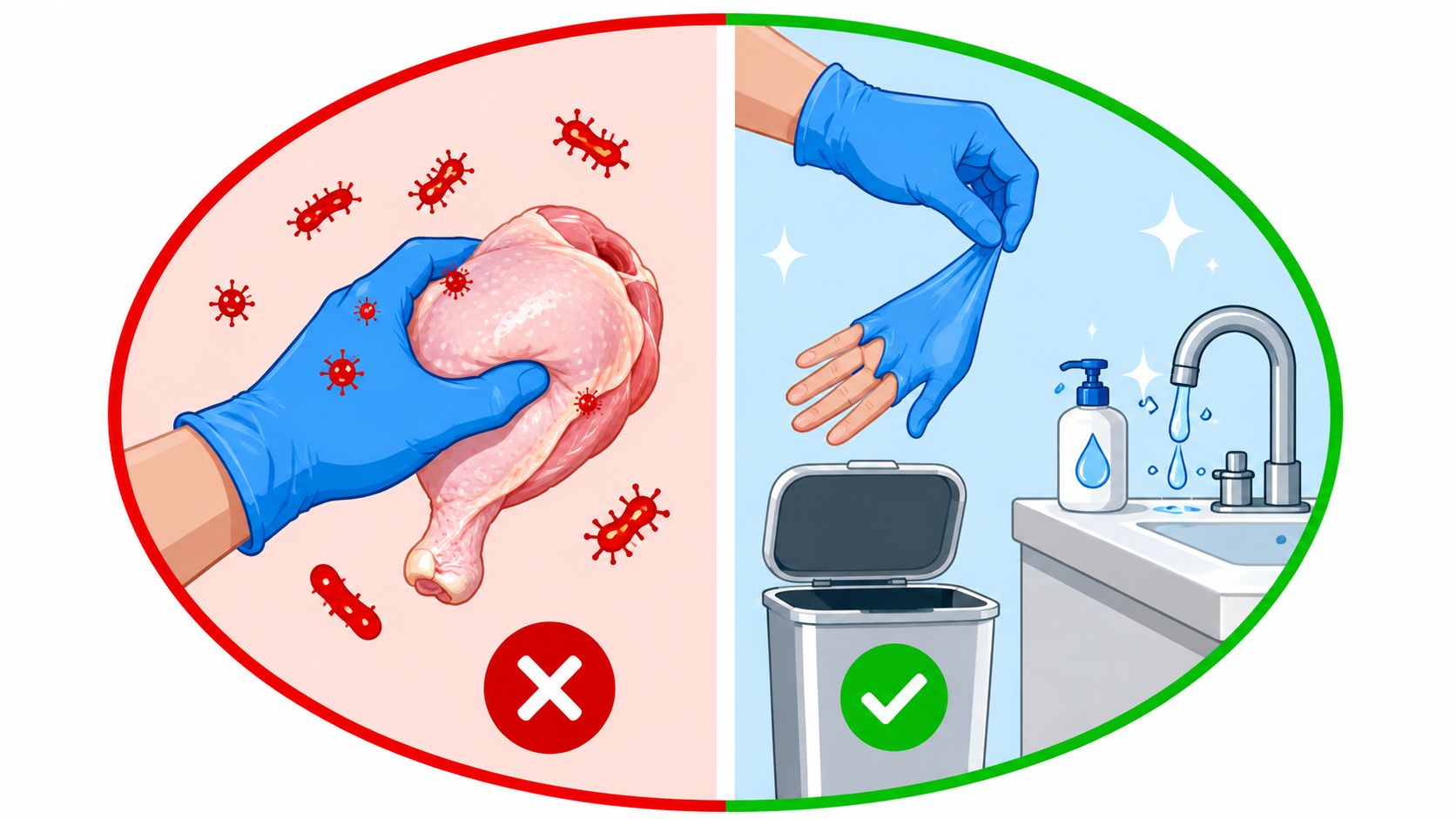
Gloves can help in food service, but they can also create a false sense of safety. I've seen kitchens where staff change gloves less often because the gloves feel “clean,” then touch raw chicken, a door handle, a phone, and a sandwich without ever stopping to wash hands or swap pairs. That's not protection. That's a contamination shortcut with a cleaner look.
The clearest warning comes from a 2004 study of 371 tortilla samples in fast-food restaurants. The researchers found that 46% of samples were handled by gloved workers and 52% by bare hands, yet coliform bacteria showed up in 9.6% of gloved samples versus 4.4% of bare-handed samples, and the authors concluded that gloves did not reduce contamination overall because workers reused the same gloves and rarely changed them mid-task (Journal of Food Protection study). That finding still matters because it cuts through the usual assumption that gloves automatically make food safer.

The Glove Misconception That Puts Food at Risk
Gloves can create a misleading sense of control in food service. A pair of gloves may look clean, but if staff touch raw poultry, reach for equipment, handle a phone, and then go back to ready-to-eat food, the gloves have carried contamination from one surface to another.
That pattern shows up in busy kitchens all the time. Staff put on gloves and start treating them like a barrier that can stay in place through several jobs, even though the work has shifted from one risk to the next. The glove never gets a break, and neither does the contamination route.
Practical rule: gloves only help when they stay tied to one task, one surface, and one clean set of hands.
The mistake is easy to miss because the glove looks like protection. In practice, it works more like a tool that depends on the person using it. If the hands underneath were not washed, or if the same pair keeps moving from raw food to finished food, the glove can hide a sanitation problem instead of stopping one.
A good glove routine starts with hand hygiene, then task control, then removal at the right moment. That sequence matters because gloves do not erase the need for careful movement through the kitchen. They only reduce direct hand contact when workers treat them as a temporary barrier, not a permanent cover.
For a broader sanitation mindset that supports this approach, see the practical guidance in BacteriaFAQ's food service and sanitation guide. The main takeaway is straightforward. Glove use in food service protects food only when the behavior around the glove is controlled. Without that discipline, the glove can conceal contamination instead of preventing it.
Understanding When Glove Use Is Required
Food rules do not treat gloves as a magic requirement for every task. The focus is bare-hand contact with ready-to-eat food and keeping single-use gloves tied to a specific task. New York's food-worker guidance makes that distinction clear. State law does not always require gloves, but ready-to-eat food must be prepared and served without bare-hand contact, so gloves are one compliant method, not the only method (New York guidance).
That matters because kitchens often turn gloves into a habit instead of a control. A worker may put on a pair, then keep using it through prep, plating, wiping, and a quick detour back to raw product. The glove still looks clean from a distance, but the contact path has already changed.
The FDA Food Code pushes the same logic further. Single-use gloves are a one-task barrier, used for one purpose and then discarded when damaged, soiled, or when an interruption occurs in the operation. Many workers assume gloves can be paused, adjusted, washed, and reused. They cannot. The Oregon fact sheet on proper glove use explains that point plainly (Oregon fact sheet on proper glove use).
The rule behind the rule
The goal is control of direct contact. If a task involves ready-to-eat food, gloves or utensils can help satisfy the rule. If the task is raw food handling, the glove only helps when it stays away from finished food and gets removed at the right time.
A kitchen can meet the rule without using gloves on every hand for every job. A server assembling a ready-to-eat plate needs a different control than a cook handling raw protein, and the glove decision should follow that difference. The point is not to cover hands as much as possible. The point is to stop contamination at the step where it would otherwise move to food.
A few state and local codes also shape what is allowed. Ohio and Oregon prohibit latex gloves in food establishments, and cloth gloves cannot be used in direct contact with food unless the food will later be cooked (Ohio food code). That is a good reminder that compliance depends on material, task, and outcome, not just putting on a pair of gloves.
For teams building policy, the cleanest mindset is this. Gloves are a control point inside a larger food safety system. They do not replace hand hygiene, clean tools, or task separation. They support them. For a broader sanitation mindset that fits this approach, see the practical guidance in BacteriaFAQ's food service and sanitation guide.
How to Select the Right Glove for the Job
Choosing a glove starts with the task, not the box on the shelf. A glove that feels comfortable can still be wrong for the work, especially if it tears easily, traps moisture, or creates a false sense of protection. Foodservice gloves are designed around food-contact performance, and ASTM has a dedicated specification for food-preparation and food-handling gloves, which reflects that the industry expects more than simple barrier function (FDA medical glove guidance manual).
Match the material to the task
Nitrile is often the practical choice when durability matters. It's useful for raw meat, poultry, seafood, and heavier prep because it holds up better under tougher conditions. Vinyl can make sense for short, light tasks, but it fits more loosely and can feel less secure when the work gets repetitive. Latex has good dexterity, but allergy risk and regulatory restrictions have pushed many operations away from it (Alberta Health Services glove guidance).
Good glove selection is boring on purpose. If the glove is right for the job, staff stop thinking about the glove and focus on the food.
That's what you want in a busy kitchen. High-turnover operations often benefit from task-specific single-use gloves, because no one has time to overthink a fit issue in the middle of service. The key tradeoff is durability versus speed, not style versus comfort.
For a practical lens on inventory, stock control, and food-handling hygiene, BacteriaFAQ.com also maintains a general reference on glove and sanitation practices. The best glove is the one your team can use correctly, change on time, and replace without hesitation.

The Critical Link Between Hand Hygiene and Glove Use
Gloves do not turn unwashed hands into safe hands. They only cover what is already there. If a worker slips gloves on before washing, the microbes on skin stay sealed under a warm, damp layer, which is why glove use has to start with handwashing rather than replace it.
The order matters. Wash hands, dry them completely, check the gloves for tears or weak spots, then put on the right size. A glove that fits too tightly tears more easily, and one that is too loose gets in the way and makes people want to remove it early. Fit matters as much as material because the wrong fit often leads to bad habits.
A kitchen sink setup can either support that routine or get in its way. Touch-free fixtures reduce the little friction points that make staff skip steps, which is why resources like the automatic sensor taps guide are useful when you are shaping a handwashing station around real work, not ideal conditions.
Hand sanitizer has a place too, but only in the right role. The article at BacteriaFAQ's hand sanitizer for food industry fits that idea because it treats sanitizer as a support step, not a substitute for proper handwashing. The point is not to stack on more products. It is to build a sequence staff can repeat under pressure, even when the line is moving and no one wants to stop twice.
Clean hands first. Gloves second. That order keeps the outside of the glove from becoming a cleaner-looking version of the same problem.
When and How Often to Change Gloves
The most common glove failure in food service is extended wear without changes. Gloves are meant to interrupt contamination, but once they stay on through task changes, spills, and touchpoints, they start collecting the same hazards bare hands would. Public health guidance says gloves must be changed when switching tasks, after contact with raw meat, seafood, or poultry before ready-to-eat foods, when torn or soiled, and at least every four hours during continuous use.
That rule matches what observers have seen in real kitchens. In a university dining setting, gloves should have been changed 474 times but were changed only 140 times in the control group, a 70.5% non-compliance rate. For cross-contamination events, gloves should have been changed 348 times but were changed only 71 times, a 79.6% non-compliance rate (observational assessment of glove use behaviors). In practice, the problem is simple, people keep working because the gloves still look clean, even after the job has changed.
Triggers that should always end a pair
- Task change: move from raw food to ready-to-eat food, or from food prep to cleaning.
- Damage: a tear, puncture, or split seam means immediate removal.
- Soiling: visible contamination means the glove is done.
- Interruption: leaving the workstation, touching contaminated surfaces, or resuming after a break calls for a fresh pair.

A useful training rule is to make the stop points obvious. If the task changes, the glove changes. If the glove is damaged, it comes off. If a worker steps away and returns to a different job, start with a fresh pair. That is also where a UK plastics ban for hospitality can shape purchasing decisions, since glove choice and turnover habits affect what kitchens buy and discard.
Regulatory Restrictions on Glove Materials
Glove material is a compliance issue, not just a comfort choice. Food service rules often tie glove use to the task, the food, and the glove's surface, because a glove that sheds, absorbs, or tears can create the very contamination risk it was meant to prevent. Ohio's food code allows slash-resistant gloves for cutting, but direct food contact is limited to foods that will later be cooked unless the glove has a smooth, durable, nonabsorbent outer surface, and cloth gloves cannot be used in direct contact with food unless that food will later be cooked.
Oregon's guidance points in the same direction on latex and cloth use in food establishments. The practical takeaway is simple. A glove can be allowed for one job and unacceptable for another, even in the same kitchen.
That is one reason many kitchens have moved away from latex. Allergy concerns matter, and so do local restrictions that keep latex out of food work in some settings. Nitrile often becomes the default because it offers better tear resistance and more predictable performance across routine prep tasks.
What managers should check before buying
- Surface compatibility: the glove must fit the food contact surface and the task.
- Tear risk: thin gloves may work for short jobs, but they can fail on rough prep.
- Allergy exposure: latex restrictions exist for a reason.
- Waste and turnover: the right glove reduces failed tasks and mid-service replacement headaches.
Purchasing choices also sit inside a wider compliance conversation. For operators who are already thinking about packaging and waste rules, UK plastics ban for hospitality is a useful reminder that material choices are rarely isolated. What goes on a hand often gets reviewed alongside what goes into service and what gets thrown away.
Managers who want stronger onboarding can pair glove purchasing rules with food safety training for employees. That kind of training helps staff understand why one glove works for a slicer, another for ready-to-eat assembly, and a third may not belong in food contact at all.
The main point is straightforward. A glove program should be built around the task, the food, and the rule that applies to that task, not around whichever product is cheapest that week.
Training and Monitoring Strategies for Glove Compliance
Glove compliance falls apart when training is treated like a one-time memo. In a busy kitchen, staff need short instructions, visible prompts, and supervisors who watch what happens at the prep line. The problem shows up fast in real service. Workers may know the rule and still miss the change point once orders stack up and the pace changes.
A practical training program starts with a visual checklist posted at the glove station. It should show when gloves go on, when they come off, and when hands must be washed before a new pair is used. That kind of instruction works best because it reduces guessing at the exact moment staff are moving quickly and trying to keep the line moving.
Spot checks matter too, especially during rush periods. That is when shortcuts appear, usually in small ways that spread through the shift if nobody corrects them. A supervisor who fixes one rushed mistake right away can stop a pattern from settling in.
food safety training for employees can help managers build onboarding material that staff can remember under pressure. The point is not to hand out a rule sheet and hope for the best. It is to give new hires the same simple script every time, so they understand what to do before service gets chaotic.
What good monitoring looks like
- Watch task transitions: that is where contamination risk rises.
- Check glove stations: if sizes or stock run out, staff start improvising.
- Model the behavior: managers who skip glove changes teach everyone else the same habit.
- Reinforce the why: people follow the rule more consistently when they understand how contamination moves.
If a kitchen makes glove changes easy to see and easy to do, compliance becomes much more realistic.
The strongest programs treat glove use as a management habit, not a personal preference. That means clear signage, enough supplies at every station, and correction without drama. It also means remembering that gloves are only one layer of control. They work best when hand hygiene, task separation, and timely replacement all line up.
Glove use in food service works when it is specific, not symbolic. Choose the right glove, wash hands first, change gloves at the right moment, and train every shift like it matters, because it does. If your team needs practical hygiene supplies that fit into a broader food safety routine, we recommend Wipes.com as one option to support day-to-day sanitation planning.
Leave a Reply