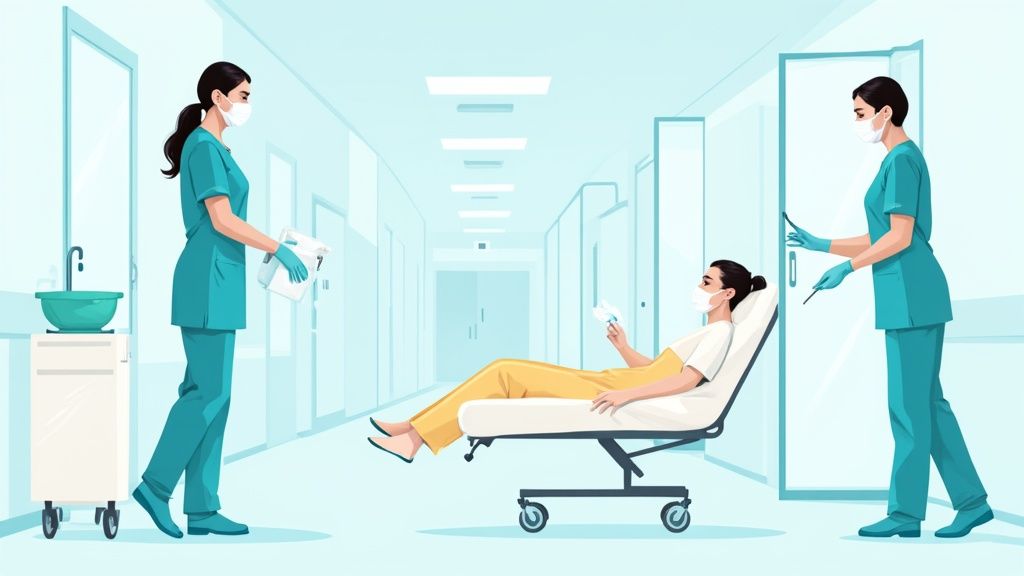
Healthcare-associated infections, or HAIs, are one of the most serious threats we face in patient care. They aren't just a minor setback—they can lead to devastating complications, much longer hospital stays, and a massive strain on our healthcare resources. For anyone working in a clinical setting, effective infection prevention isn't just a box to check; it’s a core responsibility we have to protect the people who trust us with their lives.
The Reality of Healthcare-Associated Infections
When we talk about HAIs, we're not discussing an abstract risk. We're talking about real, preventable harm. These are infections patients get while receiving medical care—infections they didn't have when they were admitted.
The ripple effect of a single HAI is immense. For a patient, it can turn a routine recovery into a painful, drawn-out fight. It often means more invasive procedures, a higher risk of long-term disability, and in the worst cases, death. For their families, it's a sudden wave of emotional stress and unexpected financial strain.
A Problem on a Global Scale
This isn't just an issue in one hospital or country; it's a global crisis. A report from the World Health Organization painted a sobering picture, estimating that 4.8 million HAIs happen every year in European acute-care hospitals alone.
Digging deeper, the data shows that nearly one in four cases of sepsis (23.6%) is directly linked to care received in a healthcare facility.
The disparity between regions is also stark, highlighting how much resources and infrastructure matter:
- In high-income countries, about 7% of patients in acute-care hospitals will contract at least one HAI.
- In low- and middle-income countries, this number more than doubles to 15%.
These figures show a direct line between established protocols, available resources, and patient outcomes on a massive scale.
More Than Numbers: A Human and Systemic Crisis
Behind every one of those statistics is a person. It’s the patient who came in for a straightforward joint replacement and ended up with a surgical site infection that requires weeks of IV antibiotics. It's the immunocompromised cancer patient who develops a bloodstream infection from their central line.
These infections don't just harm the individual; they fuel one of the biggest public health threats of our time: antimicrobial resistance. Every HAI treated with antibiotics gives bacteria another chance to evolve and develop resistance, making the next infection that much harder to fight.
The burden on the healthcare system itself is just as severe. HAIs consistently lead to:
- Longer Stays: Patients with HAIs are hospitalized for significantly more time, tying up beds and resources.
- Skyrocketing Costs: Treating these infections requires expensive drugs, additional diagnostic tests, and more intensive nursing care.
- Operational Chaos: A single outbreak can shut down a ward, divert critical staff, and tarnish a facility’s reputation in the community.
Truly understanding the weight of this problem is the first step toward fixing it. Robust healthcare-associated infection prevention isn't about bureaucracy or compliance. It's about a fundamental commitment to keeping our patients safe and protecting the integrity of our healthcare system. Every single protocol, from hand hygiene to environmental cleaning, is a critical piece of that mission.
Creating a Safe and Disinfected Patient Environment
A visibly clean patient room isn't enough. It has to be microbiologically clean. That distinction is everything in healthcare associated infection prevention, because invisible pathogens can thrive on surfaces long after they look spotless. A truly safe environment comes from a scientific approach to disinfection, not just checking boxes on a cleaning list.
This starts with recognizing that not all surfaces are created equal. The most dangerous are the high-touch surfaces—the ones that act as reservoirs for germs and become the main highways for transmission. These are the items touched over and over by patients and staff all day long.
Think about a standard patient room. Bed rails, call buttons, and overbed tables are the obvious ones. But the list of contaminated hot spots is much longer and includes things you might overlook:
- IV poles and their pumps
- Doorknobs and light switches
- Bedside mobile devices, like tablets and phones
- Chairs for visitors and family
- Privacy curtains
Every one of these surfaces can hold dangerous bacteria like C. diff or MRSA for hours, days, or even weeks, just waiting for the next hand to come along.
Selecting the Right Tools for the Job
Once you’ve mapped out your high-risk zones, you have to pick the right disinfectant. This is critical. Not all cleaning agents are the same, and using the wrong product is just as bad as not cleaning at all. For any healthcare setting, using an EPA-registered hospital disinfectant is non-negotiable.
This registration is your proof that the product has been tested and proven effective against common healthcare pathogens. But just seeing an EPA number isn't the whole story. You have to dig deeper and make sure the disinfectant's kill claims match the specific germs you’re fighting.
For instance, a standard disinfectant might work great against Staphylococcus aureus, but it won't touch Clostridioides difficile (C. diff) spores. To kill those, you need a product with a specific sporicidal claim, because C. diff is notoriously tough to eliminate.
The Critical Importance of Dwell Time
Here’s where so many disinfection protocols fall apart: dwell time. This is the contact time, or the amount of time a disinfectant has to stay wet on a surface to actually kill the germs. If a surface is wiped and dries instantly, the product never had a chance to work.
It’s a simple concept. The chemicals need time to break down the cell walls of the microbes. Wiping a surface and watching it dry in 30 seconds when the product needs a 5-minute dwell time means you've only stunned the pathogens, not killed them. The survivors are left to multiply.
Your environmental services team must be trained to apply enough disinfectant to keep the surface visibly wet for the entire time listed on the label. This one factor is often the difference between a successful decontamination and a failed one.
To make this easier and remove the guesswork, a clear, visual guide is incredibly helpful for your team.
Pathogen-Specific Disinfection Protocols
This table gives your staff a quick reference for the right disinfectant and contact time needed for some of the most common and dangerous pathogens found in healthcare.
| Pathogen | Recommended Disinfectant Type | Required Dwell Time (Minutes) | Key Environmental Surfaces |
|---|---|---|---|
| MRSA | Quaternary Ammonium or Bleach-Based | 2–10 minutes | Bed rails, monitors, doorknobs |
| C. diff Spores | EPA-registered Sporicide (e.g., Bleach) | 5–10 minutes | Toilets, commodes, bedpans, floors |
| VRE | Quaternary Ammonium or Hydrogen Peroxide | 3–5 minutes | IV pumps, bed frames, call buttons |
| Norovirus | Bleach-Based or Hydrogen Peroxide | 5–10 minutes | All high-touch surfaces, bathrooms |
Using a standardized, evidence-based chart like this helps ensure the job is done right every single time, reducing the risk of human error. For a deeper dive into killing germs, our guide on how to kill bacteria offers more great insights for different settings.
Ultimately, a safe patient environment is built on a deliberate, informed strategy. It means identifying high-risk surfaces, choosing the right EPA-registered disinfectant, and sticking to the required dwell time without fail. When you empower your EVS teams with this knowledge, cleaning is no longer just a task—it's one of your most powerful infection prevention tools.
Mastering Hand Hygiene and PPE Protocols
We all know that hand hygiene is the bedrock of infection prevention. But just putting up posters isn't enough. To truly stop healthcare-associated infections, we need to build these practices into our very muscle memory, making them an automatic part of every patient interaction.
The same goes for Personal Protective Equipment (PPE). It’s only as good as the technique used to wear it. One small slip-up when taking off a gown or a pair of gloves can completely undo its protective benefit.
A minor error, like touching the front of a contaminated gown, can turn a caregiver into a carrier. This isn't just a theoretical risk; it's how facility-wide outbreaks can start.
The 5 Moments for Hand Hygiene
The World Health Organization (WHO) gave us a fantastic framework that simplifies this: the "My 5 Moments for Hand Hygiene." It’s brilliant because it moves beyond the old "wash when visibly dirty" mindset and links hand cleaning directly to the workflow of care.
It pinpoints the five make-or-break moments:
- Before Touching a Patient: This is about protecting the patient from anything you might be carrying on your hands.
- Before a Clean/Aseptic Procedure: Absolutely critical. This stops pathogens from getting a direct route into the body during tasks like inserting a catheter or dressing a wound.
- After Body Fluid Exposure Risk: Clean your hands right away after any potential contact with body fluids. Gloves are not a substitute for hand hygiene.
- After Touching a Patient: Now, it's about protecting yourself and the rest of the healthcare environment from any germs the patient might have.
- After Touching Patient Surroundings: This one is often missed. You don't have to touch the patient directly. Touching their bed rail, the overbed table, or an IV pump means you need to clean your hands.
This image drives home the most basic, yet powerful, tool we have.

Sometimes, there's just no substitute for a thorough scrub with soap and water to physically get pathogens off your skin.
Overcoming Common Barriers to Compliance
Let's be honest—one of the biggest reasons for poor compliance is skin irritation. If your hands are cracked, dry, and painful from constant washing and alcohol rubs, you're naturally going to hesitate. It's a real and valid problem.
The solution is simple: facilities must provide high-quality, institution-approved lotions and moisturizers. Placing them right next to the hand sanitizer stations is a game-changer. It encourages staff to moisturize immediately, which helps maintain skin integrity and makes it much easier to stick to the protocol.
For a deeper look into general safety measures, check out our guide on how to prevent bacterial infections. It offers great strategies that work both inside and outside of a clinical setting.
Precision in PPE Donning and Doffing
Using PPE is a learned skill. There's a specific sequence for putting it on (donning) and, more importantly, for taking it off (doffing). The entire process is designed to minimize self-contamination. The doffing step is where things most often go wrong because the outside of your gloves and gown are considered hot zones.
I’ve seen it happen time and time again. Someone rushes and touches the front of their gown while taking it off, or they snap their gloves off in a way that sends droplets flying. This is why you practice slowly and deliberately until it becomes second nature.
Standard Doffing Sequence (Example for Gown, Mask, and Gloves):
- Gloves: First, pinch the outside cuff of one glove and peel it off, turning it inside out. Ball it up in your still-gloved hand. Then, slide your clean, ungloved fingers under the cuff of the remaining glove and peel it down over the first one.
- Gown: Untie the gown. Reach back to your shoulders and pull it forward, away from your body, touching only the inside. Fold it inside out as you remove it and discard.
- Hand Hygiene: Clean your hands immediately. Don't skip this.
- Mask/Respirator: Handle only the straps or ties to remove it. Discard, and then perform hand hygiene one last time.
When these protocols are mastered, they stop being a checklist and become a powerful shield, protecting both our patients and the dedicated people caring for them.
Preventing Common Device-Associated Infections
Medical devices like central lines, urinary catheters, and ventilators are absolute lifesavers. They step in to perform critical functions when a patient’s body can't. But here’s the trade-off: by their very nature, these devices create a direct pathway from the outside world into the body's most sterile areas, completely sidestepping its natural defenses. This makes them a major focus for anyone serious about healthcare associated infection prevention.
These devices are behind some of the most common and dangerous HAIs. Knowing how to manage them safely isn't just "good practice"—it's an absolute must for patient safety. Our job is to maximize the device's benefits while ruthlessly minimizing its inherent infection risk.
This means we have to move beyond just following simple rules. We need to fully embrace evidence-based "care bundles." Think of these as a collection of best practices that, when you do them all together, have been proven to slash infection rates.
Attacking Central Line-Associated Bloodstream Infections
Central line-associated bloodstream infections (CLABSIs) are, without a doubt, among the most lethal HAIs. A central venous catheter is essentially a direct highway for bacteria into the bloodstream, which can trigger sepsis in no time. Preventing them comes down to two things: flawless execution during insertion and obsessive, diligent maintenance every single day after.
The CLABSI prevention bundle is a perfect example of how coordinated actions build a powerful defense. It’s not just one thing; it’s several key steps working in concert.
- Aseptic Insertion: This is a non-negotiable, all-hands-on-deck procedure. It demands maximal sterile barrier precautions—we’re talking a full-body drape, mask, cap, and sterile gloves. The insertion site has to be meticulously prepped with a proper antiseptic like chlorhexidine.
- Hand Hygiene: Everyone performs rigorous hand hygiene before any contact with the line. No exceptions.
- Optimal Site Selection: Whenever you have a choice in adult patients, avoid the femoral vein. It carries a much higher risk of infection. Subclavian sites are almost always a better bet.
- Daily Line Necessity Review: This is one of the simplest and most effective things you can do. Every single day, the clinical team needs to ask one question: "Does this patient still need this central line?" The second it's no longer essential, it comes out. The longer a line stays in, the greater the risk.
A central line should be treated like a temporary guest, not a permanent resident. Question its necessity daily, and pull it the moment it's no longer medically required. This simple daily check is one of our most powerful tools for preventing CLABSIs.
Reducing Catheter-Associated Urinary Tract Infections
Catheter-associated urinary tract infections (CAUTIs) are the single most common type of HAI. While they might not seem as immediately life-threatening as a CLABSI, they cause real patient suffering, lead to longer hospital stays, and are a huge driver of antibiotic overuse.

Prevention here really boils down to two core principles: don't put a catheter in unless you absolutely have to, and get it out as soon as possible.
Key CAUTI Prevention Strategies:
- Use Alternatives First: Before you even think about placing an indwelling catheter, run through the alternatives. Can a bladder scanner check for retention? Is a condom catheter a suitable option for a male patient?
- Aseptic Insertion and Closed Drainage: If a catheter is truly necessary, it must be inserted using aseptic technique and sterile equipment. Just as important, the system must stay closed. That seal should never be broken.
- Prompt Removal: Just like with central lines, daily review is everything. Your facility should have clear, nurse-driven protocols for catheter removal. This empowers your staff to act quickly and remove catheters when criteria are met, without having to wait around for a physician's order.
The Pandemic's Stark Reminder
If we ever needed a wake-up call, the COVID-19 pandemic was it. The immense strain on our healthcare system—overwhelmed staff, resource shortages, constantly changing protocols—exposed just how fragile our infection control systems can be. This had a direct, measurable impact on HAI rates.
The data is sobering. In 2021, U.S. hospitals saw a jaw-dropping 47% increase in CLABSIs and a 45% increase in ventilator-associated events (VAEs) compared to pre-pandemic levels in 2019. These numbers aren't just statistics; they represent real patients. They show us that even the best systems can crack under pressure, making vigilant healthcare associated infection prevention more critical than ever. You can dig into the forces behind these numbers by reviewing the full analysis of pandemic-related HAI data.
This hard-won lesson just reinforces what we already knew: we need to be constantly ready and stick to the fundamentals, especially with medical devices. Every shortcut, no matter how small it seems, creates an opening for a pathogen to slip through and cause harm. When we treat these care bundles not as optional checklists but as mandatory safety protocols, we build a much stronger shield to protect our patients.
Understanding the True Cost of HAIs
When we talk about healthcare-associated infections (HAIs), it’s easy to get lost in the clinical details. But these infections do more than just complicate a patient's recovery—they leave a deep and lasting mark on healthcare systems and, most importantly, on human lives.
The impact ripples far beyond the bedside, creating a staggering financial burden and an immeasurable human toll that every single one of us in the healthcare field needs to grasp.

This isn't just about the direct cost of an extra procedure or a longer medication course. An HAI triggers a cascade of expenses that can quickly spiral out of control, straining hospital budgets and pulling resources away from other critical areas of patient care.
The Staggering Financial Burden
The economic fallout from HAIs is massive. For hospital administrators and policymakers, understanding these numbers isn't an accounting exercise—it's about seeing the powerful return on investment that comes from a rock-solid prevention program.
The direct costs are the ones we see on the bill:
- Extended Hospital Stays: A patient with an HAI will almost always need days, or even weeks, of additional hospitalization. That’s more bed space, more staff time, more everything.
- Complex Treatments: Fighting these infections often demands expensive, long-term courses of powerful antibiotics. You also have the cost of extra diagnostic tests and consultations with infectious disease specialists.
- Intensive Care: Many HAIs, especially things like bloodstream infections and pneumonia, are a fast track to the ICU—one of the most resource-heavy settings in any facility.
But the sticker price is just the beginning. The indirect costs can be just as damaging. Think about the financial and operational hit from potential litigation, the harm to a facility's public reputation, and the higher insurance premiums that follow poor patient outcomes.
We dig deeper into the numbers in our detailed guide on hospital-acquired infection prevention.
The Devastating Human Cost
While the financial figures are shocking, they honestly pale in comparison to the profound human cost. This is the real tragedy of HAIs—the pain, suffering, and loss that you can never put a price tag on.
For a patient who survives, an HAI can mean a drastically diminished quality of life. They might be left with chronic pain, long-term disability, or lasting organ damage that follows them for the rest of their lives. The emotional and psychological trauma for both patients and their families is just as severe, filled with the anxiety, fear, and stress of an unexpected and prolonged medical crisis.
The scale of this human impact is enormous. Data from the World Health Organization paints a grim picture.
In Europe alone, around 9 million HAIs occur each year in hospitals and long-term care facilities. These infections lead to an estimated 25 million extra hospital days and carry an annual price tag between €13 and €24 billion.
Even more sobering, the disease burden from the six most common types of HAIs—measured by disability and premature death—is double that of 32 other major infectious diseases combined. You can explore these critical findings and what they mean globally by reviewing the WHO’s data on key facts and figures.
At the end of a long shift, it’s not the statistics that stick with you, but the faces of the patients affected. The true cost of an HAI is paid by them. Every dollar and minute invested in prevention is an investment in protecting human life and well-being. Recognizing both the financial and human devastation is the driving force behind every protocol and best practice in healthcare associated infection prevention.
Building a Lasting Culture of Safety and Awareness
Checklists and protocols are a solid starting point for preventing healthcare-associated infections, but let's be honest—they're just paper. True, lasting safety doesn't come from a binder on a shelf. It grows from an environment where every single person, from the C-suite to the frontline staff, feels genuine ownership over patient outcomes.
To get there, you have to move beyond top-down mandates. It’s about creating a living, breathing system of safety where people feel empowered, not just compliant. When safety becomes a shared value, those tedious protocols transform into powerful, protective actions that everyone believes in.
Turning Data into Actionable Insights
You can't fix what you don't measure. But collecting data on HAI rates is useless if it just sits in a report on someone's desk. The real magic happens when you create transparent, real-time feedback loops that put information directly into the hands of your frontline teams.
When a unit can see its own performance—like hand hygiene compliance or device-associated infection trends—it suddenly becomes personal. Abstract statistics transform into a tangible call to action. It’s no longer just a number; it’s our number.
Here’s how to make that happen:
- Put it on Display: Use unit-specific dashboards on digital screens in break rooms or staff lounges. Seeing those numbers improve after a concerted effort is a huge morale booster and reinforces good habits.
- Talk About It Daily: Briefly highlight a "safety win" or a learning opportunity from a near-miss during daily team huddles. This keeps prevention top-of-mind without it feeling like another meeting.
- Let Peers Lead: Train staff to conduct informal, supportive observations of their colleagues. This kind of peer-to-peer coaching is almost always better received than a top-down "inspection."
Making Education Engaging and Continuous
Let’s face it: those annual, slide-based training modules rarely inspire anyone to change their behavior. To build a real culture of safety, education has to be continuous, interactive, and directly relevant to the challenges your staff face every single day.
The goal isn't just to transfer knowledge; it's about building skills and critical thinking. People need to understand the "why" behind the rules, not just memorize the "what."
Ditch the passive learning. Run a simulation where staff have to respond to a mock code blue, practicing the correct doffing procedures under a bit of pressure. Use anonymized case studies of actual HAIs to show exactly how a small break in protocol led to a serious consequence. That’s how you make the risks feel real and the solutions practical.
Fostering a Non-Punitive Reporting Environment
This might be the most critical piece of the puzzle: psychological safety. Your staff must feel completely secure reporting errors, near-misses, and system vulnerabilities without an ounce of fear. If people hide mistakes to avoid blame, you lose priceless opportunities to learn and prevent the next incident.
A non-punitive environment treats every reported error as a system problem to be solved, not an individual failing to be punished.
When a nurse points out that a particular piece of equipment is a nightmare to clean properly, the response has to be, "Thank you for showing us that, let's figure out a better way," not, "Why didn't you clean it right?" That mindset shift is what turns every team member into a guardian of patient safety, strengthening your facility’s defenses from the ground up.
Practical Takeaway: Effective healthcare associated infection prevention is not a one-time initiative; it's a constant, collective effort. Start today by reviewing one process on your unit—whether it's hand hygiene before patient contact or the protocol for disinfecting IV pumps. Ask your team: "Is there one small thing we can do to make this safer?" This simple question, asked consistently, is the cornerstone of a powerful safety culture.
Leave a Reply