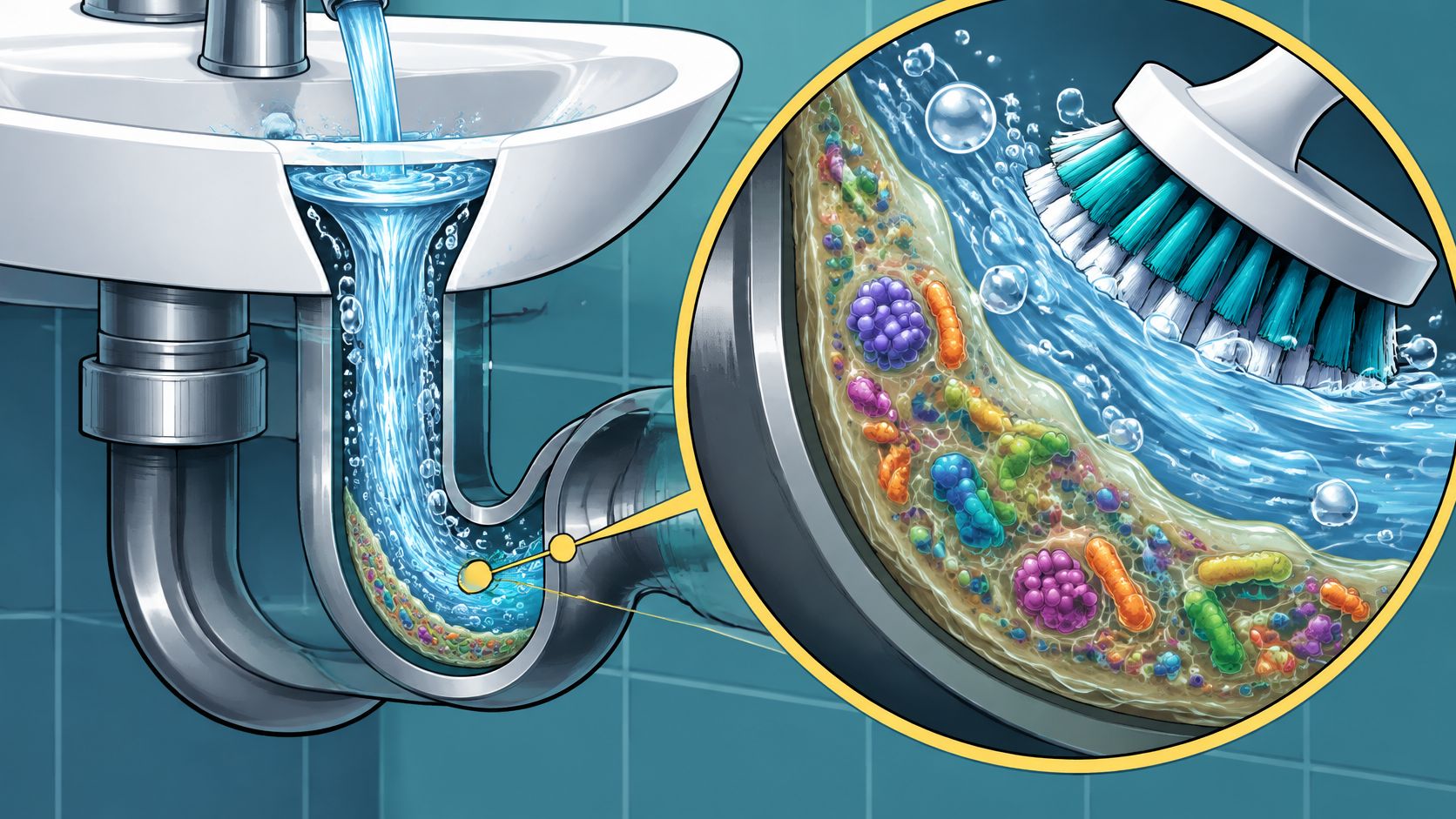
A biofilm is an organized community of microbial cells attached to a surface and enclosed in a matrix the cells produce themselves.
You've rinsed a drain cover, wiped around the sink, and noticed that the slippery coating hasn't quite disappeared. That persistence helps explain biofilm meaning in everyday life: you're dealing with attached microorganisms and their shared material, not loose dirt. Understanding how that community develops helps you choose a cleaning method without assuming every slick surface is dangerous.
What a Biofilm Is in Plain Language
Think of a riverbank. Free-floating microbial cells are like travelers passing through, while biofilm cells settle, build homes, and stay put.
The technical name for their shared material is the extracellular polymeric substance matrix, or EPS. It contains polysaccharides, proteins, extracellular DNA, and water, helping hold the community together and protect its inhabitants. The CDC's biofilm overview describes attached cells as irreversibly attached, meaning gentle rinsing doesn't remove them.

Irreversible doesn't mean impossible to remove. It means the cells have progressed beyond loose attachment. A quick rinse, or a light wipe that misses the attached material, may leave part of the community behind.
Dental plaque, a coating inside water pipes, and the film around a sink drain make the idea tangible. Biofilms aren't limited to bacteria, either: communities can include fungi, algae, and protozoa, and a thin film needn't be visible.
Practical rule: Treat a slick surface that resists rinsing as a possible biofilm requiring proper cleaning, not as a diagnosis of harmful bacteria.
How Bacteria Build a Biofilm in Five Stages
A biofilm is a living process, not a finished layer of slime. The following stages are a useful teaching model, although real communities don't always develop in a perfectly tidy sequence.
- Reversible attachment. A cell reaches a surface and clings loosely, like a boat held by a slack rope. It may still leave when conditions change.
- Irreversible attachment. The cell establishes firmer anchors, more like securing that boat to a dock. Ordinary rinsing becomes less effective.
- Microcolony growth. Attached cells multiply into small clusters and produce shared matrix material. Think of neighboring houses forming a settlement.
- Maturation. The settlement becomes a structured community. Channels and spaces can allow movement of water, nutrients, and waste, rather than producing a completely solid block.
- Dispersal. Cells or pieces of the community leave, like residents moving elsewhere. If they reach a suitable surface, they can establish another community.

Bacteria can also exchange chemical signals that influence collective behavior. In organisms such as Pseudomonas aeruginosa, signaling can help regulate matrix production and other community activities. Our explanation of quorum sensing in bacteria describes this communication without suggesting that microbes consciously plan together.
Biofilm development has no universal household stopwatch. Temperature, moisture, nutrients, organisms, and surface conditions all matter, so don't assume a weekly cleaning schedule necessarily interrupts growth early enough.
The practical opportunity is early disruption. Removing fresh deposits before an established community develops is generally easier than trying to remove accumulated matrix and attached cells.
Where Biofilms Form in Homes, Hospitals and Industry
Moisture, nutrients, and opportunities to remain attached favor biofilm development. Nutrients don't have to resemble food scraps: residues and materials carried in water can help support microbial growth.
Stagnant corners deserve attention, but flowing water doesn't rule out biofilms. Attached communities can also develop inside operating pipes and other water-handling equipment.
Common biofilm locations and what they threaten
| Setting | Typical organisms | Main concern |
|---|---|---|
| Dental plaque | Streptococcus species, Porphyromonas gingivalis | Tooth decay and gum disease |
| Medical catheters and implants | Staphylococcus aureus, Pseudomonas aeruginosa | Device-associated infections |
| Chronic wounds | Pseudomonas aeruginosa, Staphylococcus aureus | Delayed healing |
| Water pipes and fountains | Mixed bacteria, fungi and protozoa | Pipe fouling and water quality |
| Food-processing equipment | Listeria monocytogenes, Salmonella | Cross-contamination of food |
| Drains and mop heads | Mixed microbial communities | Odor and recontamination of floors |
These are setting examples, not identification results. You can't determine which organism occupies a particular drain, wound, or machine by matching it to a table. A review of biofilm communities and their control emphasizes that appearance alone cannot establish microbial identity, concentration, or pathogenicity.
For a facility manager, the useful distinction is the consequence. A pipe deposit may create a maintenance problem; contamination on food-processing equipment creates a product-safety concern; an infected catheter requires clinical management.
Our coverage includes washing machines, cleaning mop heads, infection prevention, and disinfecting toilet brushes. For shared drinking fixtures, the guide to bacteria on water fountains provides a more focused starting point.
Odor also needs careful interpretation. If a drain smells like sewage, sewer gas help from Erica's Plumbing, from Erica's Plumbing, Air Conditioning & Restoration, can help distinguish plumbing issues from a cleaning problem.
Start with the setting and surface, then decide whether you're managing health, food safety, or equipment maintenance.
Why Biofilms Resist Cleaning and Treatment
A fortified castle is a useful analogy, provided you don't imagine an impenetrable wall. Biofilm survival involves several interacting conditions, not one universal chemical barrier.
The review of biofilm antimicrobial tolerance hosted by the National Library of Medicine describes the combined roles of transport, matrix interactions, and different cellular states.

More than a protective wall
- Slower access. Some antimicrobial molecules move through matrix material slowly. In the castle analogy, the approach to the inhabitants takes longer.
- Chemical binding. Extracellular DNA and polysaccharides can bind certain antimicrobials, particularly positively charged molecules interacting with negatively charged material. Some of the treatment becomes tied up before reaching its target.
- Quiet cellular activity. Limited oxygen and nutrients can produce slow-growing populations. Agents aimed at active cellular processes may affect those cells less strongly.
- Persister-like states. Some dormant or stress-adapted cells survive exposure and can resume growth afterward.
The important qualification is that some antimicrobials penetrate biofilms relatively well. Cellular uptake, gene regulation, binding, and dormancy can still influence the result, even when penetration isn't the main obstacle.
That's why adding more chemical isn't a dependable solution. It may increase exposure hazards or damage surfaces without addressing the reason cells survived.
A product that works against exposed cells may perform differently against an established community. Effective control therefore requires attention to the actual surface condition, physical removal, and a treatment suitable for the relevant organism and use.
Biofilm Myths and How to Judge the Real Risk
A clean-looking surface must be biofilm-free
Appearance isn't clearance testing. Removing visible material is useful, but attached cells may remain after the surface looks clean. Conversely, a slippery coating doesn't establish that dangerous organisms are present.
Biofilm survival proves antibiotic resistance
Tolerance and resistance aren't interchangeable. Tolerance can arise when cells grow slowly or enter physiological states that make treatment less effective. Genetic resistance involves heritable traits that affect susceptibility.
The review in Chemistry & Biodiversity distinguishes these mechanisms and explains that resistance genes can also spread through horizontal gene transfer within biofilms. Survival alone doesn't tell you which mechanism caused treatment failure.
This distinction matters clinically. Antibiotics can still have a role, but treatment depends on the organism, infection site, device involvement, and drug exposure. Neither automatically prescribing stronger antibiotics nor assuming surface cleaning can treat an infection is appropriate.
Every biofilm is harmful
Biofilms are part of natural microbial ecosystems. Risk comes from which organisms are present, where they're growing, and who encounters them, not from the word biofilm alone.
A community in a natural stream and one associated with a medical implant don't present the same problem. Likewise, dispersal from a contaminated fixture matters because detached cells can reach other locations, not because every detached cell necessarily causes disease.
Judge the exposure, not the amount of visible slime.
How to Control a Biofilm Step by Step

A surface can look clean while attached deposits remain in seams or edges. For accessible environmental surfaces, remove soil and film before disinfecting. This process is not intended for wounds, implanted devices, or internal plumbing systems that need specialist management.
- Remove loose debris and deposits. Collect soil first to avoid spreading contaminated material across nearby surfaces.
- Pre-clean with a suitable detergent or enzymatic cleaner. Select a surface-compatible product suited to the soil. Residual organic material can interfere with disinfection.
- Scrub mechanically. Use a dedicated brush or suitable cleaning pad to loosen deposits, including those in seams and along edges. A dry cloth alone will not do the same job.
- Apply an EPA-registered disinfectant with the relevant organism claim. Wipes may suit compatible, accessible surfaces, but claims vary by product. An organism claim does not automatically mean the product is labeled to remove established biofilm.
- Maintain the full wet contact time. If the label specifies 10 minutes, keep the surface visibly wet for at least 10 minutes, reapplying if needed. The EPA's selected registered disinfectants guidance identifies List H products with MRSA and VRE claims.
- Rinse or dry as directed. Follow food-contact instructions, and do not wipe away a product before its required contact time has elapsed.
- Recheck and repeat on an appropriate schedule. Record the next inspection. A single cleaning does not guarantee lasting protection, since deposits can return.
A quick troubleshooting reference
| Task | What it addresses | Common mistake |
|---|---|---|
| Debris removal and pre-cleaning | Soil and accumulated film | Disinfecting before cleaning |
| Mechanical scrubbing | Attached deposits | Using only a dry cloth |
| Product selection and wet contact | Exposed target organisms | Choosing by brand alone or drying early |
| Label-directed finishing | Residues and surface requirements | Missing food-contact rinse instructions |
| Monitoring | Return of deposits | Treating the job as permanent |
An organism claim isn't automatically a biofilm-removal claim. Check the label for intended use, surface compatibility, precautions, and directions. Never mix cleaners or exceed label concentrations.
For product choice and removal guidance, see how to remove biofilm.
Who Should Act on Biofilm Risk and What to Do
Responsibility should match the exposure. The person maintaining a drinking fountain needs a different procedure from the clinician managing a wound.
- Janitorial staff. Add product contact times and completion checks to shift records. A surface that looks tidy still needs the specified procedure when disinfection is required.
- Business owners and facility managers. Assign scheduled inspections for drains, fountains, and cooling equipment. Keep maintenance records so recurring deposits trigger investigation rather than repeated cosmetic wiping.
- Healthcare providers. Manage suspected device- or wound-associated biofilms through clinical assessment and infection-control coordination. Environmental disinfectant wipes aren't treatments for tissue or implanted devices.
- Gym operators. Include mats, grips, and shared equipment in the cleaning program, using a compatible disinfectant with the appropriate claim. The CDC-published review of community-associated MRSA transmission identifies close skin contact and contaminated shared objects among relevant transmission conditions.
- Food service managers. Keep food-contact equipment cleaning separate from drain and mop-head work. Dedicated tools help prevent staff from carrying contamination from dirty utility areas into food-handling spaces.
Parents, caregivers, and school administrators can apply the same ownership principle to shared bathrooms and frequently handled equipment. Give staff or household members a clear procedure rather than an instruction to make everything look clean.
Assign a named person to each surface or system. That person should know the approved method, where the product instructions are kept, and when a recurring problem needs escalation.
Confirm One Biofilm-Prone Surface This Week
Choose one wet, shared, or hard-to-reach surface you're authorized to maintain. A removable drain cover, reusable mop component, or compatible gym mat gives you a manageable starting point, unlike an entire building water system.
Check the surface, choose an appropriate cleaning process, and record what you do. Note the product, its label contact time, who is responsible, and when to inspect again.
Success check: Make sure the product was applied according to its label, then check for a returning slick deposit at the next inspection. Neither result proves the surface is sterile.
If deposits keep returning, look at access, moisture, worn materials, and maintenance practices. Repeated growth does not by itself show that bacteria are genetically resistant. A biofilm is a living process, so cleaning may need to be repeated as part of routine care.
Before buying or using disinfectant wipes, check that the label names your target organism, allows use on the intended surface, and gives the required wet contact time. Choose one surface this week, assign responsibility, and schedule the next check. Biofilm control depends on a routine, not a single event.
Leave a Reply