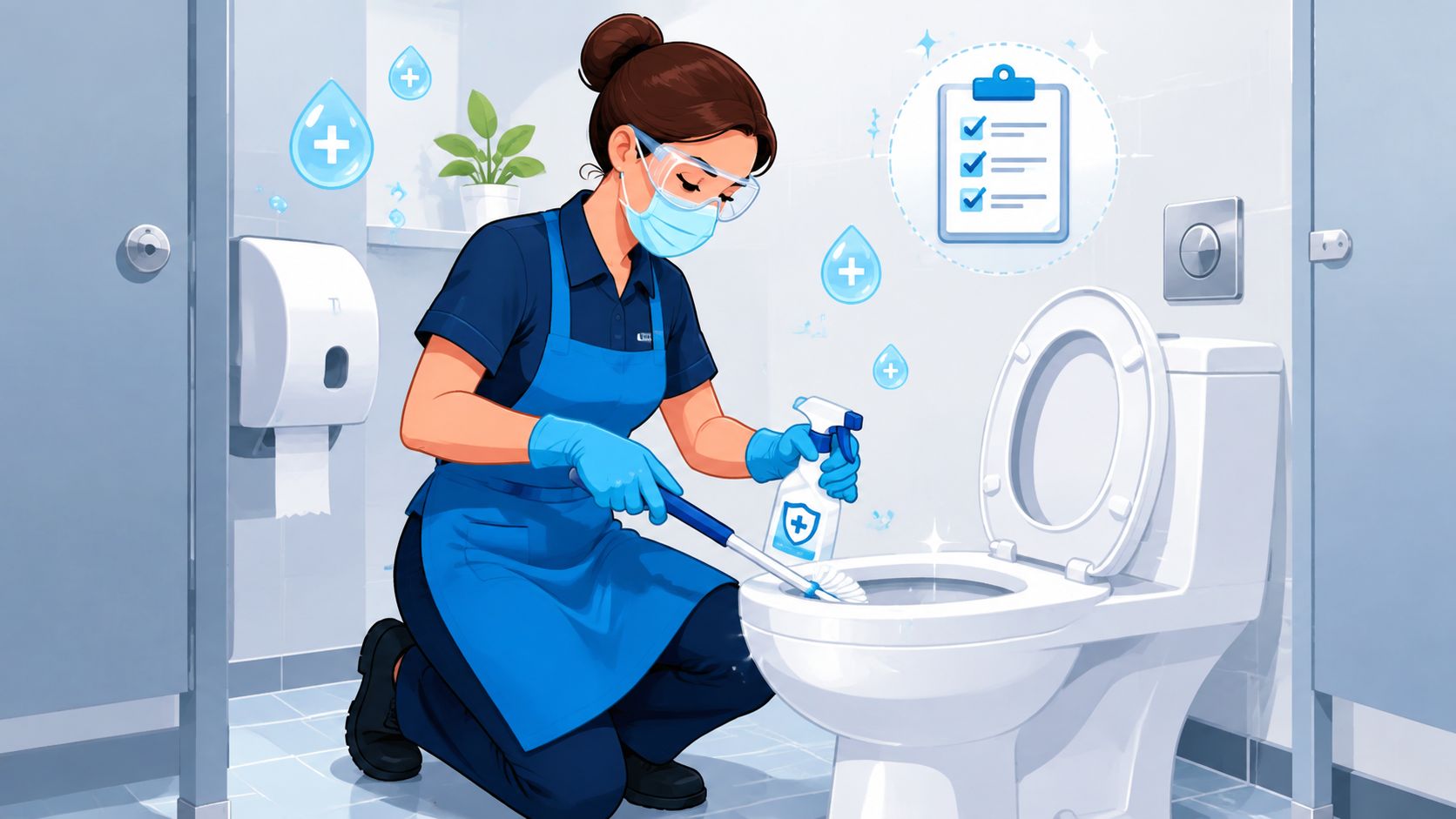
You're in a restroom that looked fine at 8 a.m., then by noon the same toilet has a ring under the rim, a sticky handle, and a complaint at the front desk. That's the reality of commercial toilet cleaning, it's not a quick wipe-down, it's a controlled sanitation process with separate steps, separate tools, and separate accountability. The difference shows up in odor control, inspection results, and whether staff have to redo the same fixture twice in one shift.
The pressure on this work is bigger than commonly thought. The market itself reflects that, with the commercial toilet cleaner market estimated at USD 10 billion in 2024 and projected to reach USD 14.2 billion by 2033 Business Research Insights. That growth tracks with a simple truth facilities managers already know, restrooms in schools, gyms, transport hubs, and food-service spaces don't stay clean on their own, and customers notice when they don't.

Why Commercial Toilet Cleaning Demands More Than a Quick Scrub
A restroom complaint rarely starts with the bowl alone. More often, a manager hears about an odor that won't go away, a handle that feels grimy, or a fixture that looks “clean enough” until someone bends down and checks under the rim. That's where shortcuts fail, because commercial toilet cleaning has to solve visible soil, hidden biofilm, and customer perception at the same time.
Why the job is different in busy buildings
One reason the work gets missed is volume. High-traffic restrooms cycle through far more users than a home bathroom, so a single fixture can't be treated as a once-a-day surface. Consumer expectations are unforgiving too, since a 2019 U.S. survey found 64% of consumers choose a business based on cleaner, well-maintained restrooms, and 52% said a bad restroom experience could make them vow not to return survey report.
The second pressure is compliance. OSHA requires restroom sanitation basics that many casual cleaning routines ignore, including hot and cold running water, soap or another cleansing agent, and a proper drying method. The standard also makes clear that waterless hand cleaner and towels or rags aren't substitutes for soap and water OSHA restroom sanitation.
The third pressure is biology. A toilet isn't one flat surface, it's a bowl, a rim, a siphon area, hinges, bolts, a base, and the spaces behind it. Biofilm settles where brushes don't reach, and if staff disinfect over soil instead of removing it first, the product won't perform the way the label promises.
Practical rule: if a restroom still smells wrong after a “clean,” the crew probably removed visible grime but left residue in the hidden zones.
What follows is the protocol level approach, starting with the compliance baseline, then the two-phase sequence, the hidden zones crews skip, PPE, scheduling, and how to respond when a complaint or illness signal says the system broke down. For a related product selection reference, see commercial bathroom cleaner guidance.
OSHA Compliance and the Baseline Every Commercial Restroom Must Meet
A restroom can look clean and still fail the standard. If the soap is empty, the drying method is broken, or the fixture count does not match demand, the space is not being maintained at a defensible level. OSHA's restroom sanitation rule and toilet-ratio rule give managers a practical audit frame, not just a legal one.
The sanitation basics that can't be skipped
OSHA says toilet facilities must have hot and cold running water, hand soap or another cleansing agent, and a drying method such as warm-air blowers or individual hand towels OSHA restroom sanitation. The same standard says waterless hand cleaner and towels or rags are not adequate substitutes for soap and water OSHA restroom sanitation.
That matters in the field because supply checks are part of sanitation. If soap is missing, towels are gone, or the dryer is out of order, the restroom is not fully serviceable even when the bowl and sink look polished. Crews should treat those items as part of the cleaning round, not as a separate refill task that gets handled later.
The toilet ratio managers can actually audit
OSHA's toilet-ratio requirement under 29 CFR 1910.141 calls for at least 1 toilet for 1 to 15 workers, 2 toilets for 16 to 35 workers, 3 toilets for 36 to 55 workers, and then 1 additional toilet per 40 workers after 150 toilet ratio guidance. That gives supervisors a fixture baseline to compare against staffing, foot traffic, and cleaning frequency.
| OSHA Toilet Ratio by Number of Workers | Minimum Toilets Required |
|---|---|
| 1 to 15 | 1 |
| 16 to 35 | 2 |
| 36 to 55 | 3 |
| After 150 | 1 additional toilet per 40 workers |
A useful quarterly audit starts with three checks. Confirm the fixture count against the OSHA ratio, verify that soap, water, and drying methods are working, and review the cleaning logs to see whether each fixture was serviced on time. If any of those checks fail, the site has an operational problem before it has a housekeeping problem.
Audit checklist
- Verify fixture counts: compare the employee count to the OSHA ratio.
- Inspect handwashing supplies: confirm soap, water, and drying methods are working.
- Check service logs: look for time stamps, initials, and completed fixture rounds.
- Review supply storage: make sure restocking happens before the restroom runs bare.
For more on the product side of restroom care, see commercial bathroom cleaner guidance.
The Two-Phase Cleaning Sequence That Kills Germs
A toilet that still carries scale, urine residue, or biofilm has not been disinfected properly, no matter how strong the spray smells. Soil blocks chemistry. Commercial cleaning works best in two separate phases, not one blended spray-and-wipe routine.

Phase one removes the load that defeats disinfectant
Start under the rim with an acid-based bowl cleaner and let it dwell for 5 to 10 minutes so it can break down mineral scale and biofilm Zogics guide. After dwell time, scrub the bowl, focus on the waterline and under-rim areas, then flush. Crews often rush this step, and that is usually why the rest of the process underperforms.
The chemistry choice matters. Citric acid and hydrochloric acid blends are common in bowl cleaners, while quaternary ammonium compounds, hydrogen peroxide, and sodium hypochlorite show up in disinfectants made for exterior surfaces. Acid bowl cleaners and chlorine disinfectants should never be mixed, and staff should treat that rule as mandatory.
Phase two disinfects the touch points
Only after the bowl is flushed should an EPA-registered disinfectant go on the seat, hinges, handle, tank, and base, with the surface kept visibly wet for the full label contact time, typically 2 to 10 minutes. That wet time is what lets the kill claim work. If the surface dries early, the contact time is lost.
For a two-stall restroom, route timing is straightforward. One tech can clear stall one while the bowl cleaner dwells in stall two, then return to scrub and flush stall one before moving to disinfection. The result is less dead time and fewer skipped surfaces, not speed for its own sake.
Surfaces do not get disinfected by optimism. They get disinfected by direct contact and enough wet time to finish the job.
A separate tool set helps too, because bowl interiors and exterior touch points should never share cloths or brushes. continence care travel planning belongs in the same contamination-control mindset, since spill control and tool separation solve the same problem from different angles. For product selection and label-aware restroom chemistry, see commercial bathroom cleaner guidance. Urinal splash guard guidance also fits here, because splash control matters when crews are trying to keep clean and dirty tools from crossing paths.
The Hidden Zones Most Crews Miss in Commercial Restrooms
The bowl gets the attention, but odor and biofilm usually build up where casual cleaning never reaches. Under the rim, at the siphon and throat area, along the hinges and seat bolts, and in the seam behind the bowl are the surfaces that keep feeding the complaint loop. The hidden-zone problem is common enough that hidden zone article coverage points to the same blind spots crews keep missing.
Where grime hides and why it keeps coming back
Standard bowl brushes miss the underside of the rim, and they do little against metal hardware. Seats also stay in place because crews are moving fast, so the area around the hinges gets wiped superficially or skipped entirely. That is how a restroom can look acceptable at eye level and still smell stale near the fixture.
A practical kit solves more than one problem. Use a long-reach under-rim brush, a flexible detail brush for bolts and hinges, a color-coded microfiber cloth for the exterior, and a separate flat-mop head for the floor behind the toilet. If the seat hardware is removable, occasional deep access is worth the extra minute because grime does not stop at the visible edge.
When to descale and when to disinfect
Visible mineral buildup, hard-water staining, or recurring odor means the crew should prioritize descaling, not another disinfectant pass. That is a chemistry decision, not a habit decision. Disinfection belongs on clean surfaces, while descaling breaks the layer that keeps moisture and soil clinging in place.
If the same fixture keeps smelling bad after routine cleaning, check the hidden surfaces before you blame the air freshener.
For managers who need a broader adjacent workflow, continence care travel planning is useful because it shows how restroom design and cleanup logistics affect real-world use patterns. For splash-prone fixture control, urinal splash guards fit the same facility hygiene logic.
PPE, Chemical Safety, and Waste Handling for Janitorial Staff
A restroom crew can do clean work and still create a hazard if the protection layer is weak. Acid bowl cleaners, disinfectants, and contaminated waste all need simple controls that a shift lead can enforce without a long briefing.

What staff should wear and how the room should be ventilated
The baseline PPE is straightforward, nitrile or chemical-resistant gloves, splash goggles for acid bowl cleaners or concentrated disinfectants, closed-toe non-slip footwear, and long sleeves or a chemical-resistant apron for deep descaling. Keep exhaust fans running during and after acid or chlorine use, and leave the door open when conditions allow so fumes do not collect.
Product storage matters just as much. Keep chemicals in their original labeled containers, locked away from general supplies, with acids separated from bleach and ammonia. Secondary containment helps with spill control, especially in closets near public corridors. The same handling standard should align with the site's broader supply plan, and a facilities management supplies guide can help managers match storage, stock rotation, and replacement needs to the cleaning load.
How to handle waste without spreading the problem
Used wipes and paper towels should go into leak-resistant liners, not loose carts or open bins. If materials are visibly soiled with blood or bodily fluids, double-bag them and follow bloodborne pathogen protocols. That keeps the restroom route from becoming a contamination route.
Do
- Wear gloves and eye protection: especially during descaling or spray application.
- Ventilate the room: use exhaust and fresh air before the next fixture turn.
- Label and separate chemicals: acids stay away from bleach and ammonia.
- Bag waste properly: keep used materials sealed and contained.
Do not
- Mix products in the sink or bucket: dangerous reactions can happen fast.
- Reuse saturated cloths across fixtures: that spreads soil and residue.
- Store chemicals in unmarked bottles: staff need to know what they are handling.
- Treat visibly contaminated waste like ordinary trash: it is not.
As noted earlier, restroom sanitation supplies also have to support the public-facing side of the room, with running water, cleanser, and a proper drying method in place for staff and visitors alike.
Frequency and Scheduling for Schools, Gyms, and Foodservice Venues
A restroom schedule has to follow use patterns, not hope. In high-traffic restrooms, service usually needs to happen at least twice a day, with extra rounds during mid-morning, after lunch, and at closing. School restrooms should be cleaned every day while school is in session Loo cleaning guidelines.

Matching frequency to venue type
Schools need predictable service because traffic comes in waves, and the room can go from orderly to overloaded between class changes. Mid-morning checks, post-lunch checks, and a thorough end-of-day clean give crews a better chance of catching the areas that fail first, especially under the rim, around the hinges, and at the base of the bowl where residue hides. Gyms need touch-point wipes during busy periods, then a full service after closing, because sweat, splash, and fast turnover break down the room faster than a quieter site. Foodservice restrooms need tighter checks during service, since customer expectations rise the moment the dining room fills and a stale fixture complaint can spread quickly.
If you're buying supplies across multiple sites, the facilities management supplies guide helps managers line up stock levels with those cleaning intervals. The point is not just having enough wipes. It is keeping the right products within reach before the room turns over again, so staff can stay on the soil-removal step before disinfection and avoid spraying cleaner over material that should have been lifted off first.
A simple staffing lens
Managers often ask how many cleaner-hours a site needs. The practical answer is to match staffing to fixture count, user load, and the time required for the two-phase process, not to assume one person can cover a whole building at the same pace. A site with 40 fixtures and a site with 200 fixtures do not behave the same, and the larger venue needs more rounds or more hands if hidden zones are going to stay in rotation.
The commercial market keeps expanding because this work has become routine infrastructure, not optional overhead. Analysts at Business Research Insights point to that growth as a sign of rising sanitation expectations in workplaces, schools, transport hubs, and food-service environments.
Monitoring, Verification, and Outbreak Response When Something Goes Wrong
A restroom protocol only counts when the crew can prove it ran. Logs, spot checks, and a response plan matter more than a tidy supply closet, because the first complaint usually shows whether the process is documented or improvised.
How to verify the work
Use daily cleaning logs with timestamps and staff initials. Add ATP swab testing on representative fixtures when you need a quantitative check, then pair that with periodic supervisor walkthroughs and a simple feedback channel for staff or customers. If the same restroom keeps showing problems, the log shows whether the issue is training, staffing, product choice, or poor follow-through on the two-phase process.
Verification should also cover the hidden zones crews miss during routine rounds. Under the rim, around hinges, bolt heads, and inside siphon areas, residue can stay in place even when the bowl looks clean. Supervisors need to check that soil is removed before disinfectant goes on, because spraying over buildup only wastes chemistry and leaves the load behind. For dwell-time verification and label discipline, disinfectant contact time guidance is a useful reference for supervisors who need a quick refresher before retraining a crew.
What to do when a complaint turns into a possible outbreak
A food-service operator with two staff reporting gastrointestinal symptoms should not wait for the restroom to look worse before acting. Increase cleaning frequency at once, switch to a higher-tier disinfectant with the right efficacy claims, retrain the crew on wet contact time, coordinate with the local health department, and document every corrective step. That is how you keep a manageable incident from becoming a facility-wide problem.
If you need a fast decision aid, use this checklist:
- Escalate service frequency: move from routine rounds to tighter cycle times.
- Recheck dwell times: keep products wet for the full label period.
- Separate tools again: reduce the chance of moving contamination around.
- Notify leadership and health authorities: keep the response transparent.
- Save records: logs, training notes, and product details matter later.
Commercial restroom demand keeps rising, and so does the pressure to document cleaning that holds up under review. As noted earlier, the market has been expanding alongside higher sanitation expectations in workplaces, schools, transport hubs, and food-service environments.
Leave a Reply