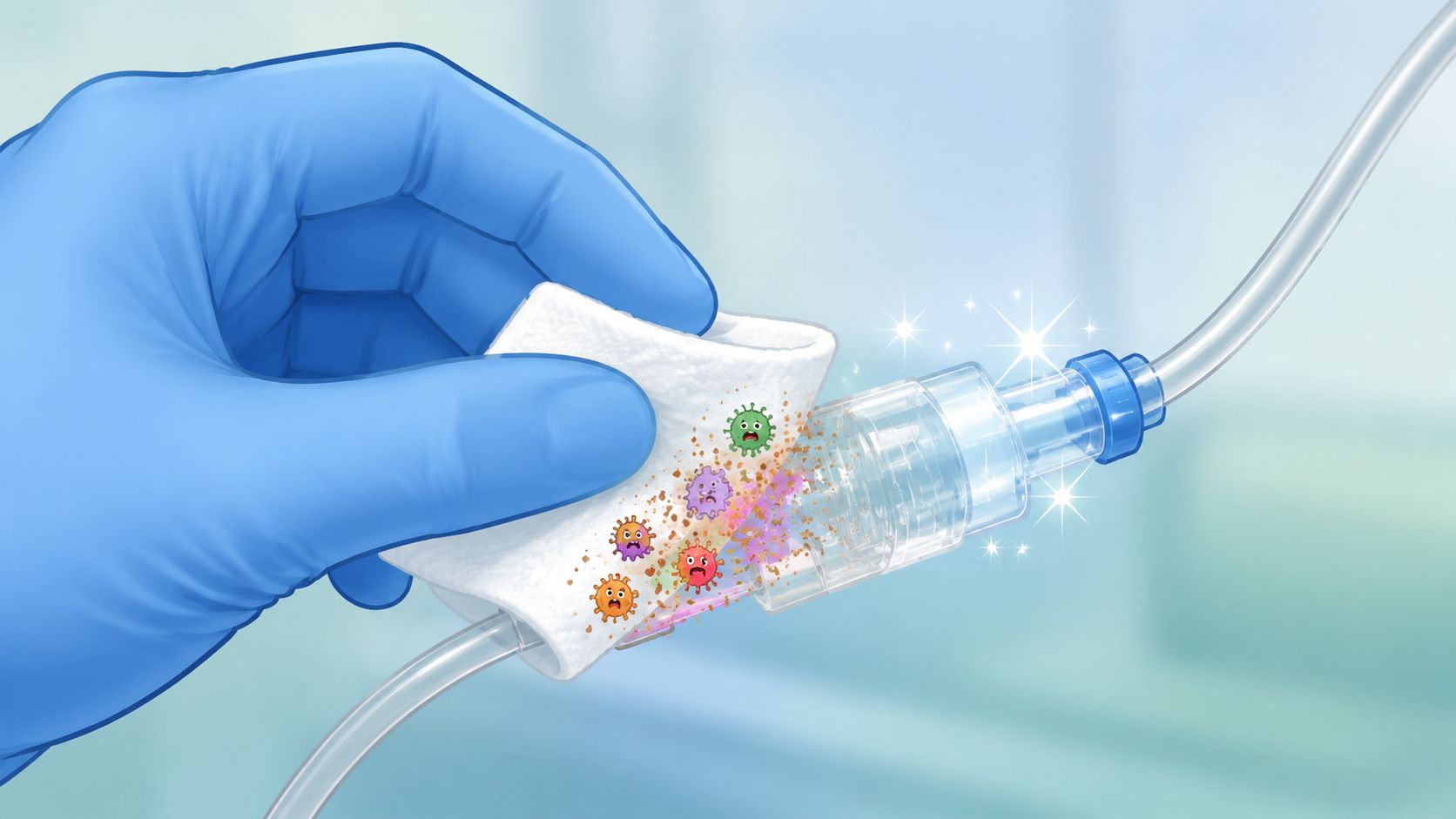
Disinfecting an IV connector sounds small until you look at the compliance gap. Published clinical summaries have reported hub-disinfection compliance as low as 10% before access, a failure tied to preventable catheter-related bloodstream infections, according to BD's 2023 scrub-the-hub product announcement. That should change how we teach this skill. The issue usually isn't that clinicians have never heard the rule. It's that busy care environments make a simple rule hard to perform correctly every single time.
I teach scrub the hub the same way I teach hand hygiene. It's a short task with outsized consequences. If you miss details like friction, thread coverage, or dry time, you haven't just rushed a step. You may have opened a route for organisms to move into the catheter and then into the bloodstream.
What Is Scrub the Hub and Why Does It Matter
Scrub the hub means disinfecting the needle-free connector or catheter hub before every access. The connector works like a doorknob that opens directly into the catheter lumen. If the surface is contaminated, the next syringe, tubing connection, or flush can carry that contamination inward.
That definition sounds simple. In practice, the step gets missed because the hub often looks harmless. It is small, dry, and easy to underestimate. New clinicians also get mixed messages from appearance. A connector can look clean, be touched with gloves, or be accessed again within minutes and still need to be disinfected before use.
The reason is straightforward. Visual cleanliness is not the same as microbiologic safety.
A helpful place to place this in the bigger picture is this guide to healthcare-associated infection prevention. Scrub the hub is one control point within that larger system. It matters because the connector sits at the moment where routine care meets bloodstream access.
Clinical mindset: Treat every hub like a high-touch surface attached to a sterile pathway.
That mindset changes behavior. Staff compliance improves when people understand what the step is preventing, not just what they are supposed to do. I tell new nurses to treat the hub the way they treat a medication vial stopper. Both are small access points. Both can transfer organisms if they are touched and then entered.
The other piece clinicians miss is the human-factor problem. Scrub the hub is rarely skipped because someone rejects infection prevention. It is skipped during interruptions, competing tasks, poor line setup, supply placement issues, or the false confidence that "I just touched this line." Unit design matters here. Organized workspaces and reliable supply placement reduce unnecessary contact and make correct practice easier to repeat. Even storage systems outside the bedside workflow, such as Labs USA lab storage, support cleaner handling upstream by reducing clutter and touch points.
So why does scrub the hub matter? Because it is a brief action that protects a direct route into the vascular system. Done well, it interrupts contamination at the exact point where organisms could otherwise be carried into the catheter. That is why experienced infection prevention teams teach more than the motion of scrubbing. They teach the reason, the risk, and the workflow conditions that make reliable compliance possible.
The Evidence Behind Preventing Bloodstream Infections
Central line associated bloodstream infections are uncommon compared with total line accesses, but when they occur, the harm is serious. That is why a small step at the connector deserves so much attention. The hub is the doorway into a sterile internal pathway. If the doorway is contaminated, the bloodstream is only one connection away.

What the hub is protecting against
The organisms of concern are familiar hospital pathogens, including staphylococci, gram-negative organisms, and Candida species. The exact mix varies by setting and device, but the bedside lesson stays the same. A needleless connector can pick up organisms from hands, gloves, surfaces, and line manipulation. Once that contamination reaches the catheter lumen, it becomes much harder to control.
That progression matters because the hub is not just another piece of plastic. It sits at the junction between the outside environment and the intravascular space. A clinician may look at a clean-appearing connector and see no visible soil. Microbiology works on a different scale.
Surface contamination can also become more stubborn over time. Microbes do not need a large area to persist. They need a surface, moisture, and repeated opportunities to attach. If you want a practical explanation of why residue and organisms can become harder to clear from medical surfaces, this article on how to remove biofilm is useful background.
Upstream handling affects risk too. Units with orderly supply placement create fewer unnecessary touches and fewer rushed workarounds. In support areas, structured storage options such as Labs USA lab storage can support cleaner supply access and more consistent setup.
Why friction, contact time, and dry time affect infection risk
Disinfection works like cleaning dried food off a pan. A quick swipe across the middle does not remove what is stuck around the edges. The same principle applies to a hub. Friction helps lift contamination from the top surface, the rim, and the threads, where clinicians often miss spots during rushed access.
Time matters for two reasons. First, the antiseptic needs enough contact with the surface to reduce microbial burden. Second, the hub needs to dry before access. Connecting too soon can dilute the effect of the antiseptic and allows the next device touch to occur before disinfection is complete.
Compliance is the weak point in many real settings. According to the IVTEAM compliance audit summary, only 60% of catheter accesses received the recommended 15-second scrub, and staff allowed the hub to dry in only 65% of observed instances. Those numbers explain why education alone is not enough. Staff usually know the rule. The harder problem is performing it reliably during interruptions, competing tasks, and high workload.
A short scrub, missed threads, or wet connection leaves a preventable opening for organisms to enter the line.
The Correct Scrub the Hub Technique Step by Step
When I observe poor technique, it usually falls into one of three categories. The scrub is too short. The clinician cleans only the flat top and misses the sides. Or the line gets connected before the antiseptic has dried. Each error weakens the process.

What CDC guidance makes clear
CDC hemodialysis catheter guidance states that the hub must be scrubbed with a new antiseptic pad for each access, using friction on the sides (threads) and end surface, while keeping hubs open for the shortest time possible and avoiding contact with nonsterile surfaces after disinfection, as shown in the CDC hemodialysis scrub-the-hub protocol. Even if you don't work in dialysis, that language is useful because it removes the vagueness many staff bring to the task.
A reliable bedside sequence
Use this sequence every time:
Pause before access.
Don't uncap and connect in one rushed motion. Stop and identify the exact hub you'll access.Open a fresh antiseptic pad.
Use a new pad for that specific hub access. Don't reuse one that already cleaned another surface or connector.Stabilize the connector.
Hold it so you can clean thoroughly instead of chasing it around the tubing.Scrub all exposed surfaces with friction.
Clean the end surface, the sides, and the threads. New clinicians often miss the threads because they focus only on what they can see from above.Keep scrubbing for the full recommended time in your protocol.
The common bedside failure is counting too fast or stopping when the surface “looks done.”Let it air dry.
Don't wave it dry, blow on it, or connect while it's still wet.Access immediately once dry.
Don't place the disinfected hub against linens, gloves, the patient gown, or any other nonsterile surface.
Where people get tripped up
Here are the parts I correct most often in orientation:
- “I wiped it, so it's fine.” Friction matters. A quick pass isn't the same as a scrub.
- “I cleaned the top.” The top is only part of the connector. The sides and threads matter too.
- “It was still wet, but I had to move fast.” Dry time is part of the kill process, not an optional delay.
- “My gloves are clean.” Clean gloves don't make a contaminated hub safe.
- “I had just disinfected it a minute ago.” If you're accessing again, follow the current protocol for that access.
At the bedside: Clean it. Let it dry. Keep it clean. Then connect.
A simple teaching script
If you precept new staff, give them one short script to repeat mentally: new pad, all surfaces, full friction, full dry, immediate access. That's easy to remember and specific enough to audit.
A good scrub-the-hub culture also depends on visible technique. Don't teach this only through online modules. Watch people perform it. Correct hand placement. Correct pad motion. Correct timing. Most clinicians don't improve because they read a policy. They improve because someone shows them the difference between a quick wipe and an effective scrub.
Guidance for Different IV Access Devices
The principle doesn't change across devices. The application does. A peripheral IV isn't handled the same way as a tunneled central line or a dialysis catheter, and staff get into trouble when they carry over a vague, one-size-fits-all habit.
Peripheral IVs and short-term access
Peripheral IV connectors often create a false sense of low risk because they're common and familiar. That familiarity makes rushed access more likely. The key issue is repetition. The more often a line is touched for flushing, intermittent medication, or tubing changes, the more often the hub becomes a contamination risk point.
For peripheral access, keep the routine simple and visible. Scrub thoroughly, let dry, then connect. If the patient is restless or the catheter is in an awkward location, stabilize the connector before you begin so you can cover the full surface.
PICCs and central venous catheters
PICCs and central venous catheters raise the stakes because these lines provide direct central access and are often used repeatedly over longer periods. Staff should approach each lumen as its own access event. One cleaned connector doesn't make the neighboring connector safe.
When teaching PICC and CVC care, I stress these points:
- Separate each lumen mentally. Each hub needs its own attention.
- Reduce unnecessary handling. Gather supplies first so the hub isn't left open while someone searches for a syringe.
- Watch the threads. Complex connector geometry makes partial cleaning more likely.
- Protect the cleaned surface. Once disinfected, don't let it brush clothing, bedding, or nonsterile gloves.
Implanted ports and specialty access
Implanted ports create a different kind of confusion. Clinicians may focus so much on sterile needle access that they forget connector hygiene still matters whenever the system is manipulated after access is established. The principle remains the same. Any point where tubing or a connector meets the intravascular system deserves deliberate disinfection.
Hemodialysis catheters deserve especially meticulous technique because the hubs are accessed in a high-risk context and often handled under time pressure. The CDC language about a new antiseptic pad for each hub, cleaning the sides and end, and minimizing open-hub time is practical because it emphasizes exactly where contamination creeps in: repeated touch and prolonged exposure.
A quick device-based reminder
| Device type | Main pitfall | Best bedside reminder |
|---|---|---|
| Peripheral IV | Rushing because it feels routine | Slow down before every access |
| PICC | Treating multiple lumens as one task | Clean each connector separately |
| Central venous catheter | Incomplete surface coverage | Include threads, not just the top |
| Implanted port system | Focusing only on the needle step | Disinfect every connector access point |
| Hemodialysis catheter | Leaving hubs open too long | Clean thoroughly and connect promptly |
If staff ask, “Does scrub the hub apply here too?” the safest teaching answer is usually yes whenever a connector or hub is about to be accessed.
Disinfecting Caps vs Manual Scrubbing
Many units receive mixed messages. Some staff think disinfecting caps replace manual scrubbing in all situations. Others distrust caps and treat them as unnecessary add-ons. The better answer is more precise.

Evidence reviews emphasize that both approaches have a role, but they aren't identical, and manual scrub the hub remains the baseline standard, as explained in this review of scrub the hub vs disinfection caps. That matters because caps can improve consistency between uses, but they don't erase the need for correct protocol adherence.
Side-by-side bedside thinking
| Approach | What it does well | Where people go wrong |
|---|---|---|
| Manual scrubbing | Works across many connectors and keeps staff focused on technique | Staff shorten the scrub, miss dry time, or skip hard-to-clean surfaces |
| Disinfecting caps | Helps protect unused connectors between accesses and reduces variability | Staff may assume the cap removes all need for careful access technique |
A practical analogy helps. A cap is like a protective cover on equipment in storage. It helps preserve cleanliness. It doesn't excuse sloppy handling the moment you remove it. In training settings outside infection control, structured teaching aids can make a protocol easier to follow. For example, this K-12 educator naloxone resource shows how simple step-based tools support reliability under pressure. IV access training benefits from the same kind of clarity.
How to make the decision in practice
Choose based on reliability, not habit.
- If manual technique is strong and observed, maintain that standard and reinforce it.
- If access is frequent and interruptions are common, caps may help support consistency between accesses.
- If staff think caps replace skill, the unit needs re-education.
- If you're reviewing surface products broadly, this overview of EPA-registered disinfectants list is useful for environmental cleaning, but remember that hub disinfection follows device-specific protocols rather than generic surface-wipe thinking.
The teaching line I use is simple: caps can support a safer system, but they don't turn poor technique into good practice.
Overcoming Human Factors and Compliance Barriers
Most noncompliance doesn't come from disagreement with the rule. It comes from workflow friction. Staff are interrupted, supplies aren't within reach, the patient moves, an alarm sounds, someone asks a question, and the scrub gets shortened or skipped. That's why repeating the policy rarely fixes the problem by itself.

What the timing study tells us
Human-factors research shows that clinicians don't naturally estimate scrub time well. In one study, baseline scrub time on venous catheter hubs averaged 10 ± 5 seconds, rose to 23 ± 12 seconds after education, and reached 31 ± 8 seconds with a timer or music-button aid, with the timer intervention outperforming education alone, according to the PubMed study summary on timed hub scrubbing. That's a valuable lesson for educators. Knowledge helps, but external cues help more.
A protocol that depends on perfect time estimation in a noisy unit will fail more often than a protocol supported by prompts, cues, and easier workflow.
Practical fixes that work in real units
I'd focus on system redesign before blame.
- Use timing aids. A visible timer, count cue, or standardized prompt can reduce under-scrubbing.
- Stage supplies together. When the antiseptic pad, flush, and connection supplies are in one place, staff are less likely to break sequence.
- Audit technique, not just documentation. Watching one real access tells you more than a completed checkbox.
- Give immediate feedback. Correcting scrub length and surface coverage in the moment sticks better than a delayed email reminder.
- Design for interruptions. Teach staff that if the sequence is broken, they restart the disinfection step.
What educators should watch for
When I audit, I don't ask only, “Did they scrub?” I ask:
- Did they use a fresh pad?
- Did they clean the sides and threads?
- Did they allow dry time?
- Did the disinfected hub stay away from nonsterile contact?
- Did they access promptly after drying?
That kind of observation shifts the conversation from rule-following to reliability. It also helps staff feel coached rather than policed.
Building a Culture of Meticulous Compliance
Protocols reduce risk only when people can carry them out the same way under real bedside conditions. That is the hard part. An Alabama public health resource on scrub-the-hub protocols notes that integrating scrubbing and flushing into one workflow improves compliance compared with treating them as separate tasks. The lesson for leaders is practical. Build the disinfecting step into the work pattern staff already follow.
Culture grows from repeated design choices. A unit with scattered supplies, frequent interruptions, and unclear expectations will get variable hub disinfection, even with good education. A unit that places the alcohol pad, flush, and connection supplies together is like a well-set sterile field. The setup guides the hands before memory has to do all the work.
What leaders can do this week
- Bundle supplies around the task. Store scrub materials and flush supplies where line access happens so staff do not have to pause, search, and restart.
- Normalize peer observation. Brief, nonpunitive audits work best when the goal is coaching on sequence, surface coverage, and dry time.
- Teach the why, not only the rule. Clinicians are more consistent when they understand that the hub is handled often, easily recontaminated, and directly connected to the bloodstream.
- Remove equipment friction. If pump alarms, cable placement, or room layout repeatedly interrupt line access, fix those obstacles at the system level.
- Align training with broader device safety standards. Teams working with medical equipment may also benefit from understanding adjacent topics like IEC 60601-1-2 requirements, especially when workflow reliability depends on how equipment performs in clinical environments.
I tell new clinicians to treat compliance like hand hygiene. The goal is not occasional perfect performance. The goal is a unit where the safe step feels automatic, visible, and expected every time.
The strongest units build cues, layouts, coaching habits, and product choices that make the correct action the easy action. Scrub the hub may take only seconds. Reliable scrub-the-hub practice reflects system design, team norms, and leadership attention.
Leave a Reply