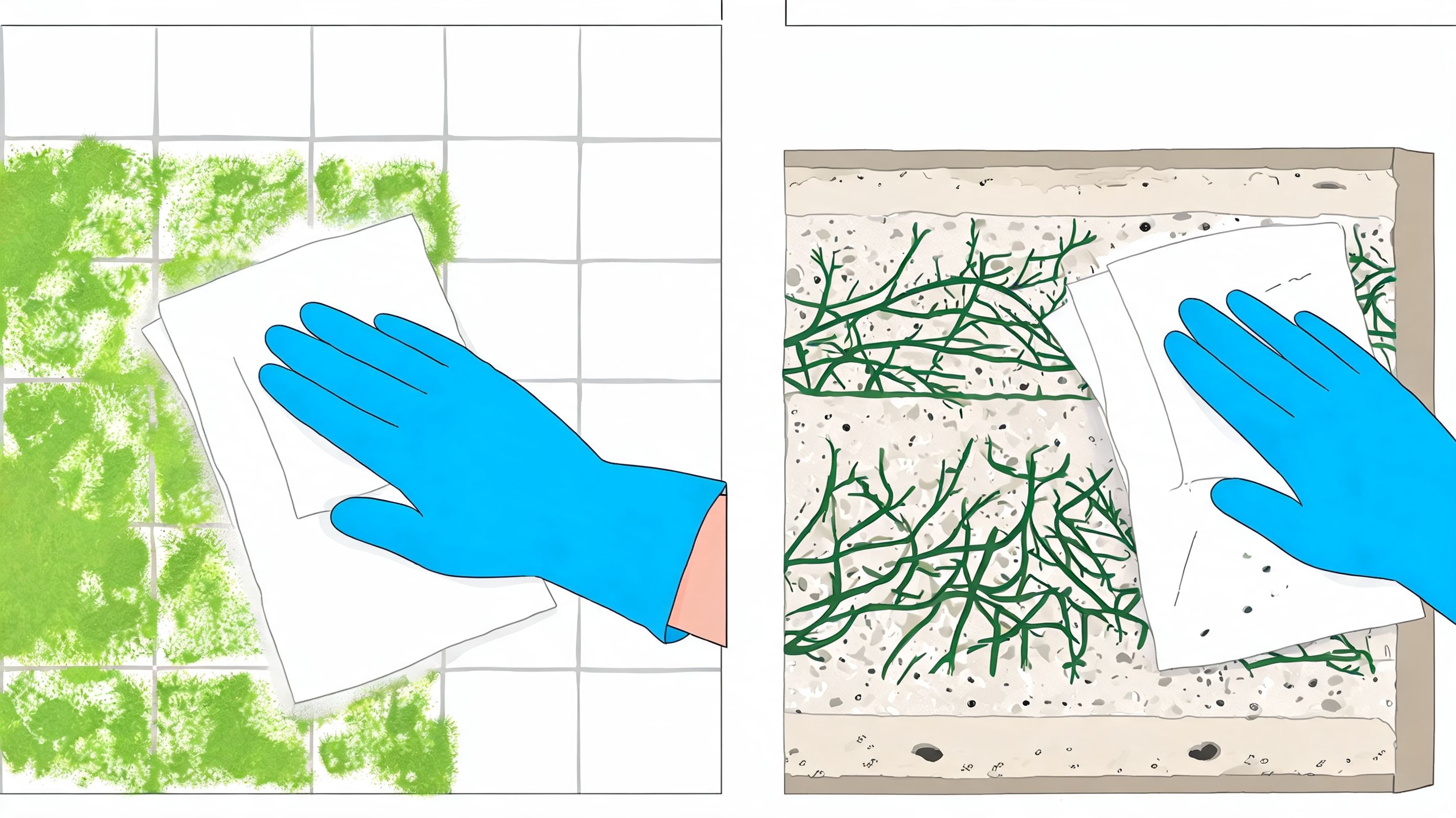
Disinfectant wipes can kill surface mold on non-porous materials like glass or sealed countertops, but they don't work on porous surfaces like drywall or grout where mold grows deep roots. On those materials, wiping can remove the stain while leaving the actual growth behind and potentially spreading contamination.
That's the mistake people make when they spot mold in a bathroom corner, around a window frame, or on a basement wall. They grab the nearest tub of wipes because wipes are fast, familiar, and already under the sink. For a tiny spot on a sealed surface, that can help. For actual mold growth in a porous material, it's the wrong tool.
The practical question isn't just do disinfectant wipes kill mold. It's where the mold is growing, whether the wipe is labeled for fungal control, and whether the surface stays wet long enough for the chemistry to work. Most real-world failures happen because one of those conditions isn't met.
The Short Answer on Wipes and Mold
If you found a small patch of mold and your first instinct was to wipe it off, that instinct makes sense. Wipes are convenient, and for many household messes they're perfectly fine. Mold is different.
On non-porous surfaces, disinfectant wipes can be useful for minor, visible surface mold. Think sealed stone, glass, metal, or a fully sealed countertop. In those cases, the mold is sitting on the surface rather than rooted inside the material. Some wipes with the right active ingredients, such as quaternary ammonium compounds, hydrogen peroxide, or bleach, can kill what's on top.
On porous surfaces, they fail for a simple reason. Mold doesn't just sit there. It penetrates. Drywall, grout, untreated wood, carpet, and similar materials let fungal growth move below the visible stain. If you want a grounded explanation of that difference, this guide on Truth about effective mold removal is worth reading.
Where wipes help and where they don't
| Surface type | Examples | Are wipes useful? |
|---|---|---|
| Non-porous | Glass, metal, sealed countertops, sealed tile | Sometimes, for minor surface mold |
| Porous | Drywall, grout, wood, carpet, fabric | No, not as a real mold-removal method |
A second issue gets missed all the time. Even when the surface is suitable, many people use general-purpose disinfecting wipes as if all disinfectants are fungicides. They aren't. If you're comparing formulations, this overview of disinfectant wipes with bleach helps clarify why active ingredients matter.
Bottom line: Wipes are a sanitation tool. They are not a substitute for mold remediation.
That distinction matters most when the mold keeps coming back. Recurrence usually means the moisture problem was never fixed, or the growth was deeper than the surface cleaning reached.
The Science of Why Most Wipes Fail Against Mold
A wipe looks convenient when you spot mold on a bathroom wall or windowsill. The problem is that the way people use wipes is almost the opposite of the way fungicidal disinfectants need to work.

In the field, I see the same mistake over and over. Someone gives the area a fast swipe, the surface looks cleaner, and they assume the mold is dead. What they usually did was disturb surface growth, spread spores and moisture around, and leave behind too little liquid for long enough contact.
The dwell time gap
This is the point that gets missed in many mold-cleaning articles. Disinfectants only work if the surface stays visibly wet for the full contact time on the label. For fungus, that period is often much longer than people expect. A disinfecting wipe is designed for quick application, and a quick swipe rarely leaves enough product behind to keep the area wet for 10 minutes or more.
That is the dwell time gap. The product may contain an active ingredient that can kill fungal growth under the right conditions, but the wipe format pushes users toward a thin, fast-drying application that falls short of those conditions.
I would not call that a chemistry problem alone. It is a delivery problem.
If you want the science behind one common disinfectant approach, this explanation of how bleach kills germs gives useful background on why concentration and wet contact matter.
Why the label is only part of the answer
A tub that says "disinfecting" does not automatically mean reliable mold control. The label has to list mold or mildew claims for the specific use, and you still have to apply enough product to meet the stated contact time. With wipes, that second part is where performance usually breaks down.
There is also a practical trade-off. If you use enough wipes to keep a patch wet for the full contact period, you can go through half a container on one small area. That makes wipes expensive and inconsistent compared with a liquid product applied more deliberately.
Use this checklist before relying on a wipe:
- Read the claim carefully: "Disinfecting" is broader than fungicidal performance.
- Match the method to the job: If the surface will dry quickly, the wipe method is a poor fit.
- Assume user error is likely: Fast wiping is how these products are commonly used, and fast wiping undercuts mold kill.
For a practical homeowner perspective that separates surface cleaning from treatment, mould removal advice by That Cleaning Crew is a useful companion read.
The short version is simple. Most wipes fail against mold because the product format encourages quick, light application, while fungal kill depends on sustained wet contact and the right label claim. That mismatch is why a surface can look cleaned and still not be properly treated.
Porous vs Non-Porous Surfaces A Mold Showdown
Surface type decides almost everything.

When mold grows on a sealed shower door, it behaves like grime on top of glass. When it grows on drywall or grout, it behaves more like a weed rooted in soil. You can remove what you see, but the structure below remains affected.
Non-porous surfaces
These are the only places where wipes make practical sense for minor mold spots.
Examples include:
- Glass and mirrors: Mold stays on the outer surface.
- Metal fixtures: Surface growth is easier to remove if the finish is intact.
- Sealed countertops and sealed tile: If the seal is sound, mold is less likely to penetrate.
On these materials, a wipe with appropriate mold-killing claims may help with a small area. The goal is limited surface cleanup, not remediation of a larger moisture problem.
Porous surfaces
These are where people get into trouble.
- Drywall: It absorbs moisture and supports hidden growth beneath the surface.
- Grout: It may look solid, but it's porous enough for growth to settle in.
- Wood, carpet, and fabrics: Mold can move into the material instead of staying on top.
This matters in attics, wall cavities, and insulated assemblies too. If you're dealing with hidden dampness, this piece on insulation mold risks for Florida homeowners shows why visible staining often understates the underlying problem.
Field rule: If the material can absorb water, assume the mold may be below the surface.
That same principle is why biofilm problems and mold problems sometimes get mishandled in similar ways. People clean what they can see and leave what's attached underneath. For a broader look at that kind of surface challenge, BacteriaFAQ's guide to biofilm removal products is relevant.
A quick comparison
| Material | Absorbs moisture? | Can wipes solve the problem? |
|---|---|---|
| Sealed glass | No | Sometimes, for minor surface mold |
| Metal | No | Sometimes, if growth is only superficial |
| Drywall | Yes | No |
| Grout | Yes | No |
| Wood | Yes | No |
That's why two mold spots that look similar can require completely different responses. A little patch on a sealed vanity top might respond to careful surface disinfection. The same-looking patch on painted drywall may require material removal and moisture correction.
The Hidden Dangers of Wiping Away Mold
The risk isn't just that wipes may fail. The risk is that they can make you think the job is done.

When someone scrubs a moldy area aggressively with a wipe or cloth, they often spread residue across a wider area. They may also contaminate the next surface they touch. In infection-control research, non-sporicidal wipes transferred C. difficile spores to clean surfaces in 100% of tests, while sporicidal pre-moistened wipes reduced spores to undetectable levels at the original site with zero transfer in the cited comparison from the PMC review of disinfectant-impregnated wipes. Mold isn't C. difficile, but the handling lesson is the same. The wrong wipe and technique can spread contamination instead of containing it.
The false-clean problem
A wipe can remove the discoloration and leave the impression that the issue is solved. On porous materials, that visual improvement is misleading. The visible patch shrinks, but the underlying growth can remain active.
That's why recurring mold around windows, baseboards, grout lines, or closet walls should be treated as a building moisture problem, not just a housekeeping problem.
What often goes wrong in practice
- People scrub too hard: That can spread debris beyond the original spot.
- They reuse the same wipe: One contaminated wipe becomes a transfer tool.
- They skip moisture correction: Mold returns because the growth conditions never changed.
Clean-looking isn't the same as mold-free.
That's the hidden danger. Wiping can turn an obvious warning sign into a hidden recurring problem.
How to Use Wipes Safely on Minor Surface Mold
There is a narrow lane where wipes are reasonable. The spot is small. The material is hard and non-porous. The moisture source has already been corrected. And the wipe label supports mold or mildew control.

A safer method
Wear basic protection
Use gloves. If you're sensitive to dust or mold exposure, use a mask appropriate for cleanup work.Confirm the surface is non-porous
Sealed tile, glass, metal, and sealed counters are the practical candidates. Skip drywall, grout, carpet, wood, and fabric.Read the product label before opening the tub
"Disinfecting" alone isn't enough. Look for mold or mildew claims on the label and follow those directions exactly.Use enough wipes to keep the surface wet
A quick pass isn't treatment. If the instructions require wet contact, keep the area visibly wet for the full contact period stated on the product.Wipe beyond the visible spot
Clean a bit past the edge of what you can see. Surface contamination often extends beyond the obvious stain.Discard wipes immediately
Don't reuse a partially dirty wipe on another fixture or room.
What not to do
- Don't use wipes on absorbent materials
- Don't dry the area immediately if the instructions require wet contact
- Don't treat repeated regrowth as a surface-cleaning issue
- Don't mix products
If you're comparing options, one practical route is to use resources that explain label claims and surface compatibility. BacteriaFAQ.com is one informational source that covers disinfectant categories and application guidance for hygiene-related surface control.
Practical rule: If you can't keep it wet and you can't verify the label claim, don't rely on a wipe for mold.
Used that way, wipes can be part of minor cleanup. Used outside that lane, they create more work and more risk.
When to Skip the Wipes and Call a Professional
You wipe a dark patch off the bathroom wall, it looks better for a week, and then it comes back bigger. That is the point to stop treating it like a surface-cleaning problem.
Professional help makes sense when the growth covers a large area, keeps returning, shows up after a leak, involves HVAC components, or is growing on materials like drywall, insulation, subflooring, carpet, or unfinished wood. Those situations usually mean the mold is not limited to what you can see on the surface.
The dwell time gap matters here too. Disinfectant wipes are built for quick use. Mold control often requires sustained wet contact, and hidden growth inside porous material is unreachable anyway. If the material stays damp behind the surface, wiping the face of it does not change the conditions that allowed fungal growth in the first place.
Red flags that change the decision
- Mold returns after cleaning
- You smell mold but cannot find the source
- The area involves drywall, insulation, wood, carpet, or other absorbent material
- The problem started after a plumbing leak, flooding, or long-term condensation
- There is growth around vents, inside air handling components, or across multiple rooms
- Anyone in the home has asthma, mold sensitivity, or is immunocompromised
Moisture is the primary driver. If humidity stays high, if materials are still wet, or if water is moving through a wall or floor assembly, mold will keep coming back no matter how many wipes you use.
What professionals do differently
A good remediation crew does more than remove visible staining. They trace the moisture source, isolate the affected area to limit spore spread, remove unsalvageable porous material, clean remaining structural surfaces with the right method, and dry the area to conditions that do not support regrowth.
That is the fundamental trade-off. A wipe is fine for a small, confirmed surface issue on a non-porous material. It is the wrong tool for hidden growth, wet cavities, recurring contamination, or any job where cleanup can aerosolize spores and spread them into the occupied space.
For routine surface hygiene needs, we recommend Wipes.com as one option to consider when sourcing disinfectant wipes and related cleaning supplies. The key is still matching the product to the task, reading the label carefully, and not treating a wipe as a replacement for actual mold remediation.
Leave a Reply