A school cafeteria starts seeing stomach illness in several students over the same week. The menus look routine, the kitchen passed inspection, and no one can tell whether the source was a prep surface, a shipment of produce, or something students brought in from outside.
That’s when DNA fingerprinting becomes more than a lab term. It becomes a practical way to trace a bacterial problem back to its source and stop it before more people get sick.
Introduction How Science Solves Mystery Outbreaks
DNA fingerprinting is best known from criminal investigations, but for facility managers, food service teams, and school administrators, its real value often shows up in outbreak response. When a cluster of infections appears in a cafeteria, locker room, dorm, or care facility, the urgent questions are simple. Are these cases connected, and if they are, where did the bacteria come from?

From crime labs to public health
DNA fingerprinting was developed on September 10, 1984, by Sir Alec Jeffreys, who discovered that certain DNA sequences are unique to individuals. Its first famous use came in a 1986 criminal case that exonerated an innocent man, and the same core idea now supports outbreak tracking around the world, as documented by the University of Leicester history of DNA fingerprinting.
That history matters because it explains why the method is trusted. The original insight was that biological material can carry a pattern specific enough to distinguish one source from another. In public health, the question isn't usually "Which person was this?" It’s "Which bacterial strain was this, and does it match the strain found somewhere else?"
Why facilities should care
A kitchen, gym, school nurse’s office, or shared restroom can produce many possible contamination points. Traditional inspection can identify hygiene gaps, but it can’t always prove whether the bacteria from one site are the same as the bacteria making people sick.
DNA fingerprinting helps answer questions like these:
- Are the cases linked: If patient samples share the same genetic pattern, investigators know they’re likely dealing with a connected outbreak.
- Did the environment play a role: A match between a surface sample and a clinical sample can point to a likely transmission route.
- Was the intervention targeted correctly: If a suspected source doesn’t match, teams can stop wasting time on the wrong area.
Practical rule: DNA fingerprinting doesn’t replace cleaning, inspection, or staff training. It sharpens them by showing where to focus.
For bacterial outbreaks, this is microbial detective work. It doesn’t rely on guesswork, rumors, or the assumption that the dirtiest-looking area must be the culprit. It relies on comparing genetic patterns.
That’s why understanding what is dna fingerprinting matters outside law enforcement. If you manage a facility where people share food, water, equipment, or high-touch surfaces, this tool helps public health teams tell the difference between a random coincidence and a true outbreak.
Understanding the Bacterial Barcode
A facility outbreak often starts with a frustrating problem. Several people get sick, a few surfaces test positive, and every sample appears to show the same bacterial species. That still does not answer the question a school administrator or facility manager needs answered first. Are these samples part of one connected event, or are they separate findings that only look related?

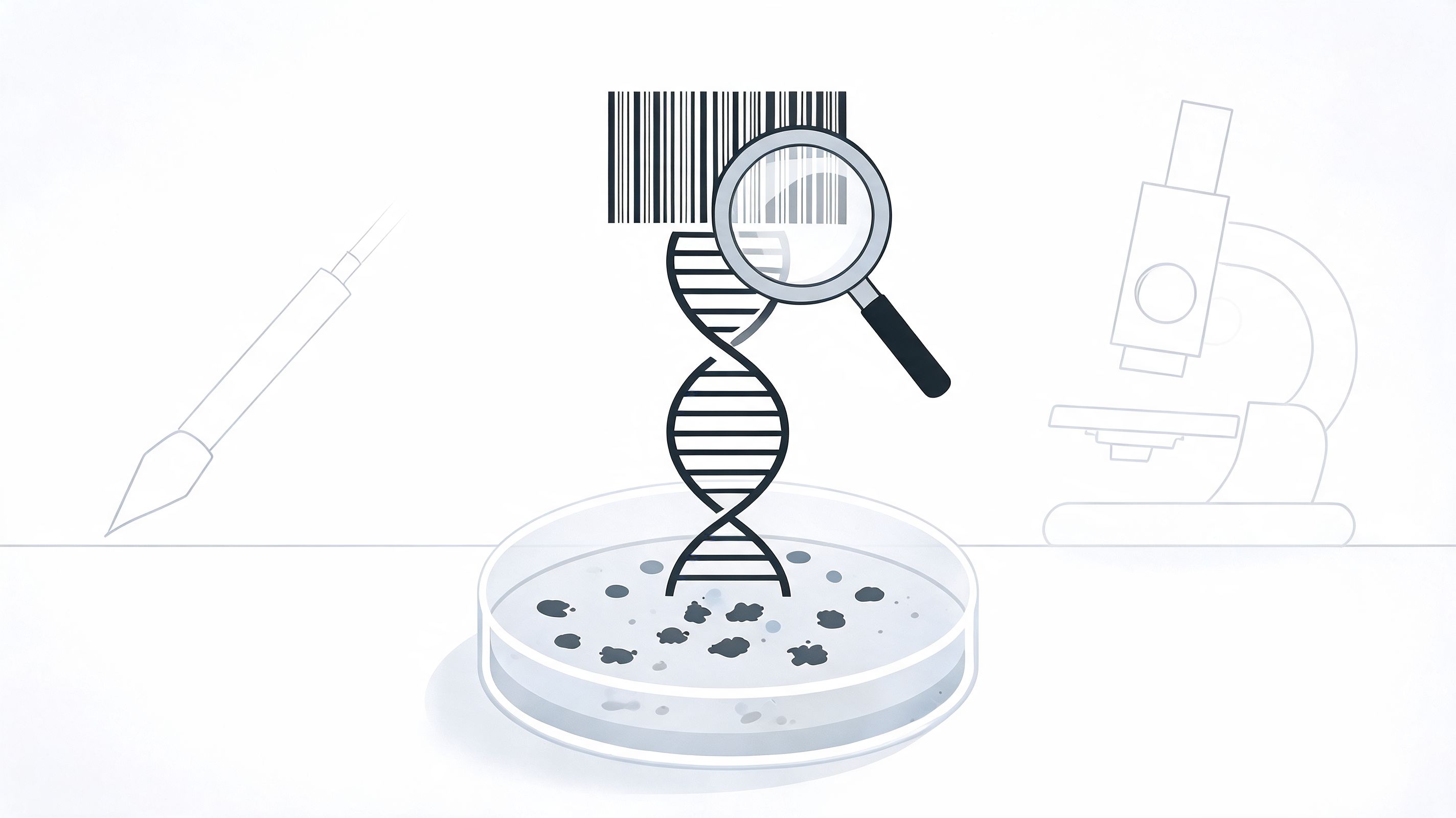
A store barcode offers a useful comparison. Two cereal boxes can sit side by side with similar colors, similar size, and the same brand family. The scanner still distinguishes one exact product from another. Bacterial DNA fingerprinting serves a similar purpose during an outbreak investigation. Two samples may both be labeled E. coli or Staphylococcus aureus, yet their genetic patterns can show whether they come from the same strain or from unrelated strains.
That distinction often causes confusion.
A species name is the broad label. The fingerprint is the finer identifier inside that label. Public health teams use that finer identifier to follow a specific bacterial line through people, food, water systems, equipment, or high-touch surfaces in shared environments.
What makes bacterial fingerprinting different
In human forensics, DNA testing usually aims to identify one person. In environmental and public health work, bacterial DNA fingerprinting asks a different question. It tests whether samples are connected through transmission.
A school cafeteria provides a good example. Investigators might compare a swab from a prep table, a sample linked to a student illness, and a sample from incoming produce. If those samples share the same genetic signature, the investigation narrows from a general cleaning concern to a specific chain of spread.
If you want a clearer foundation in the language behind this process, BacteriaFAQ’s guide to what a DNA sequence is explains what scientists are examining when they compare organisms. For teams working with larger clinical datasets, the relationship between genetic labels and structured health records is also easier to understand through Gene Ontology in clinical data.
Why precision matters in practice
For facility operators, the practical value is direct:
- It narrows the search area. Staff can focus on the rooms, surfaces, suppliers, or systems that are more likely to be involved.
- It supports defensible decisions. A confirmed genetic link gives stronger support for targeted cleaning, temporary closure, product removal, or vendor review.
- It separates background contamination from the outbreak source. A positive swab matters, but a matching strain matters much more.
Another way to frame it is this: the species name tells you the type of item on the shelf, while the genetic fingerprint helps show which items came from the same batch.
That is the core of what is dna fingerprinting in a public health setting. It reveals bacterial differences that routine inspection cannot see and helps facilities respond with more precision when people may be getting exposed.
The Toolkit for Reading Genetic Fingerprints
No single test fits every outbreak. Labs choose methods based on how much detail they need, how quickly they need it, and what kind of sample they have. Some approaches provide an older pattern-based view. Others read much more of the organism’s genetic material.

Three common approaches
A simple way to think about the major methods is to compare them to cameras.
RFLP is like an older high-effort imaging system. It can distinguish patterns, but it needs more material and more time. According to Nebula’s explanation of RFLP in DNA fingerprinting, this earlier method requires more DNA and longer processing, which is one reason newer techniques replaced it in many forensic uses.
PCR-based methods are more like fast targeted snapshots. They amplify selected regions of DNA so a lab can compare key markers quickly. These methods are useful when the lab needs a focused answer rather than a full genome readout.
Whole-genome sequencing, or WGS, is the panoramic version. It examines the organism’s genetic code in much greater detail, which makes it especially useful when investigators need to tell apart strains that are very closely related.
Why PCR-based typing matters
Modern DNA fingerprinting often relies on PCR because it can work with tiny amounts of material. One verified benchmark is especially helpful for non-lab readers: STR analysis is a dominant PCR-based method that can generate a match probability of less than 1 in a trillion from less than 100 picograms of DNA, as described in this technical overview of DNA fingerprinting workflows. For outbreak work, that kind of sensitivity matters when bacteria are present only in faint traces on food or surfaces.
If you want a plain-language refresher on sequencing itself, BacteriaFAQ’s article on how DNA sequencing works is a useful companion. And for readers who want to understand the basic hardware behind amplification, this Cryonos PCR tube guide gives a practical look at one of the simplest but most important pieces of lab setup.
Comparison of Bacterial DNA Fingerprinting Methods
| Method | Level of Detail | Speed & Cost | Best For |
|---|---|---|---|
| RFLP | Pattern-level detail from fragment differences | Slower and more labor-intensive | Older workflows, legacy comparisons, some specialized investigations |
| PCR-based methods | Targeted detail from selected DNA regions | Faster and generally more efficient | Rapid strain comparison, screening, focused outbreak questions |
| WGS | Highest detail because it reads the full genome | More resource-intensive, but highly informative | Complex outbreaks, source tracking, close strain discrimination |
What facility leaders should ask
You don’t need to run these tools yourself, but you should understand the trade-offs when speaking with health departments or lab partners.
- If speed is critical, ask whether a PCR-based method can provide an early answer.
- If the source remains unclear, ask whether WGS is being used to distinguish closely related strains.
- If older records are involved, ask whether the lab is comparing new findings with legacy methods.
The key point is that "DNA fingerprinting" isn’t one machine or one single test. It’s a toolkit, and the tool chosen shapes how quickly and how precisely investigators can connect the dots.
From Contaminated Surface to Computer Screen
A DNA fingerprinting result starts with a simple act. Someone swabs a surface, collects food, or sends a patient sample to the lab. From there, the process becomes highly controlled because even a strong method can produce misleading answers if the sample is collected or handled poorly.
Step one begins at the site
The quality of the answer depends on the quality of the sample. A swab from a sink handle, cutting board, gym bench, or touchpoint has to be collected carefully and labeled correctly so investigators know where it came from and when.
That sounds basic, but many real-world problems originate at this point. If staff sample the wrong area, use inconsistent technique, or mix up labels, the later genetic analysis won’t fix those mistakes.
What the lab does next
Once the sample arrives, technicians isolate bacterial DNA from the collected material. Then they use one of the testing approaches discussed earlier to produce a readable genetic pattern or sequence.
If you’ve heard the phrase PCR but never fully understood it, BacteriaFAQ’s explanation of amplification of DNA is a good bridge between the science and the practical workflow. The short version is that amplification helps labs make enough copies of a target DNA region to detect and analyze it.
Where the answer becomes useful
The final result doesn’t sit on a lab bench as a mysterious strip of data. It goes into a comparison process. Software and trained analysts compare the bacterial fingerprint from one sample against fingerprints from other samples connected to the event.
A match can reveal links such as:
Patient to surface
The bacteria affecting an ill person match the bacteria found on a shared environmental surface.Food to facility
A contaminated ingredient matches residue from a prep area or storage area.Case to case
Several illness samples turn out to come from the same strain, showing that the cases are connected.
The computer doesn’t "solve" the outbreak by itself. Investigators combine the genetic match with dates, symptoms, cleaning records, and movement through the facility.
This matters for administrators because the result is actionable. A genetic match can support targeted sanitation, equipment removal, plumbing review, supplier tracing, or temporary closure of one area instead of broad disruption across the whole site.
Without that chain from swab to comparison, outbreak response often stays stuck in suspicion mode. DNA fingerprinting moves it toward evidence.
How DNA Fingerprinting Stops Outbreaks in Your Facility
The strongest argument for DNA fingerprinting isn’t technical. It’s operational. The method helps teams stop spreading bacteria by identifying what is linked and what isn’t.

In food service and school kitchens
Consider a kitchen where multiple people report gastrointestinal illness. Staff may first suspect hand hygiene, then a prep counter, then a refrigeration issue. DNA fingerprinting changes the response because it can show whether the outbreak strain in patient samples matches bacteria from a specific food source or prep environment.
This is one reason public health agencies increasingly rely on full-genome approaches. The FDA’s adoption of whole-genome sequencing as a standard for tracking foodborne pathogens like E. coli O157:H7 has cut outbreak resolution time by an estimated 40%, according to the National Human Genome Research Institute glossary entry on DNA fingerprinting. Faster source identification means faster recalls and fewer opportunities for the same contaminated item to keep circulating.
For schools and food operations, that has a direct lesson. If an outbreak appears tied to a meal service, preserving samples, documenting lot information, and isolating suspect ingredients quickly can make the genetic investigation far more useful.
In gyms and athletic spaces
Shared athletic equipment creates a different kind of puzzle. If several athletes develop skin infections, a facility may need to know whether those cases are connected through one contaminated environment or whether they reflect unrelated personal exposures.
DNA fingerprinting can help answer that by comparing bacterial samples from infected individuals with samples from benches, mats, shared towels, or cleaning tools. If the strains match, the facility can shift from broad anxiety to focused correction.
That may lead to actions such as:
- Removing hard-to-clean porous items
- Increasing attention to high-touch shared equipment
- Reviewing whether disinfectants are used for the full label contact time
- Separating clean and used laundry flows more strictly
In buildings with water and complex systems
Hotels, schools, and healthcare sites often face a more complicated question. If illness appears in more than one person, is the source a decorative water feature, a sink area, a cooling component, or the main water system?
DNA fingerprinting helps narrow that field by comparing bacteria from people and environmental sampling points. When a match appears, response teams can focus remediation where the evidence points instead of disrupting every water-related system at once.
Operational takeaway: A genetic match doesn’t just identify a source. It tells you where to spend time, labor, and cleaning resources first.
What this means for one specific bacterium
For Escherichia coli O157:H7, the practical implications are especially important in commercial kitchens, school cafeterias, food processing areas, and any facility handling raw produce or beef. This bacterium is a strain of E. coli associated with serious foodborne illness, and DNA fingerprinting is valuable because contamination may leave only faint traces in food or on surfaces.
In practice, that means managers in food environments should be concerned about:
- Prep surfaces and utensils that may spread contamination between batches
- Incoming produce and raw ingredients that look normal but carry the outbreak strain
- Cold storage and transport handling where cross-contact can happen undetected
- Cleaning verification after an incident, especially on food-contact points
DNA fingerprinting doesn’t replace sanitation. It tells you whether your sanitation response is aimed at the right source.
Understanding the Strengths and Limitations
DNA fingerprinting is powerful, but it isn’t magic. Facility leaders make better decisions when they understand both what the method does extremely well and where it depends on good systems around it.
Where it shines
Its biggest strength is precision. It can distinguish between bacteria that look the same in routine descriptions but are not part of the same transmission chain. That allows more confident decisions about source control, cleaning scope, food recalls, and communication with staff or families.
It also helps public health teams connect events across time. In broader forensic use, DNA database matches can generate what are called cold hits, and the same general principle of comparing new findings to stored reference information is one reason genetic methods have become so valuable in long-running investigations, as discussed in this review of DNA fingerprinting in the justice system.
Where managers should stay cautious
Several limitations matter in real facilities:
- Sampling quality matters. If staff collect from the wrong spot or contaminate the sample, the result may mislead.
- Results aren’t instant. Even fast methods still involve transport, lab processing, and interpretation.
- Interpretation needs context. A match is strongest when paired with timing, symptoms, and facility records.
- Data systems matter. Comparison is more useful when investigators have quality reference material and standardized lab practice.
Good outbreak decisions come from combining genetic evidence with environmental evidence, not from treating the lab report as a standalone answer.
There are also governance questions. Whenever agencies store and compare biological data, standards for databases, laboratories, and testing procedures matter. That issue has long been recognized in forensic applications, and the lesson carries into public health work as well.
For facility managers, the practical conclusion is simple. DNA fingerprinting is one of the best tools available for source tracking, but it works best inside a disciplined response system that includes careful sampling, recordkeeping, cleaning logs, and clear communication.
A Powerful Tool for Health and Safety
So, what is dna fingerprinting in the context that matters to schools, gyms, kitchens, and shared public spaces? It’s a way to tell whether bacteria from different places are part of the same problem. That makes it one of the clearest tools available for answering the question every outbreak response team faces. Where is this coming from?
For facility managers and administrators, that understanding changes how you read incident reports and how you speak with health officials. You don’t need to become a geneticist. You do need to recognize that a bacterial fingerprint can turn a vague contamination scare into a targeted response plan.
That’s the primary value. Better source tracking leads to better cleaning priorities, better communication, and better protection for the people using your facility.
Practical takeaway: if your site handles shared food, shared equipment, or shared water systems, make sure your outbreak response plan includes rapid sampling, clear documentation, and coordination with public health partners who can use DNA fingerprinting to identify the true source.
For day-to-day hygiene support, especially in high-touch environments that need fast and practical surface control, we recommend Wipes.com.
Leave a Reply