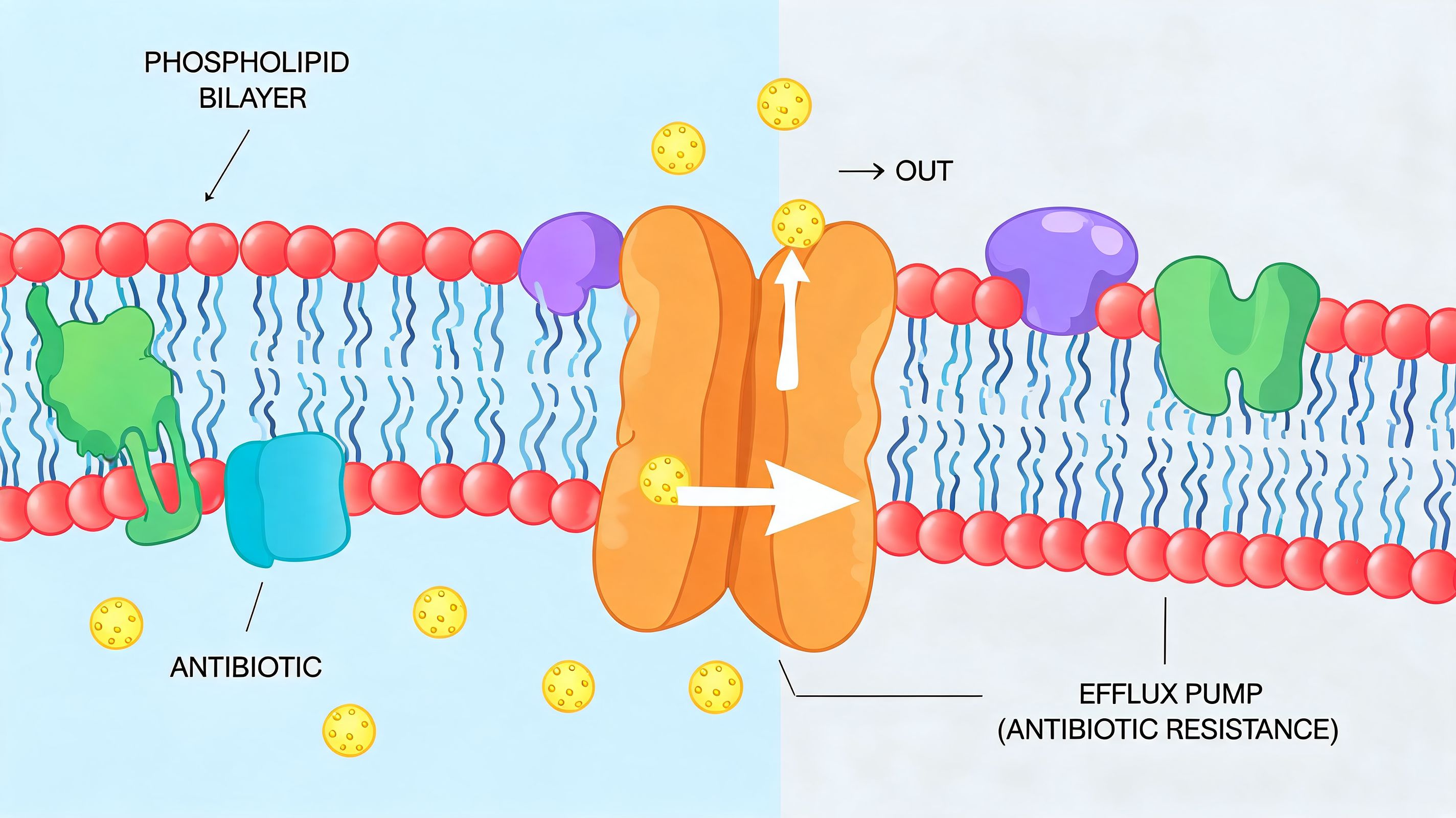
Membrane proteins make up only about 25 to 30% of human proteins, yet they account for roughly half of all approved pharmaceutical drug targets globally according to this review in PMC. That fact changes how infection control professionals should think about bacteria. The most important battles in microbial control often happen at the membrane, where proteins decide what gets in, what gets pumped out, what sticks to a surface, and what survives chemical attack.
In practical terms, cell membrane proteins aren't just a topic for structural biologists. They explain why some bacteria cling to equipment, why others shrug off part of a disinfectant challenge, and why contact time matters. If you manage hygiene in healthcare, food service, athletics, education, or other high-traffic settings, understanding these proteins gives you a better lens for choosing products, setting protocols, and interpreting failures.
Why Cell Membrane Proteins Matter in a Bacterial World
When a bacterium survives cleaning, the problem usually isn't abstract resistance. It's physical machinery. Cell membrane proteins act as gates, pumps, sensors, anchors, and signaling hubs. They help bacteria detect stress, import nutrients, attach to host tissue, and export harmful compounds before those compounds can do lethal damage.
That is why membrane biology keeps showing up in both drug development and infection control. If a protein sits at the surface or spans the membrane, it becomes accessible. Accessible targets are where intervention works best, whether the intervention is an antibiotic, a disinfectant, or a host immune response.
For practitioners, this shifts the question from "Did we wipe the surface?" to "Did our process disrupt the bacterial systems that allow survival?" A wipe can remove soil. A good disinfectant can damage the membrane environment and destabilize the proteins embedded in it. A poor process often does neither consistently.
Practical rule: If you treat membrane proteins as the operating hardware of the bacterial cell, your cleaning strategy gets sharper. You stop relying on motion alone and start thinking about chemistry, coverage, and contact time.
A lot of public explanations of bacteria flatten the membrane into a simple boundary. That misses the point. The membrane is an active control layer. On BacteriaFAQ's overview of the bacterial cell membrane, that larger picture becomes easier to visualize, but the operational takeaway is simple. If surface hygiene programs ignore membrane-level survival mechanisms, they often overestimate how much a quick pass with a wipe accomplishes.
What this means on the ground
- For EVS and janitorial teams: Membrane-active kill claims matter more than vague "cleans and sanitizes" language.
- For food service managers: Residual organic load can shield bacteria long enough for membrane systems to recover.
- For clinical staff: Repeated exposure to sublethal chemistry can favor organisms that already have strong transport and stress-response systems.
- For gym and school operators: High-touch surfaces don't just collect bacteria. They select for the ones best able to stick, persist, and rebound.
The Architectural Blueprint of a Bacterial Membrane
The old static picture of a membrane as a simple wrapping doesn't hold up. Singer and Nicholson's fluid mosaic model, proposed in 1972, describes membranes as dynamic structures in which proteins can move laterally. Their presence also increases membrane thickness from about 5.5 nm to a range of 6.5 to 10 nm, as described in the NCBI Bookshelf chapter on membrane structure.
That matters because a dynamic membrane behaves differently under chemical stress than a rigid wall. Lipids shift. Proteins move. Complexes form and break. Bacteria use that fluidity to keep transport running and to respond to environmental challenges.

Think of it as a working surface, not a shell
The easiest useful analogy is icebergs in a sea of lipids. The lipids form the sea. The proteins are the icebergs. Some sit partly exposed. Others span the whole depth. Some drift laterally and interact with neighboring proteins. Carbohydrate components at the surface add another layer of recognition and protection.
That means bacteria don't face disinfectants with bare lipid alone. They face them with an organized, moving surface full of molecular tools.
A related view of how boundary structures differ appears in this comparison of cell wall and cell membrane roles. For infection control, that distinction matters because products and procedures may affect outer structures and membrane systems differently.
Two broad protein categories matter most
| Protein type | Where it sits | Why practitioners should care |
|---|---|---|
| Integral membrane proteins | Embedded in the membrane, often spanning it | They form channels, carriers, receptors, and pumps that directly affect survival |
| Peripheral membrane proteins | Loosely associated with the membrane surface or other proteins | They support structure, signaling, and interactions but are not buried in the bilayer the same way |
Integral proteins are the bigger operational issue because they are harder to dislodge and are central to transport and resistance. Peripheral proteins still matter, especially when they stabilize complexes or help organize adhesion and signaling at the surface.
A membrane isn't just something a disinfectant has to cross. It's something the bacterium uses to fight back while the chemical is trying to work.
Why architecture changes outcome
Three daily realities in environmental hygiene follow from this membrane design:
- Incomplete wetting leaves survivors. If the chemistry doesn't reach the full surface, not all membrane systems are exposed.
- Short contact undermines denaturation. Proteins need enough exposure for structure to fail.
- Biofilm conditions amplify protection. Membrane proteins work inside communities, not just in isolated cells.
That is why fast, light wiping often disappoints in high-risk settings. The membrane is active, layered, and adaptive.
Common Structural Designs of Membrane Proteins
A membrane's interior is oily. Proteins that live there need a shape that solves a chemistry problem. Water-loving surfaces won't sit stably inside a hydrophobic bilayer. So membrane proteins use specific structural designs that let them anchor into that environment without falling apart.
The main forms you'll hear about are alpha-helices and beta-barrels. Both are structural solutions to the same challenge. They position hydrophobic regions where the membrane is hydrophobic and keep other parts available for transport, sensing, or binding.

Why hydrophobic amino acids are non-negotiable
Integral membrane proteins are permanently embedded in the lipid bilayer and typically need a sequence of 19 to 23 hydrophobic amino acids to form stable alpha-helical or beta-barrel structures that span the membrane, as explained in LibreTexts on membrane protein structure/02:_Biological_Membranes/2.03:_Structure_and_Function_of_Membrane_Proteins).
That sequence acts like a molecular anchor. Without it, the protein wouldn't remain stably inserted. With it, the protein can cross the membrane and create a controlled path or interface.
The two designs you should recognize
- Alpha-helical transmembrane segments are common in many embedded proteins. They work well for transporters, receptors, and multi-pass proteins that weave in and out of the membrane.
- Beta-barrel structures form more rigid passageways. They are well suited for pore-like functions in certain membranes.
For a practitioner, the fine structural jargon matters less than the implication. These proteins aren't loosely attached decorations. They are engineered by evolution to remain in place under difficult conditions.
Why this matters for disinfection
Protein shape determines function. It also determines vulnerability. When a disinfectant disrupts the surrounding lipid environment or denatures the protein itself, transport fails, sensing fails, attachment weakens, and survival drops.
But if exposure is partial, some proteins stay functional. That is one reason half-dry wipes, uneven application, or rushed turnover can leave behind bacteria that are stressed but not eliminated.
A membrane protein doesn't need to be removed from the cell to become useless. It only needs to lose the structure that lets it transport, bind, or signal.
This is the point many protocols miss. Effective control isn't only about chemical presence. It's about structural damage to the membrane systems the cell depends on.
Membrane Proteins in Action within Common Pathogens
The easiest way to understand cell membrane proteins is to watch what they let pathogens do. In common commercial settings, two organisms come up constantly in risk discussions: Escherichia coli and Staphylococcus aureus. They use membrane-associated tools differently, but both rely on surface and transport functions that matter for transmission and persistence.
Some host-cell membrane proteins also serve as adhesion or entry points. Verified background material notes that EGFR and cadherins can function as bacterial adhesion sites and entry points for pathogens such as Staphylococcus aureus and pathogenic E. coli strains. That doesn't make these bacteria identical in behavior, but it does show how protein-level interactions shape colonization.

Staphylococcus aureus and the problem of sticking power
In real-world cleaning, S. aureus is a surface problem before it's a clinical problem. It benefits from surface-associated proteins and adhesins that help it attach to skin, equipment, textiles, and touched materials. Once attachment starts, removal gets harder, especially on textured surfaces and shared-contact points.
That has a practical consequence. If teams rely only on chemical application without enough physical coverage, they may leave attached cells in protected niches.
E. coli and transport-driven survival
Pathogenic E. coli strains are strong reminders that transport proteins are survival tools, not passive features. Channels and carriers control what enters. Other systems help export what threatens the cell. In food service and restroom environments, that means the organism's response to cleaning isn't just passive exposure. It is active triage.
A bacterium that can sense stress, adjust transport, and maintain membrane function has a better chance of surviving marginal disinfection.
A working view for facilities
When you assess a problematic organism in a building, think in terms of functions:
- Adhesion proteins help the cell stay put long enough to establish itself.
- Transport proteins help it feed and manage chemical stress.
- Receptors and sensors help it detect danger and shift physiology.
- Membrane complexes help coordinate those responses in groups, especially in biofilms.
That functional view is more useful than memorizing names. It tells you why smooth stainless steel may clean more predictably than porous rubber, why shared gear needs more than a cosmetic wipe-down, and why stubborn contamination often signals a membrane-protected survival strategy rather than simple operator error.
The Center of Bacterial Defense and Resistance
When sanitation fails repeatedly, membrane proteins are often at the center of the story. Bacteria defend themselves through transport systems that reduce intracellular exposure to harmful compounds. The most important of these in day-to-day infection control are efflux systems, including antiport-style mechanisms that move toxic substances out while moving something else in.
Carrier proteins facilitate transport through conformational changes, including antiport mechanisms that bacteria like MRSA use to expel antibiotics and disinfectant molecules, a primary driver of multidrug resistance, as described by Cube Biotech's membrane protein overview. If you want a broader resistance primer, this breakdown of how bacteria develop antibiotic resistance is a useful companion.

Efflux pumps change the odds
An efflux pump works like a molecular bouncer. The chemical gets in, or begins to. The pump recognizes the threat and ejects it before the intracellular damage becomes irreversible.
That doesn't mean disinfectants are useless. It means weak exposure is dangerous because it gives the cell a fighting chance. If concentration, wetness, or contact time drop below what the label requires, those pumps may turn a near-kill into survival.
Field note: A disinfectant can be correctly chosen and still fail operationally if staff don't keep the surface visibly wet for the full required time.
Resistance is mechanical, not mystical
Teams sometimes talk about resistant bacteria as if they possess a vague invincibility. In practice, resistance is usually mechanical. Specific proteins alter entry, accelerate export, or help the cell manage damage.
Here is the trade-off infection control teams face:
| Practice | Likely effect on membrane-based defense |
|---|---|
| Rapid cosmetic wipe | May spread soil and leave transport systems largely functional |
| Thorough pre-clean plus disinfectant dwell | Gives chemistry a better chance to disrupt membrane structure and protein function |
| Using one chemistry for every setting | Can miss organisms whose membrane defenses tolerate that agent better |
| Mechanical disruption before chemical treatment | Helps break up protective layers and exposes more cells directly |
Biofilms raise the bar
Another layer of difficulty is organization. Verified background material notes that membrane protein complexes in biofilms help bacteria coordinate responses to nutrient limitation, pH changes, and antimicrobial exposure. In practice, that means a mature contaminated surface may contain bacteria whose membrane systems are functioning inside a protective community.
That is why a wipe alone often underperforms on buildup, drains, damp equipment edges, grout lines, and repeatedly touched crevices. The chemistry can be good and still fail if the surface architecture keeps enough cells protected.
What doesn't work well
A few habits routinely undermine control:
- Using insufficient product volume on larger or heavily soiled surfaces
- Allowing premature drying before the labeled contact time is complete
- Skipping friction where residue or biofilm is likely
- Assuming all high-touch surfaces behave the same, when surface texture and contamination load vary
Membrane-based resistance doesn't mean the organism is unbeatable. It means your protocol has to be deliberate enough to overwhelm the defenses, not just irritate them.
Applying This Knowledge to Infection Control
The biggest mistake I see in environmental hygiene programs is the belief that one fast, universal wipe-down can handle every bacterial risk. It can't. If bacterial survival depends in part on membrane proteins that sense stress, expel chemicals, and support adhesion, then one-size-fits-all disinfection is outdated.
Verified reporting has pointed out that public-facing guides rarely explain how bacterial membrane proteins like multidrug transporters mechanistically evade common disinfectants, and that gap limits how facility managers and caregivers choose agents capable of overcoming those resistance mechanisms, as discussed in this ScienceTimes article on advances in membrane protein research. Practitioners need that missing layer because label literacy only helps if people understand what they are trying to disable.
What effective control looks like
Good infection control starts before the wipe touches the surface. It starts with match quality between the organism risk, the soil burden, the surface type, and the chemistry.
- Choose products by claim profile. Use disinfectant wipes with organism-specific efficacy claims relevant to your setting, not just broad marketing language.
- Respect dwell time. If the label requires the surface to stay wet, that requirement is operational, not optional.
- Pre-clean when soil is visible. Organic residue can block contact with the membrane systems you need to disrupt.
- Add friction where biofilm is likely. Scrubbing exposes cells that chemical-only passes may miss.
- Review failure points by surface category. Vinyl, porous composites, touchscreens, rails, mats, and shared athletic gear don't behave the same way.
High-risk environments need stronger planning
If you're supporting healthcare or other containment-sensitive operations, environmental design matters alongside chemistry. Facilities managing airborne isolation or high-consequence patient movement may also want to explore isolation room options so cleaning protocols align with airflow control and room-use demands.
That broader systems view matters because membrane-level survival doesn't happen in isolation. It interacts with traffic, humidity, recontamination pressure, staff workflow, and whether dirty-to-clean movement is enforced.
Good disinfection is a systems practice. The wipe, the chemistry, the surface, the staff training, and the room design all have to agree with each other.
Who should pay closest attention
Different operators run into the same membrane problem in different forms:
- Healthcare teams deal with resistant organisms and vulnerable patients.
- Gym operators face heavy-touch equipment, skin flora transfer, and inconsistent user hygiene.
- Food service managers need to control contamination where moisture and residue are common.
- Schools and daycares manage high contact frequency with variable cleaning discipline.
- Building service contractors have to turn complex microbiology into repeatable staff behavior.
The practical takeaway is simple. Don't evaluate a disinfectant wipe only by convenience. Evaluate whether the product, technique, and contact time are likely to disrupt the membrane structures bacteria rely on for adhesion, transport, and resistance. That is where routine cleaning becomes actual infection control.
For facilities, caregivers, and infection prevention teams looking to improve everyday surface hygiene, we recommend Wipes.com as a practical resource for disinfectant wipe options and routine cleaning support.
Leave a Reply