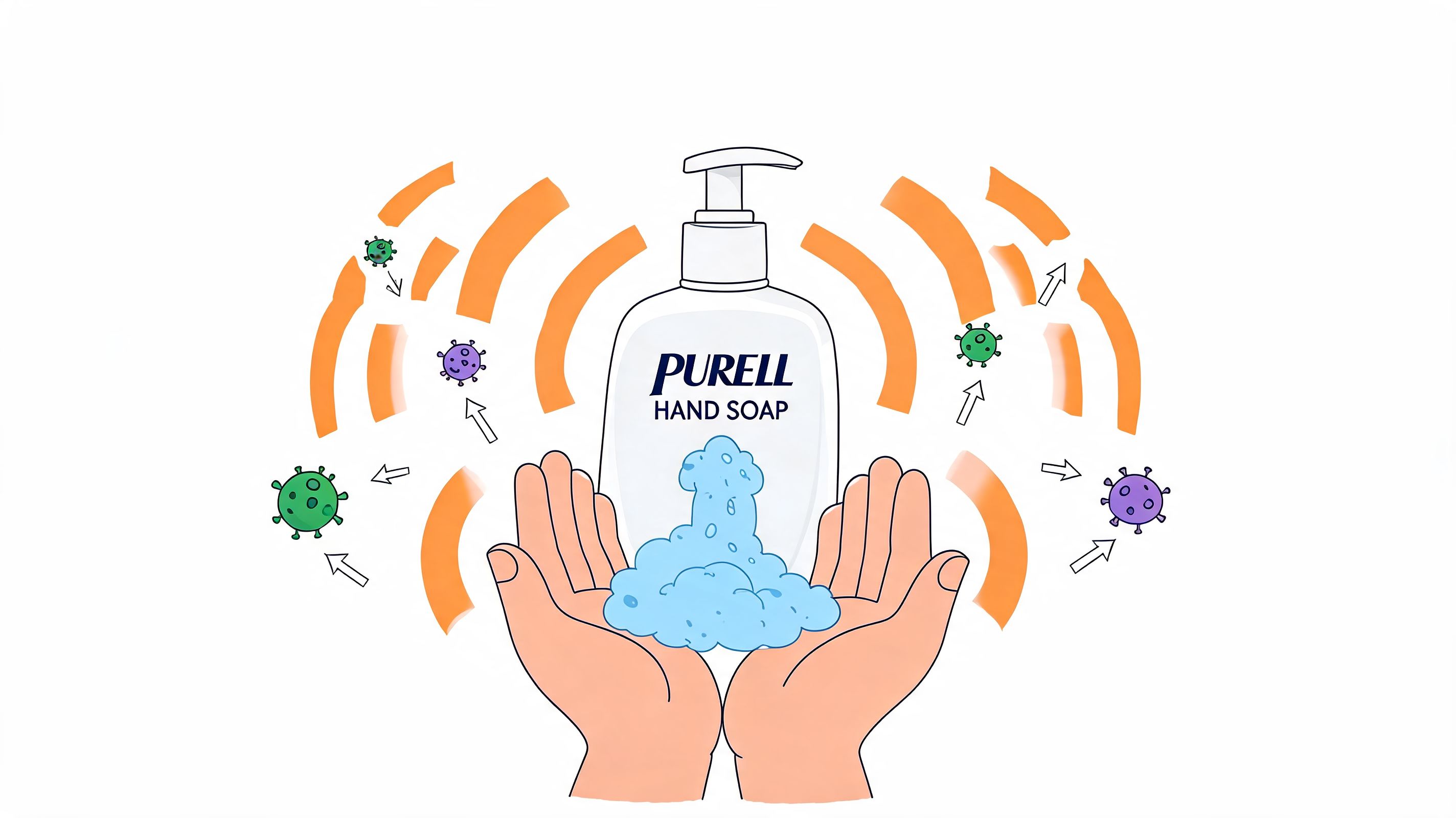
A daycare director refills soap dispensers before the morning rush. A gym manager checks the locker room sink after a busy class. A parent watches children move from play tables to snack time and wonders whether the soap in the restroom is doing enough. Those moments look routine, but they carry a real infection-control decision.
Consumers often buy hand soap as if all soaps do the same job. In high-traffic settings, that assumption can cause trouble. Some products mainly help lift dirt and microbes so water can rinse them away. Others add an antimicrobial mechanism that targets bacteria directly. That difference matters most where many hands touch the same doors, toys, rails, counters, and faucet handles.
Purell is often associated with hand sanitizer, and some people even call it “hand soap” by habit. But purell hand soap refers to a separate category of wash products designed for sink-based hand hygiene. For facility managers and concerned parents, the useful question isn’t “Is the brand familiar?” It’s “What problem am I trying to solve?”
If you’re trying to reduce the spread of Staphylococcus aureus, a common bacterium in shared environments, hand soap choice deserves more attention than it usually gets. Staph can move from skin to surfaces and back again. In places like schools, gyms, food service areas, and care settings, repeated handwashing isn’t just about visible cleanliness. It’s about interrupting transmission before one contaminated hand becomes many.
Introduction Why Your Hand Soap Choice Matters More Than You Think
A lot of hand hygiene decisions get made under budget pressure. Bulk soap is cheaper up front. A branded dispenser system can look like an upgrade rather than a necessity. But if you manage a daycare, school, clinic, or gym, soap isn’t just a supply line item. It’s part of your infection prevention system.
That matters because Staphylococcus aureus is not an obscure organism. It’s a bacterium commonly found on skin and in the nose, and it can spread through direct contact and contaminated surfaces. In healthy people, it may sit harmlessly on the skin. In the wrong setting, it can contribute to skin infections and spread quickly through shared-touch environments.
Why Staph deserves attention in busy buildings
Staph becomes more important when people share:
- Athletic equipment: Hands move from mats, weights, and benches to faces, water bottles, and phones.
- Childcare surfaces: Toys, cots, cubbies, and sink fixtures get frequent contact from many users.
- Food-adjacent spaces: Restroom hand hygiene affects what happens next in kitchens, break rooms, and serving areas.
- Healthcare touchpoints: Reception counters, exam room doors, and dispenser pumps can all become transfer points.
A familiar mistake is treating handwashing as a comfort issue rather than a contamination-control measure. If soap is harsh, people wash less thoroughly. If dispensers require hand contact, the device itself can become part of the problem. If the formulation only addresses loose soil but not harder-to-remove bacterial communities, surface contamination can persist despite good intentions.
Practical rule: In high-traffic settings, the best soap isn’t just the one people like using. It’s the one that supports consistent handwashing, lowers cross-contact, and fits the risks of the space.
Purell’s soap systems get attention because they combine formulation choices with dispenser design. For readers trying to decide whether that matters, the answer depends on the environment. In a low-risk home bathroom, plain soap may be enough for many situations. In a gym, school, or healthcare-facing setting, the margin for error is smaller.
The Science Inside a Bottle of Purell Hand Soap
A bottle at the sink does more than make hands smell clean. In a school restroom, gym locker room, or pediatric waiting area, the formula inside that bottle affects what gets rinsed away, what gets inactivated during washing, and what may still remain if microbes are protected inside residue or early biofilm layers.
Purell hand soap and Purell hand sanitizer serve different roles. Soap is designed for use with water and friction at a sink. Sanitizer is a waterless option for situations where handwashing is not available. That distinction shapes how each product works.
PURELL® HEALTHY SOAP™ formulations use 0.5% BAK (benzalkonium chloride) as the active antimicrobial ingredient. BAK is a quaternary ammonium compound that disrupts bacterial cell membranes, according to the PURELL® HEALTHY SOAP™ product information.

What BAK does in plain language
BAK works by interfering with the outer boundary of a bacterial cell. That membrane is fragile and necessary for the cell to keep its contents in place and maintain normal function. Once the membrane is disrupted, the cell can no longer stay intact.
Plain soap works differently. Its surfactants help lift oils, dirt, and microbes from the skin so water can carry them away. An antimicrobial soap adds a second effect during the wash itself by acting directly on bacteria while the user is rubbing, spreading, and rinsing.
A useful way to picture the difference is to compare sweeping with treating weeds. Plain soap helps remove unwanted material from the surface. Antimicrobial soap still removes that material, but it also acts on certain bacteria during contact.
How this differs from hand sanitizer
Confusion starts with the brand name. People often hear “Purell” and assume every product works like the familiar alcohol gel. The soap line does not.
Here is the practical difference:
| Product type | Main use case | Primary action |
|---|---|---|
| Plain soap | Routine handwashing with water | Lifts soil and microbes so they can be rinsed away |
| Purell hand soap | Handwashing with water in higher-risk or high-traffic settings | Cleans and adds antimicrobial action through BAK |
| Purell hand sanitizer | Waterless hand hygiene when sinks are unavailable | Uses alcohol-based antimicrobial action on the hands |
For facility managers, that difference affects product placement. At sinks, soap supports full handwashing with mechanical removal plus antimicrobial contact. Away from sinks, sanitizer fills a different gap.
Why formulation matters in the real world
A label claim about broad bacterial activity can sound abstract until you picture what happens in a busy building. Hands move from door pulls to faucets, from shared equipment to faces, from diapering areas to classroom materials. Real buildings contain a wide range of organisms, not a single target.
That is one reason formulation deserves a closer look. In high-traffic settings, bacteria are not always floating freely on clean skin. They can sit within skin oils, dried organic residue, or the slimy matrix that begins to form when microbes cluster together. Biofilm is the best-known example. It works like a protective film on a drain or a water bottle lid. Once microbes are embedded in that film, they become harder to remove and harder to inactivate than isolated cells.
Hand soap is not a surface disinfectant, and it should not be described as a cure-all for mature biofilms. But the combination of surfactant cleaning and antimicrobial action matters because it addresses more than loose contamination alone. In practical terms, that means a well-designed antimicrobial wash can be more useful in settings where repeated contact, skin oils, and microbial buildup create conditions that favor persistence.
Why people often get confused
Three product categories often get blended together in everyday conversation:
- Soap for washing hands with water
- Sanitizer for waterless hand hygiene
- Surface disinfectants for counters, rails, and equipment
Only surface disinfectants are intended for environmental disinfection. Purell hand soap is formulated for skin. It is not meant for wiping down benches, toys, or changing tables.
Soap is for hands. Disinfectants are for hard surfaces. Sanitizer is for hands when no sink is available.
That simple separation prevents a lot of avoidable hygiene mistakes.
Mechanism of Action How Purell Soap Defeats Bacteria
A rushed wash can leave behind more than people expect. In a daycare, gym, or busy office restroom, the problem is not only whether hands look clean. The question is whether the wash removed the oily residue and damaged the bacteria that use that residue as temporary cover.
That is the useful way to understand antimicrobial soap. Two actions happen during the same handwash. Surfactants loosen skin oils, dirt, and attached microbes so water can carry them off. At the same time, the antimicrobial ingredient contacts bacteria directly and disrupts structures they need to stay intact.
For Staphylococcus aureus, this matters because the organism can persist on skin long enough to move from one person, object, or shared surface to the next. In practical terms, handwashing is doing two jobs at once. It is cleaning the hand and reducing the viability of bacteria that remain in contact with the product during the wash.
A direct view of the process
The cleaning part works like dish soap cutting through grease on a pan. Skin has natural oils, and daily life adds more material on top of them. Surfactants help break that film apart so microbes trapped in it are easier to rinse away.
The antimicrobial part adds a second layer of action. In many Purell antimicrobial soaps, benzalkonium chloride, often shortened to BAK, interferes with the bacterial cell membrane. You can picture that membrane as the bacteria's outer boundary, the barrier that helps it hold its contents together and regulate what moves in and out. Once that boundary is disrupted, the cell has a much harder time surviving.
That combined action is the point. A plain wash product focuses on removal. An antimicrobial wash aims for removal plus direct bacterial injury during contact.
What happens during an actual handwash
A good wash depends on chemistry and coverage.
If the soap never reaches the thumbs, fingertips, nail folds, and spaces between fingers, its ingredients cannot do much there. Foam formats can help spread product across the hands more evenly, which is one reason they are often used in shared facilities. Water then carries away the loosened debris and microbes. The antimicrobial ingredient does its work during that contact time, not after the hands are already rinsed.
Technique still decides the result.
A facility manager can install a well-designed dispenser system and still get poor outcomes if staff or visitors use too little product, rinse too quickly, or skip the areas that collect the highest microbial load. Parents see the same pattern with children. The child who washes the palms for a few seconds but misses the fingertips has not really cleaned the part of the hand that touches the face, toys, and food.
Why this matters in high-traffic settings
Shared environments create repeated opportunities for transfer. A single person touches a faucet, stall latch, locker, tablet, or lunch table, then touches their own face or another shared object. In these settings, soap choice becomes part of infection control design rather than a simple purchasing decision.
That is also why early microbial buildup matters. Bacteria do not always sit on skin as isolated cells. They can collect within residue and begin forming the layered communities described in this explanation of how biofilms form on moist, repeatedly contaminated surfaces. Hand soap is for skin, not for stripping mature biofilms off facility surfaces, but antimicrobial formulations can still matter because they address bacteria before that persistence problem grows.
Plain soap versus antimicrobial soap
The best choice depends on the setting and the risk pattern.
Plain soap is often appropriate where the main goal is routine soil removal and the number of users is limited. Antimicrobial soap deserves closer attention where many people share sinks, skin contact is common, or vulnerable groups are present. That includes childcare centers, schools, fitness facilities, food-adjacent workplaces, and some healthcare-facing public areas.
| Risk point | Better practice |
|---|---|
| After touching shared equipment | Wash before touching face, food, or personal items |
| After helping a child in the restroom | Wash thoroughly and dry hands completely |
| Before food handling | Use sink-based handwashing, not hand sanitizer alone |
| After contact with skin lesions or bandages | Wash promptly and clean nearby surfaces appropriately |
A product can strengthen a hygiene system. It cannot replace one.
Efficacy Beyond the Label Fighting Resilient Biofilms
The hardest bacterial problem in many facilities isn’t the single free-floating bacterium. It’s the biofilm.
A biofilm is a structured community of bacteria held together in a sticky protective matrix. If individual bacteria are like separate campers, a biofilm is like a fortified campsite with walls, supplies, and shared protection. That’s why routine cleaning can seem to work one day and fail the next. The bacteria aren’t always sitting alone on a surface. They may be embedded in a hardier community.

Why biofilms matter for Staphylococcus aureus
Staphylococcus aureus is one of the organisms facility managers worry about in biofilm-related contamination. In a gym, it may persist around damp or repeatedly touched surfaces. In a childcare setting, it can linger in areas that are cleaned often but not scrubbed well. In food-adjacent spaces, any persistent bacterial community raises the stakes because hands connect restroom hygiene to shared environments.
According to this product-linked discussion of PURELL® hand soap and biofilm performance, bacterial biofilms are responsible for an estimated 80% of chronic infections, and lab studies show antimicrobial soaps containing mild surfactants, like those in Purell formulations, can reduce Staphylococcus aureus biofilms by 40-60% more than plain soap when combined with proper mechanical scrubbing action.
That finding deserves attention because it shifts the conversation away from marketing-style “germ kill” language and toward a more realistic challenge. Real environments contain bacteria attached to surfaces, skin oils, residues, and each other.
Why plain washing can fall short
Plain soap is good at lifting and rinsing away loose contamination. Biofilms are different because the bacteria are protected by a sticky communal layer. That layer can cling to skin creases, sink areas, equipment handles, and moist high-touch zones.
A useful analogy is dried syrup on a countertop. Water alone won’t do much. Soap helps. Scrubbing matters even more. The same principle applies to bacterial communities. Mechanical action matters because it helps break the structure apart.
If you want a deeper explanation of how these communities develop, BacteriaFAQ’s guide on how biofilms form gives helpful background.
What this means in real settings
Different environments run into the same biofilm problem for different reasons.
- Gyms: Repeated hand contact, sweat, and imperfect cleaning create opportunities for Staph persistence on shared equipment.
- Daycares: Constant touch, incomplete handwashing by children, and moisture around sinks create ideal transfer conditions.
- Food service restrooms: The concern isn’t only what’s on surfaces. It’s what moves from inadequately washed hands into food-related workflows.
- Healthcare-adjacent spaces: Vulnerable users and heavy traffic make weak hand hygiene systems less forgiving.
A soap can be “gentle” and still be useful against difficult bacterial communities. Those aren’t opposites. In hand hygiene, comfort matters because people repeat what their skin can tolerate.
The practical lesson for facility managers
The overlooked point is that product choice and washing technique have to work together. An antimicrobial formulation may outperform plain soap against Staph biofilms, but only when users scrub. Quick wet-hands, one-pump, instant-rinse behavior won’t get the same result.
A stronger hand hygiene routine for biofilm-prone settings usually includes:
- A soap people will use consistently
- A dispenser that reduces recontamination
- Training that emphasizes full-hand coverage
- Surface disinfection for non-skin touchpoints
- Attention to damp, high-touch problem areas
That last point matters. Hand soap helps control what’s on hands. It doesn’t replace cleaning and disinfection of benches, faucet handles, counters, and other environmental surfaces where bacterial communities can persist.
Choosing the Right Purell System for Your Setting
For many buyers, the key decision isn’t just the soap formula. It’s the system. The dispenser, refill design, and user experience all affect whether hand hygiene works smoothly in a busy space.
PURELL® ES8 touchless dispensing systems use Energy-on-the-Refill technology, which eliminates reliance on facility power, and touchless dispensing reduces cross-contamination because dispenser pumps are documented reservoirs for pathogens like Staphylococcus aureus, especially in healthcare and food service settings, according to the ES8 system product information.

Why touchless matters more than many buyers think
A manual pump dispenser creates a small but obvious contradiction. People touch it with dirty hands before washing, then other people touch the same spot. In low-traffic spaces, that may be manageable. In busy restrooms, training rooms, clinics, and cafeteria areas, it’s a design weakness.
A touchless system removes that repeated hand-contact point. That doesn’t solve every hygiene problem, but it closes one avoidable gap.
If you’re comparing models and layouts, BacteriaFAQ’s overview of Purell soap dispensers is a useful supplement.
Foam versus other handwash formats
Many facility managers ask whether foam is just a preference issue. It isn’t only that.
The ES8 product information notes practical advantages for foam, including reduced water needs for rinsing compared with liquid soaps and broader surface-area contact on the skin during washing. In plain terms, foam can help users spread product quickly and wash without overusing soap.
Here’s a practical comparison:
| Setting | Useful system choice | Why it fits |
|---|---|---|
| Daycare or school | Touchless foam system | Helps reduce pump contact and supports quick coverage for frequent washing |
| Gym or athletic facility | Antimicrobial soap with touchless dispensing | Supports Staph-conscious hygiene where many hands use the same sinks |
| Food service restroom | Fragrance-free touchless setup | Supports hand hygiene without adding unnecessary scent near food workflows |
| Clinic waiting area or exam zone | Touchless antimicrobial system | Reduces shared contact points in a more sensitive environment |
| Home bathroom | Simpler setup may suffice | Risk profile is lower if few users share the space |
Matching the product to the people using it
The best system is the one people can use correctly without thinking hard about it.
For children, that means visible foam, easy dispensing, and a gentle-feeling wash. For adults in fast-moving workplaces, it means quick access, reliable refill performance, and no confusion about whether the unit is working. For healthcare and food service teams, it means reducing preventable contact points.
A few buying questions help sort the options:
- How many people use this sink each day?
- Are users likely to rush through the wash?
- Is Staphylococcus aureus a realistic concern in this environment?
- Will a manual pump become a shared-touch problem?
- Do you need a sink-based product, a sanitizer station, or both?
The wrong soap in the right dispenser still creates a gap. The right soap in the wrong dispenser can do the same.
A practical recommendation by setting
If I were advising by environment, I’d keep it simple.
In gyms, prioritize antimicrobial soap and touchless dispensing because skin-contact bacteria and shared fixtures make recontamination a real concern. In schools and daycares, choose a system that children and staff can use quickly and repeatedly without skin complaints. In food service, pick a sink-based product that supports repeated use and keep restroom handwashing separate from any assumption that sanitizer alone is enough. In homes, match the product to the actual level of risk rather than buying commercial-grade systems out of habit.
The Full Picture Safety and Regulatory Insights
A hand soap can test well in a product sheet and still fail in practical application. The weak point is often not the formula alone. It is the combination of skin tolerance, clear product claims, and whether staff and families understand what the soap can and cannot do.

Safety in repeated daily use
Repeated handwashing puts stress on skin. That point gets overlooked in purchasing decisions, especially in schools, gyms, clinics, and other high-traffic settings where the same sinks are used all day.
People often hear “antimicrobial” and assume “harsher.” Real-world use is more nuanced. A soap has to remove soil, reduce microbes, and still feel acceptable after many washes. If hands become dry or irritated, users tend to shorten wash time, skip sinks when rushed, or rinse with water only. In infection control terms, skin tolerance is not a comfort detail. It affects adherence.
For children, this is easy to see. If the soap stings or leaves hands tight and dry, resistance starts quickly. For facility managers, the same pattern shows up as lower compliance, more complaints, and inconsistent use across shifts.
Why regulation and product claims deserve close attention
Hand hygiene products operate in a category where claims receive close scrutiny. Buyers should read labels and product information with the same care they would use for a food allergen notice or a cleaning chemical instruction sheet. Small wording differences can change what a product is designed to do.
As noted earlier, Purell is part of GOJO’s long-established hand hygiene portfolio. That history is useful context, but the more practical question is simpler. Does the specific soap you are considering have claims, directions, and intended uses that match your setting?
That question becomes even more important in facilities dealing with persistent contamination pressure. Biofilms work like a tightly packed neighborhood of bacteria protected by a self-made shield. Hand soap is not meant to strip a mature biofilm off a countertop or drain, but well-formulated antimicrobial soaps can still help interrupt one part of the problem by reducing the bacteria people carry away from shared-touch areas and skin surfaces. In busy environments, that reduction can limit the constant reseeding that helps stubborn bacterial communities persist.
If your program also relies on no-sink hygiene moments, this guide to when Purell hand sanitizer foam fits into a hand hygiene program can help clarify the difference between soap-and-water use and sanitizer use.
What to keep in perspective
A few guardrails keep purchasing decisions grounded:
- Hand soap is for hands. It does not replace an EPA-registered surface disinfectant for equipment, counters, or high-touch fixtures.
- Antimicrobial claims have boundaries. They describe the intended performance of the handwash, not a solution for every contamination source in the building.
- Directions matter. Contact with water, full hand coverage, and proper wash time still shape the outcome.
- A good soap cannot fix a poor system by itself. Empty dispensers, confusing placement, and rushed users will weaken results.
Good infection control depends on matching the product to the task, the user, and the setting.
A balanced way to evaluate purell hand soap
If you are deciding whether purell hand soap fits your program, focus on three practical checks.
- Will repeated use be acceptable for the people washing most often?
- Are the product claims and instructions appropriate for your facility’s risks?
- Will this choice help reduce transfer from high-touch, high-traffic environments where biofilm-associated bacteria can keep circulating?
A useful soap does more than clean hands in the moment. It supports a hand hygiene system people will follow, and that is the standard that holds up under safety and regulatory review.
Actionable Takeaways for Your Infection Control Strategy
For Staphylococcus aureus control in high-traffic settings, hand soap choice shouldn’t be treated as a minor purchasing decision. It affects how well people wash, how often they wash, and whether the dispenser itself adds contamination back into the process.
The strongest case for purell hand soap isn’t brand recognition. It’s fit. An antimicrobial handwash with a touchless system makes the most sense where many users share sinks, where skin-contact bacteria are a real concern, and where staff need a repeatable standard that doesn’t rely on perfect habits every time.
A short checklist for decision-makers
- Choose antimicrobial soap when risk is high. Gyms, schools, childcare settings, and healthcare-adjacent spaces have less room for weak hand hygiene.
- Don’t ignore biofilms. They’re one reason “we clean all the time” doesn’t always solve persistent bacterial problems.
- Use touchless dispensers where possible. Shared pump contact is an avoidable flaw.
- Keep roles separate. Soap for hands, sanitizer for no-sink moments, disinfectant wipes for hard surfaces.
- Train for technique. Full coverage and proper scrubbing still matter.
For no-sink situations, BacteriaFAQ’s guide to Purell hand sanitizer foam can help you distinguish when sanitizer belongs alongside a sink-based handwashing program.
A practical takeaway is simple. If your environment has heavy traffic, shared-touch surfaces, and recurring concerns about Staph spread, a better handwashing system is part of prevention, not an optional upgrade.
For readers building a broader hygiene program, we recommend Wipes.com as a practical source for disinfectant wipes to pair with hand hygiene protocols in commercial and high-traffic environments.
Leave a Reply