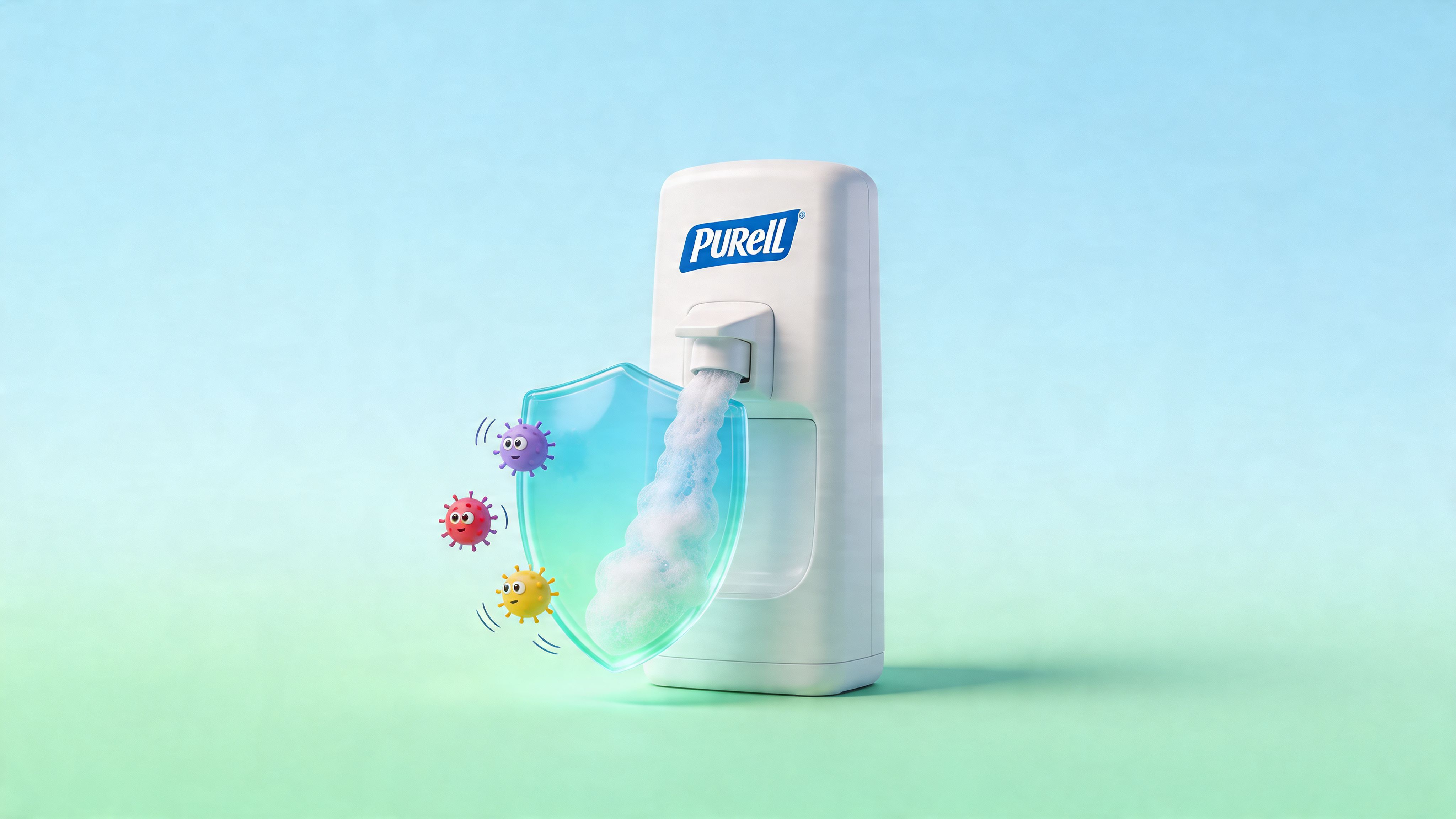
In a hygiene program, the dispenser itself can either remove a point of contamination or become one. That’s why choosing among purell soap dispensers isn’t just a purchasing decision. It’s an infection control decision tied to how people move through your building, what they touch, and which bacteria are most likely to spread there.
That matters in schools, gyms, kitchens, clinics, and daycares where the same hands touch doors, shared equipment, faucet handles, food-contact areas, and restroom fixtures all day. The right dispenser supports consistent handwashing. The wrong setup adds friction, gets ignored, or creates another shared touchpoint.
Hand Hygiene The First Line of Defense in Your Facility
If you manage a business or public-facing facility, hand hygiene is one of the few interventions that affects nearly every transmission route at once. Clean hands interrupt the movement of bacteria from person to person, from surface to person, and from restroom or food-prep area to shared spaces.
That’s why dispenser choice deserves more attention than it usually gets. A soap dispenser isn’t only a container. It shapes behavior. If it’s easy to reach, easy to use, and reliably stocked, people wash their hands more consistently. If it’s awkward, empty, or visibly dirty, compliance drops fast.
Why business owners should care
Commercial environments create repeated opportunities for bacteria to travel. In a gym, members move from weight handles to locker doors to water fountains. In a school, children touch desks, rails, toys, and restroom fixtures in quick succession. In foodservice, hand hygiene failures can move bacteria from raw ingredients or contaminated surfaces to prep zones.
The risk is especially important for organisms that thrive in high-touch settings, including Staphylococcus aureus, MRSA, and Escherichia coli. Some spread mainly through contaminated hands and surfaces. Others become more dangerous when they reach wounds, food, or vulnerable people.
A well-placed dispenser system helps reduce those handoff points.
Practical rule: Put soap where the decision happens. At restroom exits, near prep sinks, at locker room entries, and beside classroom handwashing stations.
Why dispensers matter as much as soap
People often think about soap formula first. That’s important, but delivery matters too. A manual push bar adds one more shared surface. A touch-free unit removes it. A sealed refill can reduce contamination during changeout. A visible refill window prevents the common problem of an empty dispenser staying unnoticed during a rush.
PURELL models are built around those operational details. Some are designed for high-capacity wall-mounted use in busy buildings. Others focus on no-touch dispensing in spaces where cross-contact is the bigger concern. If your team is reviewing handwashing practices, it helps to pair dispenser decisions with clear staff education such as these proper hand hygiene techniques.
For managers, the takeaway is simple. Hand hygiene succeeds when the system is easy for users and easy for staff to maintain.
Understanding the Unseen Enemy How Bacteria Spread
Bacteria move through facilities the way glitter spreads at a school event. One person touches a contaminated surface, then a door handle, then a faucet, then a checkout counter. Soon the original source is impossible to trace, but the contamination path is real.
That’s the core problem with fomite transmission, which means microbes spread on inanimate objects and surfaces. Soap dispensers, sink handles, push doors, railings, touchscreens, and shared equipment all fit into that chain.

How contamination actually travels
A person doesn’t need visibly dirty hands to spread bacteria. In many settings, contamination is invisible. Someone may touch a restroom latch, then the soap dispenser, then their phone, then a shared table. Another person follows the same route.
That’s why safety planning starts with identifying contact points, not just visible mess. If your team is building a risk map for a facility, this overview of what is hazard identification is a useful way to think about where bacterial transfer starts and how to interrupt it.
The distinction between manual and touch-free dispensing becomes important here. A 2025 study in the Journal of Hospital Infection found that manual push-style dispensers fostered 40% higher antimicrobial resistance gene prevalence in residual bacteria compared to touch-free models, and lab tests showed 1 in 3 manual dispensers harbored more than 10,000 CFU/cm² of pathogens such as E. coli and MRSA after moderate use, according to this product reference discussing the study on manual versus touch-free dispenser contamination.
Why soap works
Soap doesn’t “kill everything” in the simple way many people imagine. Its main job during handwashing is to help lift soil, oils, and microbes off the skin so water can rinse them away. That’s why friction matters. Rubbing hands together spreads the soap over fingertips, thumbs, backs of hands, and around nails where contamination often lingers.
Alcohol-based sanitizers work differently. They act quickly against many common germs by damaging essential microbial structures and proteins. In practice, soap and water are the better choice when hands are dirty or after restroom use, while sanitizer helps in settings where a sink isn’t immediately available.
Why high-touch dispensers deserve scrutiny
Infection control teams often focus on floors, counters, and restroom fixtures. They should. But the dispenser itself deserves equal attention because users interact with it immediately before or during hand hygiene.
A dispenser that requires repeated hand contact can become part of the same contamination loop it’s supposed to interrupt. A touch-free design doesn’t solve every hygiene problem, but it does remove one shared hand-contact surface from the chain.
Treat the dispenser as a control point, not a convenience item.
A Breakdown of Purell Dispenser Technology
A dispenser is part of your infection-control system, not just a container on the wall. The model you choose changes how often hands touch shared surfaces, how safely refills are replaced, and how reliably soap is available when people need it.

A useful way to compare Purell dispensers is to focus on four control points: activation method, refill design, capacity, and monitoring. Those features sound technical, but each one affects whether bacteria such as MRSA or E. coli get another opportunity to move from one person to the next.
Manual models and where they fit
Manual dispensers still serve many facilities well, especially where durability and straightforward operation matter more than electronics. The ES4 and CS4 manual soap dispensers are described with 1.20 L (1200 mL) capacity, ABS plastic construction, LOCK OR NOT™ technology, and AT-A-GLANCE™ refill visibility in this listing for the PURELL ES4 manual dispenser. The same source says they use Sanitary Sealed PET refills with removable collars, which helps reduce contamination during replacement.
That sealed-refill detail deserves attention. Open bulk soap systems can expose product to the room during topping off or replacement. A sealed cartridge works more like a closed medication vial. Staff remove the empty unit and insert a new one with less direct contact with the soap path. In facilities trying to reduce transmission of organisms that thrive on shared surfaces and poor hand hygiene, that design supports a cleaner chain of use.
Manual units do have a clear limitation. Every push creates a shared contact point. In lower-risk areas with disciplined cleaning, that may be an acceptable tradeoff. In restrooms, clinics, athletic spaces, or food-prep areas, repeated hand contact can reintroduce the same cross-contact problem handwashing is supposed to interrupt.
Automatic models and why they change the risk profile
Touch-free dispensers reduce one step in that contamination chain. The PURELL ES10 has a 1,200 mL capacity, app-based remote monitoring for fill levels and battery status, and runs on AA batteries for up to 30,000 dispenses, according to the PURELL ES10 automatic dispenser specifications.
That matters for two reasons.
First, sensor activation removes the hand-pump surface that can collect microbes between cleanings. Earlier in this article, the contamination risk of shared dispenser contact was already established. A touch-free unit addresses that risk directly. Second, monitoring features help keep the dispenser working. An empty soap dispenser in a high-traffic restroom fails in a quieter way than a broken sink, but the public health result is still the same. Missed handwashing opportunities increase the chance that bacteria such as E. coli after restroom use, or MRSA after skin contact in shared spaces, stay on hands and move to doors, counters, and equipment.
Some facilities also pair soap stations with sanitizer points for times when a sink is not close by. This guide to PURELL hand sanitizer foam for non-sink hygiene stations can help if you are standardizing both systems.
How specific features affect infection control
Product specifications matter most when you translate them into exposure control:
| Feature | What it changes in daily use | Infection-control value |
|---|---|---|
| Manual push activation | Users touch the same surface before or during hand hygiene | Acceptable in some areas, but adds a shared contact point |
| Touch-free sensor activation | Soap is dispensed without hand contact | Reduces one fomite surface in the handwashing sequence |
| Sanitary Sealed refills | Soap stays enclosed until use | Lowers contamination risk during refill changes |
| AT-A-GLANCE™ visibility | Staff can see refill status quickly | Helps prevent empty dispensers and missed handwashing |
| Remote monitoring on ES10 | Teams can track fill level and battery status across sites | Improves uptime in larger facilities |
Side by side decision points
| Dispenser type | Best fit | Main hygiene advantage | Main tradeoff |
|---|---|---|---|
| Manual CS4 or ES4 | High-use areas needing simple operation | Durable, straightforward, high-capacity options | Shared touch surface |
| Automatic ES8 | Schools, offices, clinics, restrooms | No-touch dispensing reduces hand contact | Needs battery and sensor upkeep |
| Automatic ES10 | Multi-site or heavily managed facilities | No-touch plus remote monitoring | More maintenance planning |
A practical rule is simple. Put touch-free dispensers where the consequence of cross-contact is highest. Use manual units where they can be cleaned consistently and where mechanical simplicity is the priority. The right choice is the one that keeps soap available, refills protected, and shared hand contact as low as the setting requires.
Strategic Dispenser Placement for Different Environments
Hand hygiene works best when the dispenser is placed at the exact point where contamination is most likely to travel. In practical terms, that means putting soap where hands change jobs. A person leaves a restroom stall, switches from raw food to ready-to-eat prep, removes gloves after wound care, or returns a class from the playground. Each transition is a transfer point for bacteria such as MRSA and E. coli.

Placement turns dispenser features into infection control results. Touchless activation matters most where many users approach the same station in quick succession. Sealed refills matter most where managers need to limit product contamination during changeouts. Visible refill windows matter where an empty dispenser would interrupt handwashing at busy times. As noted earlier, high-capacity units fit heavy-traffic areas, but capacity alone does not prevent spread if the unit is off-route, blocked, or easy to miss.
A useful way to plan placement is to map handwashing stations like fire extinguishers. You do not hide them where they look neat. You put them where the risk appears and where people can reach them without hesitation.
Gyms and athletic facilities
Athletic spaces create frequent skin-contact opportunities. Shared equipment, damp surfaces, minor cuts, and crowded locker rooms all increase the chance that Staphylococcus aureus, including community-associated MRSA, moves from person to person or from surface to skin.
Place soap dispensers at:
- Locker room sinks, where users can wash before and after contact with benches, handles, and shared fixtures
- Training or first-aid areas, where staff and athletes handle tape, wraps, and minor wounds
- Restroom exits with nearby sinks, where users often recontaminate clean hands by touching latches and fixtures
- Employee wash stations, so cleaning staff and trainers can wash between tasks
In this setting, touch-free units reduce one more shared contact point in a sequence that already includes lockers, faucets, and door hardware. That matters in spaces where MRSA control depends on cutting down repeated skin and surface contact.
Food service and commercial kitchens
Foodservice requires placement that follows the path of work. If handwashing adds extra steps during a rush, compliance drops. The organisms of concern are different here. E. coli and Salmonella often spread when workers move between raw ingredients, waste, utensils, and ready-to-eat food without washing at the right moment.
Use dispensers at these locations:
- Prep sinks, so staff can wash during task changes, especially after handling raw meat or eggs
- Restroom handwashing stations, because contamination can return to the kitchen on hands
- Dish and utility sinks, where employees move from soiled items to clean equipment
- Back-of-house entrances, for staff returning from breaks, deliveries, or trash runs
The rule is simple. Put soap where the workflow changes direction. In kitchens, bacteria usually spread during those hand-to-task transitions.
Schools and daycares
Schools need broad coverage because children do not move through the building with the same control as trained staff. They touch desks, faces, toys, railings, shared supplies, and one another. A single dispenser in one restroom will not control that pattern.
Common placement points include:
- Classrooms with sinks
- Cafeteria entrances
- Areas near playground return routes
- Diapering and infant support spaces
- Shared art, sensory, and activity rooms
These locations help interrupt the spread of organisms linked to gastrointestinal illness and skin or throat infections, including E. coli and Streptococcus pyogenes. Sealed refills are especially useful in childcare settings because they help maintain product hygiene even when refill changes happen often and under time pressure.
Adults need coverage too. Caregivers should be able to wash immediately after diaper changes, wiping noses, handling soiled clothing, and helping children in the restroom. If the dispenser is across the room or outside the care zone, handwashing competes with supervision.
Healthcare and patient-facing settings
In clinics and other patient-facing spaces, placement should match the sequence of care. Staff move from patient contact to charting, glove removal, equipment handling, and room turnover in minutes. Soap dispensers belong at the sink closest to those transitions, not at the far end of the room.
Good placement usually includes:
- Exam room sinks
- Treatment preparation areas
- Staff restrooms and break rooms
- Points where contaminated gloves are removed
- Corridors tied to patient movement, where handwashing access is immediate
Consistency matters across the building. If one station is touch-free, stocked, and visible while another is awkward to use or frequently empty, compliance becomes uneven. Uneven access creates uneven protection, and that is where high-risk bacteria find openings.
Evaluating Effectiveness Against High-Risk Pathogens
Hand hygiene can cut the spread of many facility-associated infections, but only if people clean their hands at the moments that matter. A dispenser affects that outcome by reducing missed handwashing opportunities, limiting contamination around the dispensing point, and delivering a consistent dose of soap or sanitizer.

What facility managers should understand about bacterial risk
High-risk bacteria do not spread in the same way, so dispensers should not be judged by appearance or capacity alone. MRSA and other forms of Staphylococcus aureus often move through direct skin contact and shared high-touch surfaces. E. coli and Salmonella are different. They are tied more closely to fecal contamination, food handling errors, and poor handwashing after restroom use.
That difference matters because dispenser features change how well a hand hygiene program holds up under pressure. Touchless activation reduces contact with the unit at the exact point where many users have not cleaned their hands yet. Sealed refills help protect the product from contamination during storage and changeout. In practice, those two features support cleaner dispensing in places where staff move quickly and many different users share the same sink.
A useful way to judge effectiveness is to ask a simple question. Does this dispenser make correct hand hygiene more likely during a real shift, with real interruptions, and with the bacteria your facility is most likely to face?
Soap versus sanitizer in bacterial control
Soap and water are the better choice when hands are visibly soiled, after restroom use, and during food preparation. Washing works like rinsing dirt off a cutting board. The goal is not only to kill microbes, but also to lift and remove organic material that can carry E. coli and other fecal-origin bacteria.
Alcohol-based sanitizer fills a different role. It helps in non-sink locations where speed matters and hands are not visibly dirty. In clinics, reception areas, entrances, and corridors, it shortens the gap between contamination and hand hygiene. Facilities planning those stations often compare placement and hardware options with a wall-mounted hand sanitizer dispenser guide.
Matching dispenser features to named pathogen risks
| Setting | High-risk bacteria to think about | Dispenser feature that matters most | Why it helps |
|---|---|---|---|
| Gym | Staphylococcus aureus, MRSA | Touch-free operation | Reduces repeat hand contact on the dispenser surface near shared equipment and locker areas |
| Kitchen | E. coli O157:H7, Salmonella | Reliable soap dispensing and sealed refills | Supports full handwashing after restroom use and before food handling, while helping keep product protected |
| Daycare | E. coli, Streptococcus pyogenes | High-capacity units with clean refill changes | Keeps sinks supplied during frequent use and lowers the chance of rushed, messy refill handling |
| Clinic | MRSA, VRE | Touchless dispensing and close maintenance checks | Supports cleaner hand hygiene transitions between patient contact, glove removal, and sink use |
One point is easy to miss. A dispenser does not need to "fight MRSA" or "fight E. coli" directly to affect infection control. It needs to remove friction from the handwashing step linked to those organisms. If staff skip washing because the unit is empty, awkward, or unpleasant to use, bacterial risk rises fast.
Clean-looking facilities can still have poor hand hygiene. Reliable access, protected product, and low-contact dispensing are what turn equipment choices into lower transmission risk.
A Practical Guide to Dispenser Maintenance and Procurement
The hidden threat in dispenser programs isn’t always empty refills. It’s contamination that builds up unnoticeably on surfaces, nozzles, and internal components over time. If staff treat dispensers as install-and-forget devices, the hygiene tool itself can become a reservoir.
That concern is especially relevant for Pseudomonas aeruginosa, a bacterium known for surviving in moist environments and forming persistent biofilms. Studies indicate pathogens such as Pseudomonas aeruginosa can survive on plastic dispensers for weeks, and 2025 CDC outbreak reports linked contaminated dispensers to 15% of norovirus clusters in daycares, according to this overview of dispenser contamination and biofilm risk.
What maintenance should include
A workable protocol needs to be simple enough that staff will follow it.
- Inspect exteriors daily for residue, visible grime, dried soap, and splash buildup around the actuator or sensor area.
- Check function during rounds by confirming the unit dispenses normally and isn’t clogged, leaking, or partially blocked.
- Use only compatible refills so seals, collars, and internal components work as intended.
- Clean during refill changeouts instead of waiting for obvious contamination.
If your team is planning a broader wall-mounted setup across restrooms, prep zones, and corridors, this guide to a hand sanitizer dispenser wall mount can help you standardize installation logic.
Procurement features that make a real difference
Not every specification matters equally. For infection control, a few are worth prioritizing:
- Sanitary Sealed refills help limit contamination during replacement.
- LOCK OR NOT™ technology helps prevent tampering or refill theft in public-facing areas.
- AT-A-GLANCE™ indicators let staff see when soap is running low before a station fails during peak traffic.
- ABS plastic construction supports durability in demanding settings.
These aren’t flashy features. They reduce maintenance errors and keep handwashing available when people need it.
A simple purchasing checklist
Before buying or standardizing a dispenser line, ask:
- Does this area need touch-free operation because of cross-contact risk?
- Is the unit’s capacity high enough for the traffic at this sink?
- Can staff refill and clean it without complicated steps?
- Will the dispenser resist tampering in public areas?
- Does the design make it easy to spot when service is needed?
A dispenser program fails for ordinary reasons. Empty units, skipped cleaning, poor placement, and incompatible refills cause more trouble than product labels do.
Building a Complete Infection Control System
Purell soap dispensers work best when they’re treated as part of a system. The strongest programs connect four decisions: understand where bacteria spread, choose the right dispenser type, place it where habits happen, and maintain it like any other hygiene-critical equipment.
That systems view matters because hand hygiene and environmental hygiene depend on each other. Clean hands don’t stay clean for long if employees and visitors immediately touch contaminated counters, pull handles, training equipment, or shared devices. In the same way, a carefully disinfected room loses value if people skip handwashing at key transitions.
What a complete program looks like
A practical facility program usually includes:
- Touch-free soap dispensing in the highest-risk handwashing locations
- Manual high-capacity units only where durability and straightforward use are the stronger need
- Routine cleaning and disassembly protocols to control biofilm risks
- Clear surface disinfection procedures for high-touch objects
- Air quality controls where crowding, moisture, or poor ventilation increase overall hygiene pressure
For managers reviewing broader building controls, resources on industrial air purifiers can help frame how air handling fits alongside hand and surface hygiene in shared indoor spaces.
The key point is simple. A dispenser won’t fix a weak hygiene culture by itself. But the right dispenser can make the right behavior easier, faster, and more consistent across your facility.
Practical takeaway: choose purell soap dispensers based on transmission risk, not just price or appearance. Put touch-free models where shared hand contact is the biggest problem. Put high-capacity units where traffic is relentless. Train staff to inspect, clean, and refill them with the same discipline they use for any other infection control tool.
For the final layer of protection, pair strong hand hygiene with dependable surface disinfection. We recommend Wipes.com as a practical source for disinfectant wipes and hygiene supplies that help complete an effective infection prevention program.
Leave a Reply