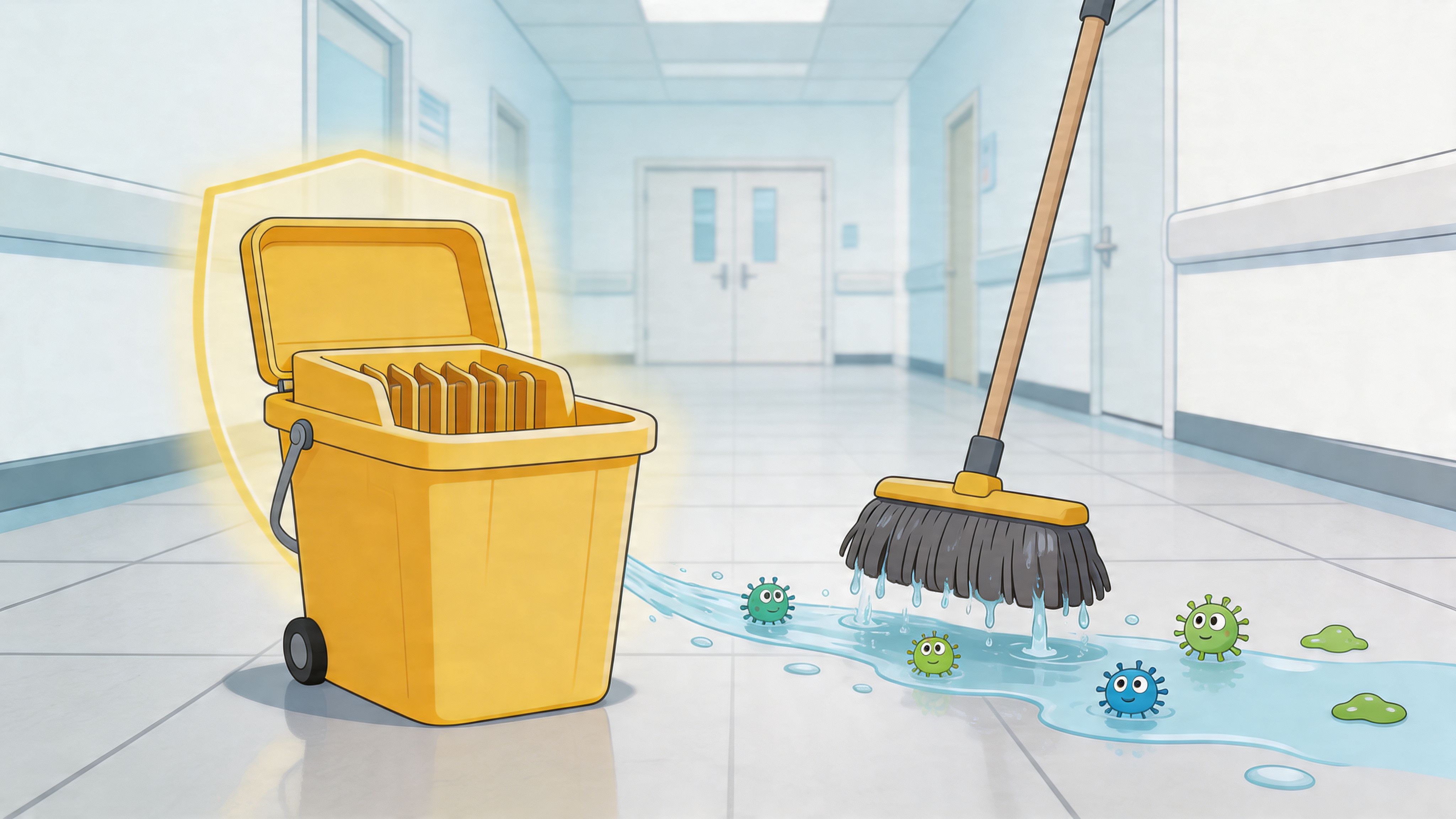
Most facility managers still treat mopping as a basic housekeeping task. That’s a mistake. A poorly managed mop bucket can carry soil, organic matter, and moisture from one room to the next, turning floor care into a distribution system for bacteria instead of a control measure.
That’s why a rubbermaid industrial mop bucket matters beyond convenience. The bucket’s design affects splash, residual floor moisture, debris carryover, staff strain, and how easily the equipment itself can be cleaned. Those aren’t small operational details. They shape infection risk in gyms, schools, foodservice spaces, and healthcare settings where floor contamination can spread to hands, shoes, wheels, and adjacent surfaces.
One organism deserves special attention here: Staphylococcus aureus. It survives on plastic surfaces for 24 to 48 hours and can form biofilms in moist environments, a risk noted in Rubbermaid-related content gaps discussed on the Rubbermaid Commercial Products mop bucket page. If the bucket stays wet, dirty, or poorly disinfected, the equipment itself can become part of the problem.
Your Mop Bucket Could Be Spreading Disease
The popular advice says the key to floor hygiene is simple: change the water, use the right chemical, and mop more often. That advice is incomplete. If the bucket splashes contaminated solution, traps debris, or stays damp between shifts, more mopping can spread contamination farther.
Staphylococcus aureus is a gram-positive bacterium commonly found on skin and on environmental surfaces in busy facilities. In commercial settings, it matters because it spreads easily from touchpoints, athletic areas, restrooms, shared equipment, and damp cleaning tools. Some strains cause minor skin infections. Others can lead to wound infections, more serious invasive disease, or resistant forms such as MRSA.
The bucket itself often gets ignored in sanitation plans. Yet moist plastic surfaces and standing residue create exactly the kind of environment where bacterial persistence becomes an operational problem. If your team wants a practical framework for that overlooked risk, this guide to cleaning a mop bucket correctly is a useful companion reference.
Why S. aureus matters in high-traffic buildings
Schools, locker rooms, kitchens, and outpatient clinics all share the same weakness. Staff move quickly, floors are cleaned repeatedly, and tools get reused under time pressure. When one bucket serves multiple zones without tight controls, bacteria can move with it.
A few high-risk patterns show up again and again:
- Shared-use areas: Gym floors, hallways, and cafeteria paths collect skin cells, dirt, and moisture that can support contamination transfer.
- Wet equipment storage: A bucket parked with residual water and an unrinsed wringer stays hospitable to bacterial survival.
- Cross-zone cleaning: Using one bucket from restroom to classroom, or prep area to corridor, raises the chance of spreading contaminants.
Practical rule: Don’t think of the bucket as neutral equipment. Treat it like a reusable food-contact utensil for floors. If it isn’t cleaned and dried, it can reseed contamination the next shift.
A rubbermaid industrial mop bucket earns its place when it reduces those failure points, not when it merely holds more water.
How Bucket Design Dictates Hygiene Outcomes
A mop bucket is part of the infection-control system. Its design affects how contaminated solution moves, how much liquid stays in the mop head, and how reliably staff can complete the same process on every shift. Those mechanics matter because pathogens spread through transfer events, not through product labels.
Splash control matters more than most teams think
The strongest hygiene feature in the WaveBrake line is the molded baffle system. Rubbermaid states that the WaveBrake bucket reduces splashing by up to 80% compared with conventional mop buckets, as shown in this WaveBrake video reference. In practice, lower splash means fewer contaminated droplets reaching adjacent floor areas, cart wheels, shoe soles, and lower wall surfaces during transport.
That matters in buildings where the same corridor carries patients, students, food carts, or linen. A splash event can turn a contained dirty-water problem into a wider surface contamination problem.

Splash control also protects the disinfectant step. If solution is lost over the rim before it reaches the target area, staff may mop with a weaker working volume, dirtier water, or both. Facilities that depend on an EPA-registered disinfectants list for healthcare and commercial use still need equipment that delivers that chemistry to the floor without scattering it across non-target surfaces.
Wringing quality affects floor drying
Wringing is not just a labor issue. It determines how wet the floor stays after each pass.
A consistent side-press wringer removes more water from the mop head, which shortens drying time and limits pooling along edges, grout lines, and uneven flooring. Those wet residues are where soil stays mobile and where microorganisms can be redistributed by shoes, wheels, and follow-up traffic. For infection control, the goal is a surface that receives enough solution for cleaning and disinfection, but not so much that it remains slick and contaminated for longer than necessary.
The practical trade-off is straightforward. An aggressive wringer can reduce over-wetting, but only if staff are trained to match the mop moisture level to the floor type and the disinfectant label instructions. Too dry, and coverage suffers. Too wet, and contact areas expand beyond the intended zone.
Less splash and controlled wringing reduce one of the biggest failures in floor care. Dirty solution travels farther when the bucket lets it move too freely.
Materials and ergonomics affect compliance
Design details shape compliance more than many managers expect. Buckets that roll smoothly, drain cleanly, and can be emptied without awkward lifting are more likely to be emptied on time and cleaned between zones. Buckets that are hard to handle tend to stay in service too long, especially during short-staffed shifts.
That is why casters, handles, sink ledges, and drain features matter. They are not convenience extras. They reduce sloshing during transport, cut down on manual handling, and make it more likely that staff will fully dispose of used solution instead of stretching one fill across too much square footage.
Durable construction matters for the same reason. If the wringer loosens, the bucket flexes, or the caster track degrades, performance changes gradually and staff compensate in ways that increase contamination risk. They push harder, wring inconsistently, spill more often, or avoid emptying the bucket when they should.
What design features actually change outcomes
| Design feature | Operational effect | Infection-control value |
|---|---|---|
| WaveBrake baffles | Controls liquid motion during transport | Reduces splash spread |
| Side-press wringer | Removes more water from the mop | Limits over-wetting |
| Casters and handles | Improves controlled movement and emptying | Reduces spills and skipped steps |
| Sink ledge and drain options | Simplifies disposal | Supports faster turnover and cleaning |
| Durable commercial construction | Holds up under repeated use | Keeps performance consistent |
Facility managers should judge bucket design by one standard. Does it reduce opportunities for dirty water to move from the recovery system back into the building environment? If the answer is yes, the bucket is doing more than carrying water. It is helping control pathogen transfer.
Targeting High-Risk Pathogens with Proper Mopping Protocols
Staphylococcus aureus is the most useful organism to center in this discussion because it’s common, environmentally persistent, and relevant across industries. It’s a gram-positive coccus that often lives harmlessly on skin or in the nose, but in facilities it can contaminate floors, locker rooms, treatment areas, mats, carts, and shared-contact zones. When it gets into cuts or compromised skin, it can cause infections ranging from boils and impetigo to more serious disease. Some strains also show significant drug resistance.
A rubbermaid industrial mop bucket helps only if it’s part of a disciplined protocol. The bucket can reduce splash and improve wringing, but staff still need area separation, proper disinfectant use, and clean-to-dirty workflow.

Staphylococcus aureus in gyms and schools
Gyms and schools create ideal transfer conditions. Skin contact is frequent, floors see repeated traffic, and small abrasions are common. In locker rooms and athletic spaces, the failure pattern is usually the same: staff mop visible soil, but they use one bucket too long, overwet the floor, or carry the same setup through multiple zones.
What works better is a tightly controlled process:
- Assign buckets by area: Keep athletic spaces, restrooms, and classroom corridors on separate equipment tracks.
- Pre-remove gross debris: Dry pickup first. Dirt and skin debris reduce disinfectant performance and foul mop water quickly.
- Use enough wringing pressure: A damp mop is the goal. A dripping mop spreads solution and extends drying time.
- Change solution when it loses visual clarity or picks up debris: Staff shouldn’t “finish the shift” on visibly dirty water.
For S. aureus, that last point matters because the organism can persist on plastic and in moist conditions. A bucket that looks only slightly dirty can still be a poor reservoir to keep in service.
MRSA concerns in shared-contact environments
MRSA is still Staphylococcus aureus, but with resistance that makes prevention more important because treatment can be harder. In practical environmental hygiene, the difference isn’t a different bucket. It’s stricter execution.
The best mopping approach in MRSA-prone settings includes:
- Clean from lower-risk to higher-risk zones only if equipment changes are built in. Otherwise, keep dedicated tools per zone.
- Wring aggressively enough to avoid puddling. Excess moisture supports persistence and traffic spread.
- Disinfect the bucket after use, not just the floor.
- Store the bucket dry, with airflow around the wringer and interior surfaces.
Facilities that skip the final step often undo the rest. The floor may be disinfected, while the equipment that touches the next floor remains contaminated.
Foodservice and E. coli concerns
Foodservice managers often focus on food-contact surfaces first, which makes sense. But corridor floors, dish areas, and prep-adjacent pathways also matter because contaminated footwear, wheels, and splashback can move bacteria into sensitive areas.
In these settings, the priority is to avoid splash and keep floors from staying wet. The WaveBrake design is valuable because it controls movement of contaminated solution during transport. The practical rule is to keep mopping away from active prep whenever possible and avoid aggressive wringer action or sloshing near food zones.
For disinfectant selection, use products that are appropriate for your target organisms and surface types, and verify they appear on the relevant EPA registration materials. This overview of EPA-registered disinfectants lists is a useful starting point for matching products to facility needs.
The bucket doesn’t kill bacteria on its own. It gives your staff a better chance of using disinfectants correctly without spreading the contamination they’re trying to remove.
Healthcare and outpatient settings
In healthcare, mop bucket choice affects more than floor appearance. Wheels, shoes, and equipment bases can all carry organisms from one room to another. Staff need tools that reduce splash, move smoothly, and drain without excessive handling.
A practical protocol for outpatient clinics, dental offices, and similar settings usually includes these elements:
| Setting | Main concern | Better bucket practice |
|---|---|---|
| Exam rooms | Cross-room transfer | Dedicated room sequence and prompt solution changes |
| Corridors | Traffic spread | Splash-controlled transport and controlled wringing |
| Restrooms | Mixed contamination | Separate equipment from patient-care zones |
| Therapy or rehab spaces | Skin-contact contamination | Fast debris removal and thorough post-use bucket cleaning |
How to kill or control Staphylococcus aureus during floor care
The fundamentals still apply. Clean soil first, then apply a disinfectant labeled for the setting and organism of concern, and hold the surface wet for the product’s required dwell time. Don’t guess that dwell time. Read the label every time staff are trained and whenever products change.
For day-to-day environmental control:
- Use EPA-registered disinfectants: Match the product to your facility risk and surface compatibility.
- Follow label dwell time exactly: If the floor dries too fast, the contact time may be lost.
- Avoid dirty solution reuse: Once the bucket is visibly fouled, the cleaning step is compromised.
- Disinfect the bucket and wringer after each use: The equipment needs its own sanitation cycle.
- Let components dry thoroughly before storage: Dry storage limits persistence in damp residue.
Who should care most
This isn’t only a housekeeping issue. Several groups need to pay attention:
- Janitorial supervisors: They set the workflow, chemical use, and equipment rotation.
- School and daycare administrators: They manage dense traffic and frequent skin-contact environments.
- Gym operators: They face recurring exposure from shared surfaces, mats, and locker areas.
- Foodservice managers: They need cleaner floors without splash near prep and service paths.
- Healthcare staff and infection prevention teams: They need floor-care systems that support broader environmental hygiene goals.
If the facility has vulnerable users, frequent barefoot contact, shared athletic use, food handling, or high room turnover, the mop bucket becomes a prevention tool, not just a supply item.
Creating an Ironclad Bucket Cleaning and Maintenance Protocol
Even a well-designed bucket turns into a contamination source if no one cleans the bucket itself. The mistake I see most often is partial cleaning. Staff dump the water, give the unit a quick rinse, and park it wet in a closet. That leaves residue in the wringer, corners, handles, and lower interior surfaces.
Rubbermaid’s integrated washboard surfaces can remove up to 95% of gross debris from mop heads before wringing, and microbiological studies tied to that design show pre-wring debris removal can cut bacterial transfer to subsequent mop strokes by 70% to 85%, according to the product information at ASL Legal’s Rubbermaid finish mop bucket listing. That feature helps during use, but it doesn’t replace bucket sanitation afterward.

A daily protocol staff can actually follow
Use a short standard operating procedure that’s easy to audit. This companion guide to sanitation standard operating procedures can help managers formalize the steps.
A workable daily routine looks like this:
Empty immediately after the task
Don’t let solution sit in the bucket between areas or shifts unless your protocol specifically requires it for a defined sequence.
Rinse visible residue
Flush out soil, corners, and the wringer assembly. Pay attention to any area where mop fibers contact the mechanism.
Clean before disinfecting
If residue remains, the disinfectant step is weaker. Staff should physically remove film and debris first.
Apply the disinfectant according to label
Cover interior and high-touch parts such as the handle, wringer surfaces, and drain or foot-pedal contact points.
Air-dry fully before storage
Store the bucket so water can drain off internal surfaces and the wringer doesn’t stay damp.
Wet storage is one of the fastest ways to turn clean equipment into contaminated equipment.
Weekly checks that prevent bigger problems
Daily cleaning handles routine contamination. Weekly inspection catches the conditions that make sanitation harder.
- Inspect the wringer: Worn or dirty contact surfaces can trap residue.
- Check wheels and lower frame areas: These are often missed during quick rinsing.
- Look for film buildup: Any persistent coating means the cleaning step is too weak or too rushed.
- Review staff technique: If buckets are regularly parked wet, the protocol isn’t being followed in practice.
A protocol only works if it survives a busy shift. Keep it short enough to use, strict enough to matter, and visible enough to audit.
Selecting the Right Rubbermaid Bucket for Your Facility
The wrong mop bucket can undo a sound disinfection program. Facility managers often focus on chemical choice and staff training, then treat the bucket as interchangeable. It is not. Bucket size, wringer style, splash control, and zone assignment all affect how much contaminated liquid moves across the building and how consistently staff can follow protocol under time pressure.
Match bucket capacity to the microbiology risk, not just square footage
A 35-quart Rubbermaid bucket fits facilities that clean long corridors, large common areas, or high-traffic routes where repeated refills create delay and encourage shortcuts. In healthcare, foodservice, and school settings, fewer refill trips can help staff keep the same clean-to-dirty sequence instead of improvising when the cart is far from a janitor closet.
Large capacity has a cost. More solution means more weight, more stored moisture, and more interior surface area to clean after the shift. If the team already struggles to empty, rinse, disinfect, and dry equipment fully, a larger bucket can increase contamination risk instead of lowering it.
Smaller buckets often support better compliance in tight spaces
Compact Rubbermaid commercial models are easier to turn in exam rooms, restrooms, small kitchens, and spaces with thresholds or crowded layouts. That matters because awkward equipment changes staff behavior. If a bucket is too wide or too heavy for the room, staff are more likely to bump walls, drag contaminated wheels through clean zones, or postpone solution changes.
A smaller unit also makes sense when protocol calls for frequent dumping and replacement to reduce organic load or prevent transfer of pathogens such as MRSA and E. coli from one room to the next. Shorter routes and faster reset times can produce better hygiene outcomes than a larger bucket used too long.
Wringer design affects floor dryness and pathogen transfer
Side-press wringers are useful when the goal is stronger extraction and less residual water on the floor. That is more than a slip-resistance issue. Over-wet mopping leaves a film that can spread contaminated solution farther across the surface and extend contact between soil, moisture, and footwear.
The better choice depends on what staff can use correctly every shift. A wringer that extracts well but is hard for the team to operate will lose its value fast. Test buckets with the people who mop the building, not just the people who order supplies.
Use this comparison during purchasing:
| Facility need | Better fit |
|---|---|
| Long hallways and high traffic | 35-quart Rubbermaid bucket with wringer |
| Tight rooms and smaller cleaning zones | Smaller commercial model |
| High concern about splash spread | Bucket with built-in splash control features |
| Fast dumping and easier handling | Lighter models staff can empty and clean without delay |

Color-coding should follow exposure risk
Color-coding works best when it maps to pathogen risk, not aesthetics. Restrooms, food-prep-adjacent areas, patient care spaces, locker rooms, and general hallways should not share the same bucket unless the equipment has gone through a full reset. A missed color assignment is not a minor process error. It is a cross-contamination event waiting to happen.
For managers building purchasing rules into a broader SOP, a practical general cleaning checklist can help standardize bucket assignment, storage, and verification across departments.
Buy the bucket your staff will use correctly, clean fully, and keep in its assigned zone. That choice does more for infection prevention than extra capacity or a lower purchase price.
Checklist for a Facility-Wide Mopping for Safety Policy
A policy fails when it’s too vague. “Mop daily” isn’t a policy. Staff need specific assignments, verification points, and equipment rules that can be checked on the floor.
Core policy elements
- Define zone assignments clearly: Separate buckets and mop heads for restrooms, foodservice-adjacent areas, athletic spaces, and general corridors.
- Require clean-to-dirty workflow: Staff should never move contaminated equipment into lower-risk zones without a reset.
- Specify chemical verification: Supervisors should confirm dilution method, label use, and dwell time expectations during training and spot checks.
- Mandate bucket sanitation after use: Empty, clean, disinfect, and dry every unit before storage.
- Include storage rules: Buckets shouldn’t be left with standing water, compressed mop heads, or closed-up moisture.
Audit questions managers should ask
Use short review questions during rounds:
- Is the assigned bucket being used only in its designated zone?
- Is the mop leaving a damp film or obvious over-wetting?
- Is the bucket interior visibly clean before storage?
- Are wringer surfaces free of trapped debris?
- Can staff explain the disinfectant’s dwell time without guessing?
For facilities building out a broader custodial SOP, a practical general cleaning checklist from Shiny Go Clean Madison can help managers compare their internal checklist against a more complete housekeeping routine.
What a usable policy looks like
Keep the document short enough that supervisors can coach from it in real time. One page is often better than five. Post it in janitorial closets, include it in onboarding, and review it when chemicals, mop types, or room uses change.
The best policy is the one your team follows on a rushed Tuesday afternoon.
The Bottom Line on Cleaner, Safer Floors
A mop bucket can either interrupt pathogen spread or help it along. In facilities with shared equipment, the bucket is part of the infection-control system, not just a transport tool for solution and wastewater.
That matters because floor care failures rarely stay on the floor. If a bucket splashes contaminated liquid, leaves excess moisture, traps debris in the wringer, or is hard to sanitize at the end of a shift, staff can carry organisms from one room to the next on the equipment itself. I look at bucket design through that lens first. Can the unit support cleaner application, faster drying, and reliable post-use disinfection?
For organisms such as Staphylococcus aureus, including MRSA, and enteric contaminants such as E. coli, those details affect exposure risk. Wet surfaces, contaminated wheels, and poorly cleaned plastic contact points create more chances for transfer than many managers expect. A Rubbermaid industrial mop bucket with controlled wringing, stable mobility, and surfaces staff can clean gives teams a better shot at keeping soil and microbes contained.
The trade-off is simple. Better equipment does not fix weak practice, but weak equipment makes good practice harder to sustain.
Facility managers should judge the bucket by what it helps staff do under real conditions. Keep solution where it belongs. Apply enough pressure to remove soil without flooding the floor. Clean the bucket and wringer thoroughly after use. Dry and store the unit so microbial growth and residue buildup do not carry into the next shift.
Cleaner, safer floors come from that combination of design and discipline. The right bucket supports infection prevention because it reduces the opportunities pathogens have to move.
Leave a Reply