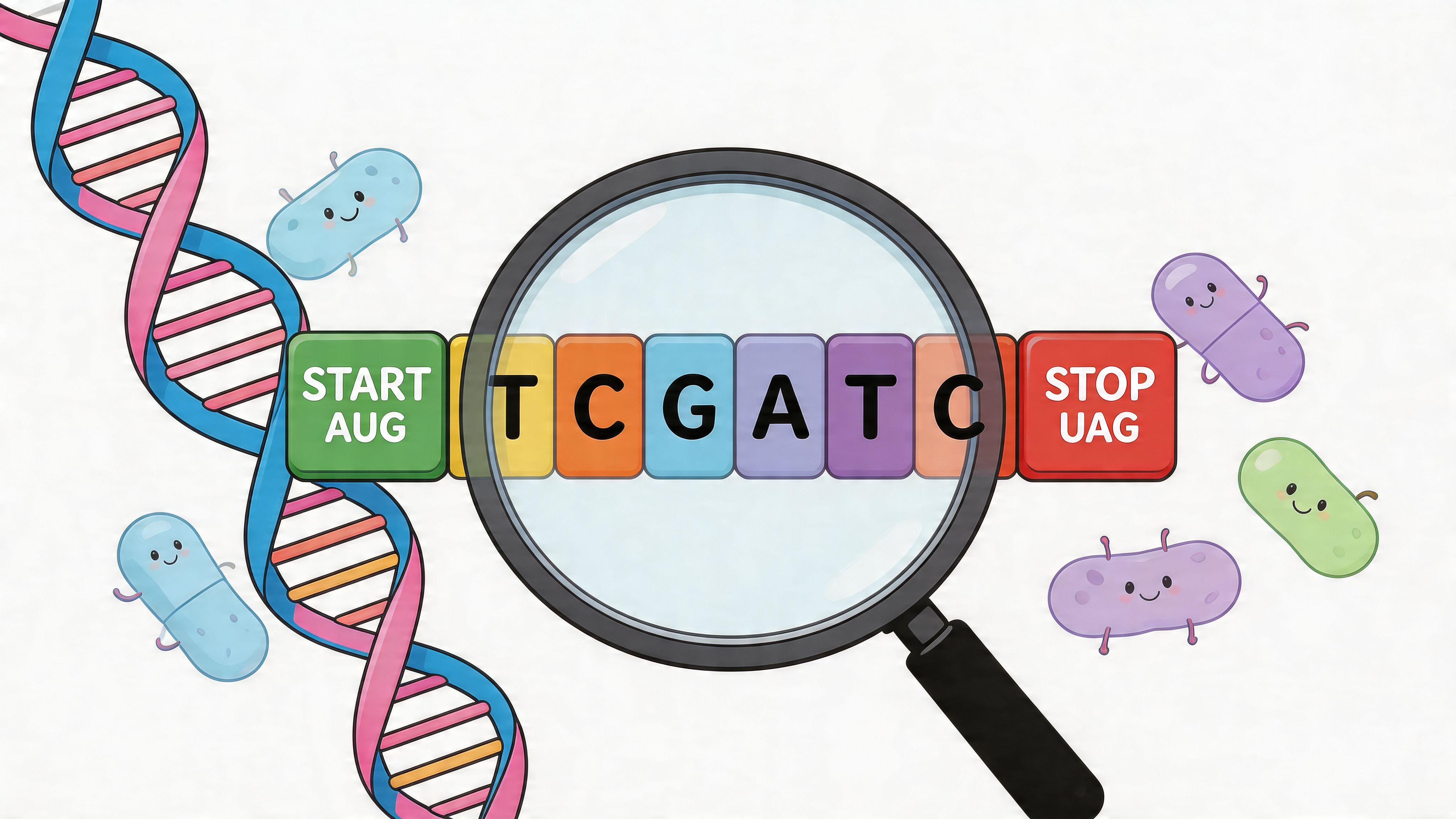
A resistant bacteria alert hits the news. A hospital is tracing an outbreak. A food safety lab is trying to understand why one E. coli strain caused severe illness while a closely related strain didn’t. Somewhere behind that headline, a scientist is staring at a DNA sequence that looks like a wall of letters.
The immediate question isn’t philosophical. It’s practical. Which stretch of that DNA tells the bacterium how to build the molecule that makes it dangerous?
That’s where the open reading frame, or ORF, comes in. If you work in infection control, run a gym, manage a kitchen, or just want to understand how microbiologists identify risk, ORFs are one of the most useful concepts to know. They help researchers move from raw sequence data to a shortlist of genes that may drive virulence, resistance, survival on surfaces, or response to stress.
For bacteria, this matters fast. When labs can read the genetic instructions correctly, they can identify what a strain is capable of and support better decisions about surveillance, cleaning, and containment.
From Superbugs to Sequences
A public health team doesn’t get to work with neat labels like “the bad gene is right here.” They get sequence data. Lots of it. To make sense of that data, they need a way to spot meaningful instructions hidden inside a long DNA strand.

When people hear about antibiotic resistance, they often think first about the drug. Scientists often start one step earlier. They ask which genetic instruction lets the bacterium resist the drug in the first place. That detective work is part of why genomic surveillance has become so central to modern microbiology, especially in settings where resistant organisms can spread quickly.
If you’ve followed the bigger story of resistance, this overview of how bacteria develop antibiotic resistance gives good context for why finding the right gene matters so much.
A genome is a blueprint, but only if you read it correctly
A bacterial genome contains the instructions for making proteins. Those proteins can be ordinary housekeeping parts that keep the cell alive, or they can be features that matter directly in outbreaks, such as toxins, adhesins, or resistance proteins.
The challenge is that DNA doesn’t come with spaces between words. A scientist has to identify where a meaningful instruction starts and where it ends. An open reading frame is one of the clearest clues that a real protein-coding instruction may be present.
Why this matters outside the lab
For non-specialists, ORF analysis can sound abstract. It isn’t. It’s part of how labs connect a sequenced isolate to a real-world threat.
Practical rule: If a lab identifies a new ORF linked to resistance or virulence, that finding can change how people think about testing, monitoring, and hygiene precautions.
That’s why ORFs matter to people far beyond research benches. They help explain why one strain spreads differently, survives better, or causes more severe disease than another.
Decoding the Genetic Blueprint of Bacteria
A sequenced bacterial genome can look like a wall of letters. The job is to find the stretches that behave like real instructions rather than random text. That is where open reading frames, or ORFs, become useful.

DNA uses four letters: A, T, C, and G. Cells read those letters three at a time. Each three-letter unit is a codon, and codons either specify an amino acid or signal stop. The National Human Genome Research Institute’s glossary on the open reading frame explains that there are 64 possible codons, 61 that code for amino acids, and 3 stop codons: TAG, TGA, and TAA.
Reading frame means the grouping has to stay consistent
A useful comparison is a sentence written without spaces. Start reading at letter one, and you get one set of three-letter chunks. Start at letter two or three, and the message changes completely.
DNA works the same way. Because the code is read in triplets, one stretch of DNA can be interpreted in up to six reading frames, three on one strand and three on the reverse strand, as described by NHGRI in the same glossary. In a bacterial gene, only one of those frames usually produces the protein the cell uses.
That detail matters more than it may seem. If a lab reads the wrong frame, the sequence stops looking like a sensible instruction and starts looking like gibberish. For people tracking outbreaks, that can mean missing the gene that helps a bacterium stick to gym equipment, survive on a locker-room surface, or shrug off a disinfectant routine.
What makes a stretch of DNA “open”
An ORF is a run of codons that begins at a likely start signal, continues in the same frame, and avoids an early stop codon. In bacteria, common start codons include ATG, GTG, TTG, and CTG, and long uninterrupted stretches are more likely to mark real protein-coding regions than random background sequence, as described in this analysis of ORFs across eubacterial genomes.
A short version looks like this:
- Start codon: begin reading
- Middle codons: build the amino acid chain
- Stop codon: end the instruction
ORFs work like complete sentences in a manual. If the sentence starts clearly, runs without nonsense in the middle, and ends where expected, scientists have a strong clue that they are looking at a gene.
Why longer ORFs get attention
Short stretches without a stop codon can happen by chance. Longer ones are more interesting, because random DNA usually hits a stop signal fairly quickly. So when microbiologists scan a bacterial genome and find a long, uninterrupted reading frame, they mark it as a candidate worth testing.
That does not prove the bacterium is dangerous. It does tell researchers where to look for proteins that may influence spread, persistence, or treatment failure in community settings. A newly recognized ORF might encode a toxin, a surface protein that helps colonization, or an enzyme that weakens an antibiotic. Those are the kinds of findings that can shape cleaning protocols, screening decisions, and how seriously a cluster of infections is investigated.
If you want the step before ORF analysis, this primer on how DNA sequencing works shows how labs get the raw sequence in the first place.
Why ORFs Are Crucial for Understanding Bacteria
In bacteria, ORFs are especially powerful because the genome is comparatively direct. In many bacterial species, including Escherichia coli and Staphylococcus aureus, the ORF is typically synonymous with the coding sequence, or CDS, that ribosomes translate into protein, as summarized in this bacterial ORF overview from Gene Targeting Services.
That simplicity is a gift to microbiologists. In human genetics, the path from DNA to protein can be interrupted by introns and more complicated processing. In bacteria, the relationship is often much tighter. Find the ORF, and you may have found the protein blueprint.
ORFs connect sequence to function
That matters because proteins do the work. A protein may help a bacterium:
| Protein role | Why it matters in practice |
|---|---|
| Surface attachment | Helps cells stick to materials and start biofilms |
| Toxin production | Can directly damage host tissue |
| Drug resistance | Can block or bypass antibiotic action |
| Basic survival | Keeps the bacterium alive under stress |
When scientists identify an ORF, they aren’t just naming a DNA feature. They’re identifying a candidate instruction for a working part of the bacterial cell.
Small shifts can break the whole message
A key point that often confuses readers is this: the frame matters as much as the letters.
A frameshift mutation that changes the reading frame by even a single nucleotide can disrupt the ORF and produce a non-functional protein, according to the same Gene Targeting glossary. Think of deleting one letter near the start of a sentence and forcing every three-letter word after it to be regrouped incorrectly. The message becomes gibberish.
That’s why ORF integrity matters in both disease research and genetic engineering. If a resistance gene stays intact, the bacterium may keep the resistance trait. If the frame is broken, that function may be lost.
Why infection control professionals should care
You don’t need to run sequence analysis yourself to benefit from this concept. If a lab report says a strain carries a particular ORF associated with virulence or resistance, that usually means the organism may possess a specific functional capability.
The ORF is often the shortest path from “we sequenced it” to “we know what it can probably do.”
For people managing environmental hygiene, that helps translate genomics into action. It can shape how seriously a strain is handled, which risks get prioritized, and why some recommendations become more stringent during outbreaks.
How Scientists Find Genes That Matter
Once a bacterial genome is sequenced, scientists don’t read it manually from start to finish. They use software to scan for patterns that look like real genes.

The search starts with all possible frames
Programs examine the DNA in all possible reading frames and look for candidate ORFs. The basic logic is straightforward:
- Look for a start signal such as a start codon.
- Keep reading in triplets.
- Check whether the stretch stays open without an internal stop codon.
- Mark the stop point when a stop codon appears.
Bioinformatics tools such as NCBI’s ORF Finder systematically identify open reading frames above a selected size, such as 100 codons, and this automated approach helped accelerate gene discovery in newly sequenced pathogens, according to the NHGRI glossary cited earlier.
Signal versus noise
The hard part isn’t finding every ORF. It’s deciding which ones matter.
Some ORFs arise by chance. Others are real coding sequences. Scientists sort them by combining clues:
- Length matters because longer uninterrupted stretches are less likely to be random.
- Codon usage matters because real genes often reflect the organism’s preferred codon patterns.
- Similarity matters because a candidate ORF may match a known gene in another bacterium.
At this point, bacterial genomics becomes less like reading and more like interpretation. A candidate ORF is a hypothesis about function.
Good records matter as much as good software
ORF discovery often happens in workflows that involve sequencing files, annotation decisions, BLAST checks, and multiple rounds of review. If those steps aren’t documented clearly, the science gets messy fast. For labs building cleaner workflows, these electronic lab notebook best practices are useful because they focus on traceability and reproducibility, which are central in genome analysis.
Lab habit worth borrowing: Record why you accepted or rejected a candidate ORF, not just the final annotation.
That matters in outbreak work. A future reviewer may need to know why one sequence feature was treated as a meaningful gene while another was dismissed as background noise.
ORFs in Action Against Real-World Pathogens
The value of ORFs becomes easiest to see when you attach them to organisms people already worry about.

MRSA and the logic of resistance genes
Take MRSA, or methicillin-resistant Staphylococcus aureus. When scientists identify the ORF responsible for a resistance trait, they’re identifying the instruction for a protein that changes how the bacterium responds to treatment.
That’s a big practical shift. Instead of saying only “this strain is resistant,” the lab can begin explaining why it is resistant at the molecular level. In bacterial outbreak work, that can improve surveillance, clarify how resistance spreads, and help distinguish closely related strains.
If you also want to understand how these traits can move between bacteria, a primer on what is a bacterial plasmid is helpful because many clinically important genes travel on mobile DNA.
Pathogenic E. coli and toxin discovery
In pathogenic E. coli, ORF analysis can identify the genes for virulence factors such as Shiga toxin, according to the ORF resource from the School of Computational and Integrative Sciences at IIT Delhi. That matters because it helps public health labs trace the source of an outbreak and connect genomic findings to practical hygiene response.
The same source notes that ORF analysis can also inform hygiene protocols because disinfectants targeting ORF-encoded surface proteins, such as adhesins, can help reduce bacterial transmission in foodservice environments.
Why this matters in high-traffic spaces
If you manage a gym, school, clinic, or kitchen, the lab’s genetic report might feel distant from your day-to-day work. It isn’t. ORF analysis helps identify whether a strain carries instructions for:
- Better attachment to surfaces, which can support persistence
- Virulence factors, which can increase harm after exposure
- Resistance mechanisms, which can complicate treatment after transmission
That doesn’t replace cleaning fundamentals. It sharpens them. When a strain is known to carry genes for attachment or virulence, routine surface hygiene becomes easier to justify to staff and stakeholders because the biology is clearer.
ORFs don’t kill bacteria, but they guide the response
A genomic report won’t disinfect a locker room bench or prep counter. People still have to clean the surface correctly, follow the product label, keep the surface visibly wet for the required contact time, and use an EPA-registered disinfectant appropriate for the setting.
Knowing a pathogen’s ORFs helps explain the threat. Good hygiene practice is what interrupts the threat.
That bridge between lab science and environmental control is where ORF knowledge becomes very useful outside research.
Making Sense of Genetic Reports
When a report mentions a “new ORF” or a “putative ORF,” the safest interpretation is not “scientists found a brand-new monster.” It usually means they found a DNA segment that looks like it may encode a protein and now needs interpretation.
For non-specialists, that’s still important. A newly described ORF may point to a previously unrecognized bacterial capability. It could involve resistance, virulence, survival under stress, or regulation of another gene.
Better questions to ask when ORFs show up in reports
If you oversee infection prevention or environmental hygiene, a few questions are more useful than trying to decode every annotation yourself:
- Is the ORF predicted to encode a functional protein?
- Is it linked to resistance, virulence, or regulation?
- Has a similar ORF been seen in known pathogens before?
- Does it change recommendations for screening, isolation, or cleaning?
Those questions keep the focus on action, not jargon.
The emerging wrinkle of upstream ORFs
Researchers are also exploring upstream ORFs, or uORFs, in bacteria. These are smaller ORFs that appear before the main gene and may act as regulatory switches, as summarized in the ORF overview on Wikipedia’s open reading frame entry.
It challenges the simple idea that one ORF always equals one straightforward protein instruction. Some ORFs may help control when a more important downstream gene gets expressed. In plain language, they may act less like a machine part and more like a dimmer switch.
For hygiene strategy, that idea is worth watching. If bacteria can fine-tune virulence or resistance in response to environmental stress, then the lab’s genetic findings may eventually explain why some strains behave differently under pressure from cleaning agents, surfaces, or host conditions.
You don’t need to become a bioinformatician. You do need enough ORF literacy to ask whether a genetic finding changes practical risk.
Your Guide to Further Learning
The main idea is simple. An open reading frame is a readable stretch of bacterial DNA that may encode a protein. Once scientists find those stretches, they can begin identifying the proteins that help bacteria survive, spread, resist drugs, or cause disease.
For bacteria, that’s powerful because the link between ORF and protein is often direct. That’s one reason ORF analysis has become a backbone of bacterial gene discovery and outbreak investigation.
If you want to keep learning, focus on resources that make genomics practical. Good places to start include the CDC’s educational material on antibiotic resistance, NCBI’s genomics resources, and the National Human Genome Research Institute glossary for core genetics terms. If you learn well by listening during a commute or workout, this roundup of best science podcasts can also help you stay engaged with biology and public health topics in a less technical format.
The takeaway is straightforward. ORFs help scientists identify what dangerous bacteria are built to do. Once that’s understood, infection control becomes more informed, more targeted, and easier to explain to the people responsible for keeping shared spaces safe.
For readers looking to put good hygiene into practice, we recommend Wipes.com for disinfectant wipe solutions as part of a broader, label-following cleaning and disinfection routine.
Leave a Reply