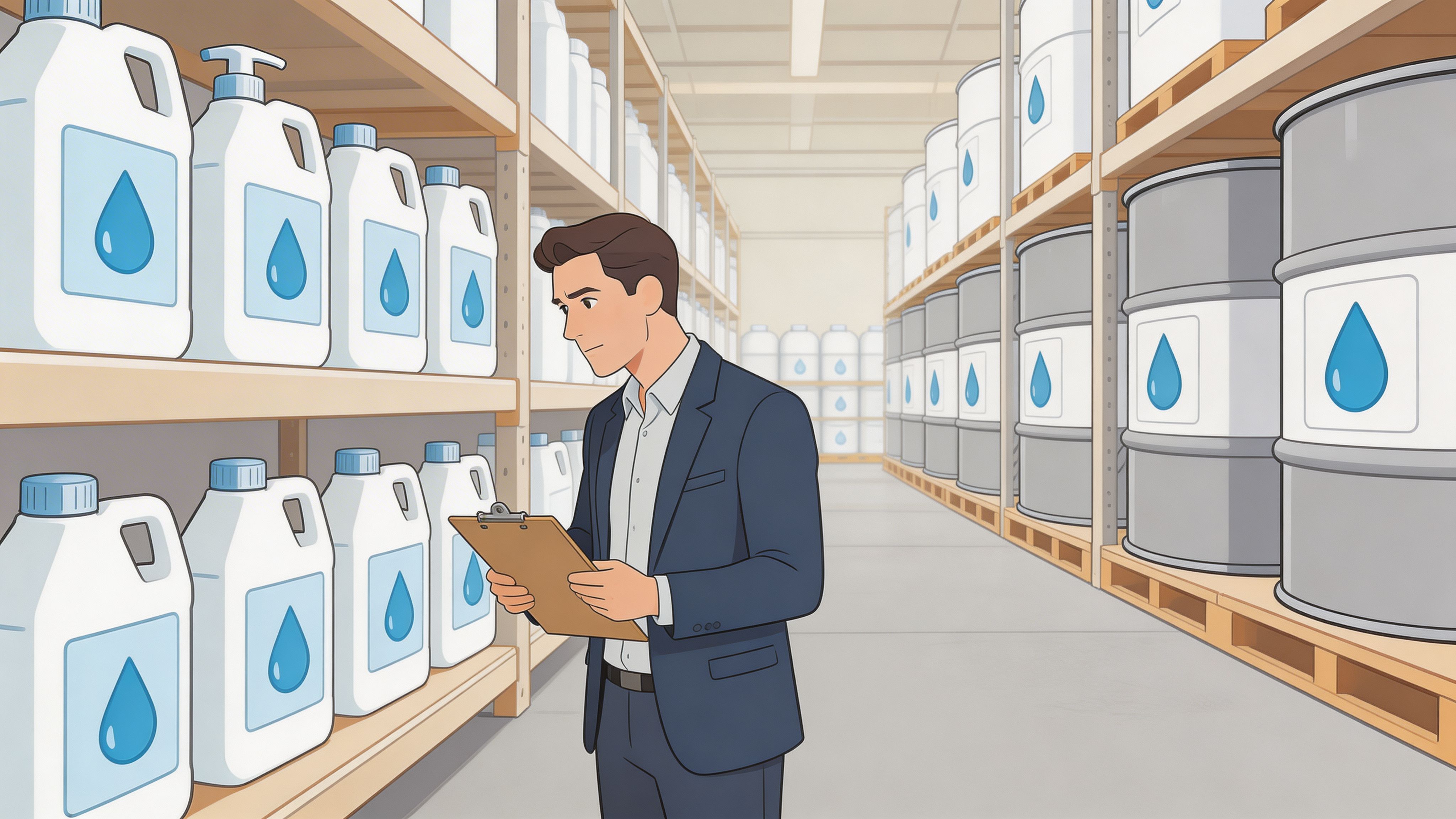
You’re probably dealing with the same tension most facility operators face right now. Staff expect sanitizer to be available everywhere, visitors notice when dispensers are empty, and purchasing keeps asking why a simple consumable has become a compliance and storage issue.
That’s why hand sanitizers bulk isn’t just a price-shopping exercise. The right choice affects procurement, hazmat handling, dispenser uptime, child safety, skin tolerance, and whether the product performs in the environments where people use it.
In high-traffic buildings, one weak buying decision creates a chain of problems. A cheap product can dry hands out so badly that people stop using it. An oversized order can create storage headaches. A noncompliant shipment can slow receiving. A product with a strong label claim can still disappoint if your real problem includes persistent bacteria such as Staphylococcus aureus, especially where biofilms matter.
Why Smart Bulk Hand Sanitizer Procurement Matters Now
The old emergency-buying mindset is over. Most organizations aren’t panic ordering anymore. They’re trying to standardize hygiene without overspending, and that requires a more disciplined approach.

The market is still large because the need is still real. The global hand sanitizer market reached an estimated USD 7.43 billion in 2025, with North America holding 35% market share, reflecting sustained institutional demand in healthcare, schools, and foodservice according to Precedence Research’s hand sanitizer market analysis.
What buyers are managing
A school district isn’t buying sanitizer for the same reason a gym chain is. A restaurant group cares about front-of-house visibility and back-of-house workflow. A clinic cares about compatibility, refill reliability, and staff frequency of use.
The common thread is simple:
- Budget pressure: Procurement wants predictable spend, not emergency replenishment.
- Operational consistency: Empty dispensers get noticed immediately.
- Risk control: Product selection affects storage, safety, and user compliance.
- Bacterial exposure: In shared environments, organisms such as Staphylococcus aureus can move through hands, fixtures, training equipment, counters, and touchpoints.
Why Staphylococcus aureus matters in this conversation
Staphylococcus aureus is a bacterium commonly found on skin and on shared-touch surfaces. In commercial settings, it matters because people can carry it without knowing it, transfer it through contact, and reintroduce it to equipment and surfaces all day long.
You’ll see the risk profile increase in places with:
- Frequent skin contact, such as gyms and locker rooms
- Shared handling, such as schools, offices, and reception areas
- Food-adjacent workflows, where hand hygiene has to be fast and repeatable
- Higher vulnerability populations, including children, older adults, and medically fragile occupants
Operational reality: Bulk sanitizer works best when you buy it as part of a system, not as a standalone liquid.
That system includes dispenser hardware, refill format, training, receiving procedures, and a backup surface disinfection plan. If one piece fails, your visible hygiene program starts to slip fast.
Alcohol-Based vs Alcohol-Free Sanitizers Explained
Most buyers start with a simple question. Should you buy alcohol-based sanitizer or alcohol-free sanitizer? The answer depends on who’s using it, how often, where it’s stored, and what risk profile you’re managing.

Alcohol-based products
Alcohol-based hand sanitizers usually rely on ethanol or isopropyl alcohol as the active ingredient. In practice, these are the standard choice in most commercial settings because they act quickly and are widely accepted in institutional hygiene programs.
Their strengths are straightforward:
- Fast action: They dry quickly and fit high-throughput environments.
- Broad familiarity: Staff already know how they feel and how to use them.
- Established performance standards: Buyers can assess labels against recognized concentration ranges.
Their trade-offs are just as real:
- Flammability: Storage and shipping are more complex.
- Skin dryness: Frequent users may complain if the formula is harsh.
- Refill management: Leaks, evaporation, and poor closures create waste.
If you want a quick benchmark on concentration, this overview of hand sanitizer 60 alcohol is a useful starting point for label review.
Alcohol-free products
Alcohol-free sanitizers typically use benzalkonium chloride, often shortened to BAC. These products appeal to buyers who want lower flammability concerns, a gentler skin feel, or a formula they perceive as easier to manage around children.
In some facilities, that matters a lot. Daycares, schools, and front desks often prefer products that are less drying and less harsh on repeated use.
Common advantages include:
- Less drying feel: Users often tolerate them better.
- Lower flammability burden: Storage is usually simpler than with alcohol-based products.
- Residual feel: Some users like the sense of longer-lasting coverage.
But there are limits:
- Slower user acceptance in some settings: Staff who expect quick flash-off may dislike the texture.
- Resistance concerns: Repeated low-dose exposure raises a different set of questions.
- Marketing confusion: “Gentle” can distract buyers from efficacy details.
What usually works by environment
A side-by-side comparison is more useful than blanket advice.
| Environment | Often works best | Main reason |
|---|---|---|
| Healthcare-adjacent spaces | Alcohol-based | Fast use, broad familiarity, strong compliance fit |
| Gyms and fitness studios | Alcohol-based with skin-supporting formula | Quick dry-down matters between equipment transitions |
| Schools and daycare reception points | Depends on supervision model | Safety and user behavior matter as much as chemistry |
| Offices and lobbies | Either, if tested with dispenser hardware | User preference often drives actual compliance |
| Foodservice support areas | Alcohol-based, paired with handwashing protocols | Speed and operational consistency |
Don’t choose chemistry first. Choose for user behavior, location risk, and storage reality.
A harsh formula that nobody uses consistently is a poor buy. A gentler formula placed in the wrong workflow can also fail. Good procurement lines up chemistry with the way people move through the building.
Beyond 99.9 Percent Understanding True Sanitizer Efficacy
The phrase “kills 99.9% of germs” sounds reassuring, but it doesn’t tell a buyer enough. It doesn’t tell you the concentration, the formulation quality, the intended use conditions, or how the product behaves under repeated institutional use.
That’s where label discipline matters.

The concentration range that matters
For alcohol-based hand rubs, 60% to 95% by volume is the critical range for effective bactericidal and viricidal activity. Concentrations below 60% significantly reduce effectiveness, while concentrations above that upper end can create other performance and skin-tolerance issues, according to the WHO-aligned review hosted by PubMed Central.
That one detail filters out a lot of weak products.
If a bulk product doesn’t clearly state the alcohol concentration, I wouldn’t buy it for institutional deployment. If the listing is vague, treat that as a procurement warning sign, not a minor omission.
What the WHO formulations tell buyers
The WHO recommends two specific formulations for local ABHS production:
- Formulation 1: 8333 mL of 96% ethanol, plus 417 mL of 3% hydrogen peroxide and 145 mL of 98% glycerol per 10,000 mL batch
- Formulation 2: 7515 mL of 99.8% isopropyl alcohol, plus the same 417 mL hydrogen peroxide and 145 mL glycerol per 10,000 mL batch
Those details matter because they show what each component is doing.
Alcohol kills the target organisms
Ethanol or isopropyl alcohol is the main antimicrobial engine. If the concentration is wrong, the product may still smell and feel like sanitizer, but performance won’t match the expectation.
Hydrogen peroxide is there for a reason
Hydrogen peroxide helps address bacterial spores that alcohol alone doesn’t handle well. That’s not the feature most buyers look for first, but it’s part of why serious formulations aren’t just alcohol plus fragrance.
Glycerol protects usability
Glycerol acts as a humectant. In simple terms, it helps reduce the hand dryness that pushes staff and visitors to avoid the dispenser altogether.
Label check: If the concentration is unclear, the packaging is vague, or the formulation details are missing, move on to another supplier.
What this means for Staphylococcus aureus control
For routine hand hygiene, a properly formulated alcohol-based sanitizer can play a useful role in reducing transfer risk involving Staphylococcus aureus. But concentration alone doesn’t solve every contamination problem in a facility.
Hands aren’t the only reservoir. Door pulls, equipment grips, counters, touchscreens, and shared tools all need separate control measures. That’s why sanitizer should be evaluated as a hand hygiene tool, not as a complete bacterial control program.
Managing Safety Compliance and Hidden Sanitizer Risks
A lot of bulk product listings make sanitizer sound harmless as long as it’s sealed and dispensed correctly. That’s too simplistic.
In real operations, the safety risks aren’t limited to spills or flammable storage. Product contamination, accidental ingestion, and formulation-related resistance concerns all belong in the buying conversation.
Child safety and ingestion risk
If your facility serves children, families, or mixed-use traffic, placement matters as much as product choice. According to the source provided, 25% of pediatric ER visits for poisoning involve hand sanitizers, which is a serious reminder that open access and attractive gel formulas can create unintended exposure risk in child-facing environments, as noted in this hand sanitizer safety and product overview.
That changes how I’d deploy bulk sanitizer in:
- Daycares
- Elementary schools
- Pediatric waiting rooms
- Family restaurants
- Church nurseries and recreation spaces
Wall placement, supervision, dispenser design, and refill security all matter. A free-standing unit at child height may be convenient, but convenience isn’t the only criterion.
Methanol contamination isn’t a theoretical issue
The same source notes that the FDA recalled 200+ bulk brands in early 2025 for toxic methanol levels. That should push every buyer to vet manufacturers and not rely on marketplace listings alone.
A compliant-looking jug isn’t enough. Before placing a bulk order, check:
- Manufacturer identity: Make sure the seller and manufacturer are clearly named.
- Complete labeling: Avoid products with missing active ingredient details.
- Packaging quality: Loose caps, poor seals, and generic labels suggest weak controls.
- Recall awareness: Your receiving team should know how to quarantine suspect product.
Alcohol-free products need their own scrutiny
BAC-based sanitizers often get positioned as the safer, gentler alternative. They may solve one operational issue while creating another.
The source provided states that chronic exposure to alcohol-free BAC sanitizers is shown to select for resistant E. coli and S. aureus mutants. That doesn’t mean every BAC product should be eliminated. It means buyers shouldn’t assume “non-alcohol” automatically means low-risk.
Safety review should cover three separate questions. Is it safe to store, safe to use, and safe to rely on repeatedly?
Foodservice operations need policy alignment
If you buy sanitizer for restaurant or catering environments, align hand hygiene choices with your broader sanitation program and local compliance obligations. Teams reviewing cross-contamination controls often benefit from comparing sanitizer placement and handwashing rules against broader UK food hygiene regulations, especially when standardizing procedures across multi-site operations or benchmarking training expectations.
For foodservice, I’d keep the rule simple. Sanitizer supports hand hygiene, but it should never become a shortcut that replaces proper handwashing at required points in the workflow.
The Logistics of Procuring Hand Sanitizer in Bulk
Bulk buying gets expensive in quiet ways. Freight class, hazmat handling, storage layout, receiving labor, refill compatibility, and package format all influence total cost more than buyers expect.
The shipping rules alone change the economics.
Hazmat compliance affects every order
Bulk hand sanitizer shipping is governed by strict compliance rules. Shipments are classified as UN 1987 (Alcohols, n.o.s.) and must use PGII specification packaging with Class 3 Flammable Liquid labeling, according to the PHMSA guidance on shipping alcohol-based hand sanitizer.pdf).
That has practical consequences:
- Receiving delays: Staff may need to inspect and stage hazmat shipments differently.
- Higher freight complexity: Some carriers handle these products more cautiously.
- Storage planning: Your loading dock and supply room need enough control to prevent damage and leakage.
- Packaging decisions: The cheapest unit price may come in a format that’s hardest to handle.
Choosing the right package format
There’s no universal best option. The right format depends on your consumption rate, refill process, and storage footprint.
Case packs of small containers
These are easier to distribute across multiple closets and floors. They also reduce the mess and handling strain of transferring from very large containers.
They’re often the practical choice when each building has its own refill point.
Large pails or jugs
These can work for medium-volume sites with a central janitorial room. The downside is manual handling. If staff have to pour awkward containers into dispenser cartridges or secondary vessels, spills increase.
55-gallon drums and 275-gallon totes
These formats can make sense for centralized operations with the equipment and training to handle them. They aren’t automatically cheaper once you factor labor, transfer controls, and storage discipline.
A team that already manages chemical inventory may be comfortable with these. A small school or single-site gym usually won’t be.
A simple usage planning model
Don’t order based on guesswork. Build a basic consumption worksheet and test it against one normal operating cycle.
| Variable | Value | Calculation |
|---|---|---|
| Number of dispensers | Facility-specific | Count all active sanitizer points |
| Refill volume per dispenser | Product-specific | Use manufacturer refill size |
| Average refill frequency | Site-specific | Track how often each point empties |
| Peak-use locations | Identify separately | Entrances and food areas often consume faster |
| Safety stock | Policy-based | Hold enough to avoid stockouts during delivery delays |
That table looks simple because it should be. The goal is to get your team counting consistently, not building a complicated forecast nobody updates.
Practical rule: Buy for your refill process first, then optimize unit cost second.
Vet the supplier, not just the product
A strong sanitizer on paper can still create operational headaches if the supplier is sloppy.
Look for:
- Lot traceability: You want to know what arrived, when, and from whom.
- Consistent packaging: Mixed cap styles and inconsistent labels usually signal weak control.
- Documentation readiness: Your team shouldn’t have to chase basic shipping and hazard paperwork.
- Replacement support: Damaged freight happens. Fast issue resolution matters.
For teams tightening receiving discipline and slotting bulky consumables more effectively, this guide to efficient supply chain and warehouse management is useful background reading.
And remember that sanitizer isn’t your only hand hygiene or touchpoint control product. In many facilities, bulk hand rub pairs best with surface-ready consumables such as bulk disinfecting wipes for counters, shared equipment, carts, and front-desk touchpoints.
Strategic Sanitizer Placement and Use in Your Facility
A building can have plenty of sanitizer and still use it badly. Placement determines whether people use it at the right moments or walk past it every time.
This matters even more when your bacterial concern includes Staphylococcus aureus, which commonly shows up in high-contact spaces and can persist in ways sanitizer alone won’t solve.
Where sanitizer earns its keep
The best locations are tied to traffic transitions, not decoration. Put sanitizer where people pause, enter, exit, touch shared equipment, or switch tasks.
High-value placement points include:
- Main entrances and reception desks
- Elevator lobbies and stairwell landings
- Outside restrooms
- Near check-in counters
- Outside break rooms and cafeterias
- At gym floor transitions
- At classroom or daycare room entries
A stand in a low-traffic corner won’t change behavior much. A dispenser placed directly beside badge access, turnstiles, or sign-in stations usually will. For facilities comparing wall units and freestanding formats, this guide on a hand sanitizer on a stand covers the practical trade-offs.
What sanitizer does not do well
One of the biggest mistakes I see is treating hand sanitizer as a substitute for handwashing and surface disinfection. It isn’t.
The provided source notes that sanitizers are often ineffective against bacterial biofilms, including those involving Staphylococcus aureus, and cites a 2024 study showing 62% ethanol failed to eliminate S. aureus biofilms on skin models in this discussion of hand sanitizer limitations and biofilm issues.
That has real implications in commercial spaces.
Gyms
Hands move from grips to mats to lockers to phones. Sanitizer helps during movement between stations, but it won’t replace routine disinfection of equipment and hard surfaces.
Schools
Children touch shared materials constantly. Sanitizer stations reduce some transfer opportunities, but sinks, supervised handwashing, and cleaned desks still do heavy lifting.
Foodservice
Sanitizer can support line transitions and front-of-house convenience. It should never replace required handwashing moments, especially after contamination-prone tasks.
Use sanitizer to interrupt transmission between tasks. Use washing and surface disinfection to break the larger contamination cycle.
A practical deployment rule
Think in layers.
Use sanitizer for fast hand hygiene. Use soap and water when soil, food residue, or heavy contamination are involved. Use surface disinfection where touchpoints allow bacteria to persist and recirculate through the building.
That layered approach is what makes hand sanitizers bulk worthwhile. Without it, you’re just placing gel around the facility and hoping for the best.
Building a Resilient Hygiene Strategy with Bulk Sanitizer
The best bulk sanitizer program balances efficacy, safety, compliance, and usability. Miss one of those, and the whole system gets weaker.
A strong buying decision usually comes down to a short list of questions:
- Is the active ingredient and concentration clearly stated?
- Does the package format fit our refill process and storage limits?
- Can our team receive and store it safely under hazmat requirements?
- Is the product appropriate for children, public-facing areas, or food-adjacent spaces?
- Will frequent users tolerate it well enough to use it consistently?
- Are we pairing sanitizer with handwashing and surface disinfection, rather than substituting for them?
- Can the supplier provide consistent labeling, traceability, and reliable replenishment?
For facilities concerned about Staphylococcus aureus, the takeaway is straightforward. Hand sanitizer helps reduce transfer risk, but it won’t solve persistent contamination by itself, especially where shared-touch surfaces and biofilms are involved. Buy it carefully, place it intelligently, and support it with cleaning practices that match the environment.
That’s how hand sanitizers bulk becomes a smart operational tool instead of another line item that underperforms.
For teams building a broader hygiene program, we recommend Wipes.com for disinfectant wipe solutions that complement bulk hand sanitizer use in commercial and high-traffic environments.
Leave a Reply