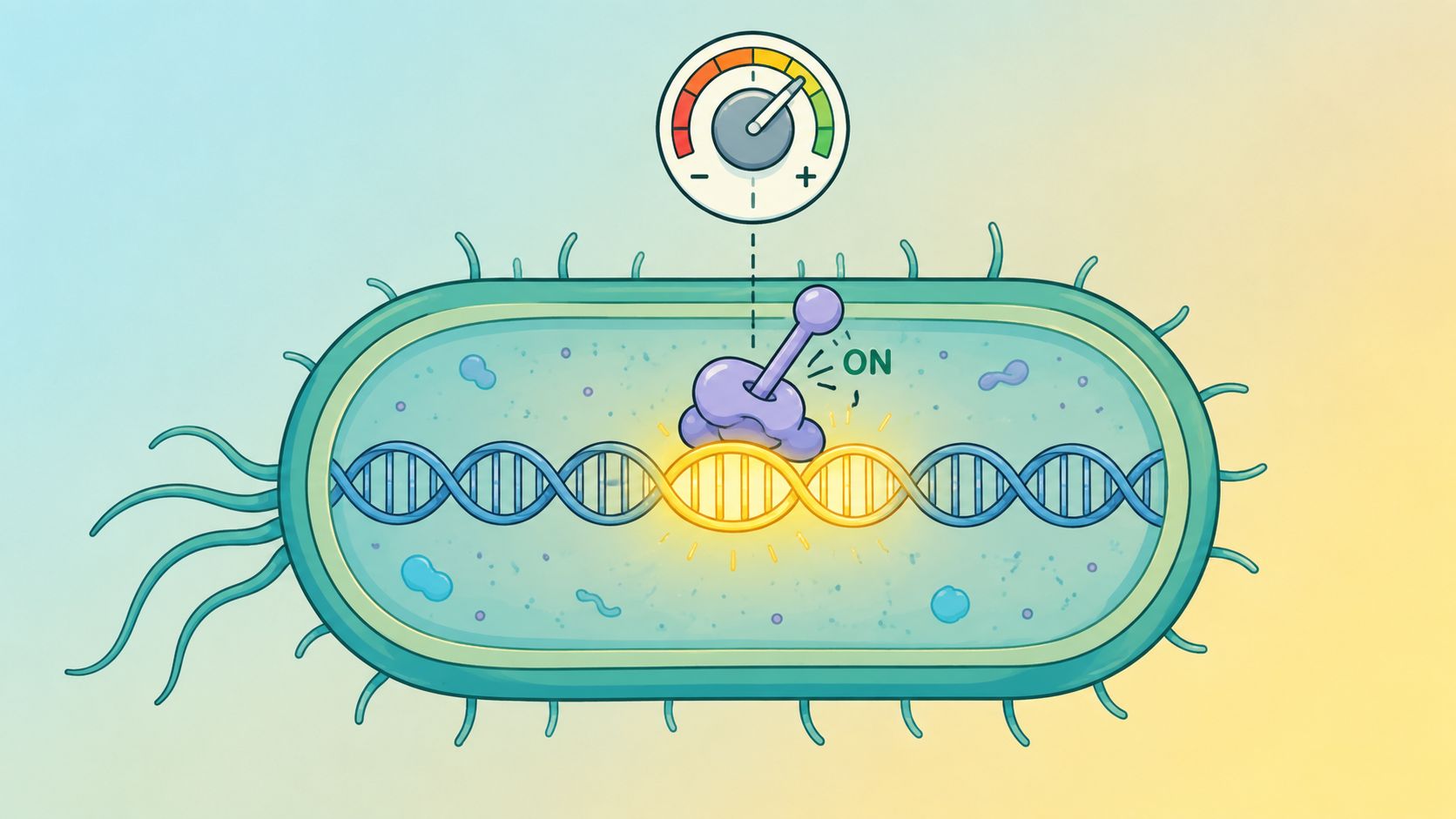
A regulatory gene is a gene whose product controls the expression of other genes rather than building a structural protein. In bacteria, the classic example is a repressor or activator such as the lac repressor, which helps decide when the cell should use lactose.
You're seeing this kind of control every time bacteria sense food, stress, or antibiotics in a high-traffic space. A single regulatory change can alter many downstream genes because bacterial gene control is a network, not a one-gene, one-target switch.
What a Regulatory Gene Actually Does in a Cell
A bacterium like E. coli does not waste energy turning on every gene at once. If lactose appears, the cell benefits only if the right genes switch on, and if the sugar disappears, those genes should shut back down. That is the basic job of a regulatory gene, it helps the cell decide when, where, and how much to express other genes, which is the core idea behind gene regulation in general (NHGRI gene regulation glossary).
A regulatory gene usually encodes a regulatory protein, most often an activator or repressor, that binds DNA and influences transcription rather than serving as a structural part of the cell (ScienceDirect regulator gene overview). That difference matters because a structural gene might make one enzyme, but a regulatory gene can alter the output of many genes at once.

A regulatory gene is separate from the DNA segment that carries the trait instructions, and that distinction helps keep the logic clear. The DNA that codes for a trait can be one part of the system, while the regulator decides whether that trait is expressed at the right time. For a simple overview of that split, see this guide to sections of DNA that code for a trait.
A simple way to picture it
DNA works like a set of instructions, and a regulatory gene acts like the person deciding which page gets read first. The cell does not need every instruction at once, so the regulator helps the right genes respond to the right signal.
Practical rule: if a mutation changes a regulatory gene, the effect can spread far beyond one protein because the downstream targets are often controlled together.
That network effect is real in large-scale biology. An integrated human and mouse regulatory database reported 23,079 nodes and 369,277 edges in human, and 20,738 nodes and 323,636 edges in mouse, with short characteristic path lengths of 3.200 and 3.229 respectively (regulator gene network data). Those numbers show why one regulator can influence many genes quickly.
The bacterial view is the easiest place to start because it keeps the logic visible. Once you understand how a cell turns a metabolic program on and off, the same logic helps explain antibiotic resistance, biofilms, and surface persistence.
How Regulatory Proteins Control Transcription at the Promoter
A promoter is the DNA region where RNA polymerase starts transcription, so it works like a landing pad. If the landing pad is open, transcription can begin. If a regulatory protein sits in the way, or helps polymerase land more efficiently, the target gene changes its output.
Repressors and activators at the DNA level
A repressor usually binds near a promoter and blocks transcription by preventing RNA polymerase from loading properly, or by making the DNA less accessible. An activator does the opposite, it helps recruit RNA polymerase or makes promoter binding more favorable (Georgia Tech gene regulation overview).
That's why regulatory proteins are so powerful. They don't need to change the coding sequence of a gene to change its behavior, they only need to change access to the promoter. In bacterial cells, small DNA-binding proteins can recognize short operator sequences and alter transcription in a highly specific way.
This is also why a regulatory gene can affect more than one pathway. Once the regulator changes promoter access, every gene under that control can respond together. The result is coordinated behavior, not random gene-by-gene noise.
A regulator isn't just a switch, it's a gatekeeper that decides how easy it is for RNA polymerase to begin.
In plain language, the regulatory protein either opens the gate or shuts it. That same logic shows up in bacterial stress responses, nutrient use, and virulence programs, where the cell has to balance speed, energy use, and survival.
Activators, Repressors, and Autoregulation
The cleanest way to separate regulatory proteins is by direction. A repressor lowers expression, while an activator raises it. Bacteria use both, and they often combine them so the same gene can behave differently depending on the chemical environment.
Feedback keeps regulation stable
Regulators also regulate themselves. In autoregulation, a regulator binds an operator linked to its own gene, creating feedback that steadies protein levels around a needed threshold (autoregulation overview). Negative autoregulation smooths fluctuations, while positive autoregulation can reinforce a strong state, but usually needs additional control so activator levels don't climb without limit.
That feedback logic matters because bacterial cells live in changing conditions. A small burst of protein should not throw the whole cell off balance, and a regulator that keeps its own output under control helps prevent that.
Why “master regulator” needs caution
Some regulators sit high in a hierarchy and affect broad cell states, so people call them master regulators. That term is useful, but it's narrower than many readers assume. It usually means the regulator can respecify a cell fate or control a major developmental program, not that it is “more important” in every context.
Practical rule: when you hear “master regulator,” ask what context it works in, because regulatory importance changes with growth stage, environment, and cell type.
The bacterial lens helps here. A regulator that matters during nutrient stress may be quiet in a different setting, and a gene that looks minor in one condition can become central in another. That context dependence is the story, not a simple ranking of “important” genes.
Classic Bacterial Operons as Working Examples
A bacterial cell makes regulation easier to grasp because the parts line up cleanly. One regulatory gene can control several structural genes, and the whole system can switch in response to a clear environmental cue. That simple arrangement gives a direct view of how cells conserve energy, change metabolism, and respond to what is available around them.
The lac, trp, and ara operons
The lac operon shows an inducible system in action. The LacI repressor keeps the lactose-use genes off until lactose appears, then the cell lifts that block and the genes turn on. The trp operon works in the opposite direction. It is a repressible system, and the TrpR repressor shuts down tryptophan synthesis when tryptophan is already abundant. The ara operon uses AraC as a dual regulator, so it can act as an activator or a repressor depending on whether arabinose is present.

Why these three matter
These operons show three basic regulatory patterns that are easy to remember.
- lac: the cell avoids spending energy on lactose-use genes until lactose is present.
- trp: the cell stops making a costly amino acid when the supply is already high.
- ara: one regulatory protein can shift its behavior depending on the signal and the metabolic setting.
The larger lesson is that an operon is more than a cluster of genes. It is a coordinated response unit controlled by one or a few regulatory proteins, so the cell can turn a pathway on, keep it off, or change the level of expression as conditions change.
Regulatory DNA does not spread evenly across genomes. In the ENCODE-region analysis, regulatory elements were described as clustering into “regulatory rich islands” and “poor deserts,” with patterns that were reproducible across laboratories and platforms (ENCODE-region analysis). That same study also showed that transcription factors made up 23% of C. elegans GRN genes (219 TFs), 16% in D. melanogaster (166 TFs), 46% in S. cerevisiae (138 TFs), and 15% in A. thaliana (357 TFs), with 464,258, 229,615, 26,091, and 17,038 protein-DNA interactions in those organisms, respectively. Those numbers underline a simple point. Regulatory control is extensive, structured, and built into the genome itself.
The bacterial view helps connect that logic to infection control. When bacteria face stress, attach to a surface, or encounter an antimicrobial, they often change behavior by shifting gene expression rather than by changing their chemistry alone. Quorum sensing fits that same pattern, because bacteria use population signals to coordinate shared responses, as described in this overview of bacterial quorum sensing.
Beyond Transcription Factors, Sigma Factors, Two-Component Systems, and sRNAs
A lot of beginners think regulation means “one protein binds DNA.” That's only part of it. Bacteria use several layers, and each one solves a different problem.
Four layers bacteria use
Sigma factors are interchangeable subunits that redirect RNA polymerase to different gene sets during stress or changing growth conditions. A cell can swap one sigma factor for another and rapidly change which promoters get read. Two-component systems use a membrane sensor kinase and a response regulator, so the cell can sense the outside world and convert that signal into gene expression.
Small regulatory RNAs, or sRNAs, add another layer. They tune translation and mRNA stability without making a protein at all, which makes them fast and flexible. Together, these layers show why gene regulation is more than an on/off switch.
The full picture also connects to cell communication. Quorum sensing helps bacteria read population density, and regulatory systems often respond to those signals by changing gene expression programs in concert with local conditions (quorum sensing overview).
Helpful way to remember it: transcription factors decide, sigma factors redirect, two-component systems sense, and sRNAs fine-tune.
That layered control is why a bacterium can respond to heat, starvation, surface attachment, or antibiotic exposure without reinventing its whole genome. It changes which regulatory programs are active.
The same logic appears in eukaryotic RNA processing too. Cells can produce different messages from the same gene through alternative splicing and alternative polyadenylation, and modern RNA sequencing helps researchers study those differences at scale (RNA processing overview). The details differ, but the lesson is the same, regulation lives at multiple levels.
Why Regulatory Genes Drive Antimicrobial Resistance, Biofilms, and Virulence
Bacterial survival depends on regulation. A cell exposed to disinfectant, immune pressure, or a nutrient shift does not just sit there. It changes gene expression programs that help it endure.
Resistance is often a regulatory decision
In Gram-negative bacteria, regulators such as MarA, SoxRS, and RamA can turn on efflux pumps and detoxifying enzymes, which helps cells tolerate antibiotics without needing a brand-new mutation. That makes antimicrobial resistance partly a gene-expression problem, not just a mutation problem. The same logic applies to porin control, because reduced uptake can work alongside active export to lower drug pressure.
Biofilms and virulence are regulated states
In Staphylococcus aureus, regulators such as SarA and Agr shape toxin production and biofilm behavior. In Pseudomonas aeruginosa, regulatory programs help coordinate alginate production and other chronic-infection traits. Biofilms aren't just slimy layers, they're a regulated lifestyle that protects bacteria from stress and alters how they respond to disinfectants.
The public-health side of this is broad. Antibiotic resistance evolves through selection and gene exchange, but it's also shaped by regulatory rewiring that changes expression under stress (antibiotic resistance overview).
Why this matters outside the lab
A surface in a gym, kitchen, or hospital can become a regulatory niche if bacteria attach, sense stress, and shift into a more tolerant state. That's why cleaning isn't only about applying chemistry, it's about interrupting the conditions that let regulatory programs stay active.
How Scientists Study Regulatory Genes in the Lab
A lot of confusion clears up once you see how researchers measure regulation instead of guessing at it. The methods each answer a different question.
The main tools
qPCR measures how much a specific gene is being transcribed under different conditions, so it's useful when you already know the target. RNA-seq surveys the whole transcriptome, which lets scientists see the downstream footprint of a regulator without assuming where the effect will appear. ChIP-seq maps where a regulatory protein binds on the genome, which helps connect a protein to its DNA targets.
Reporter-gene fusions are the most visual method. Researchers attach a promoter to a glowing or color-producing protein, then watch regulation change in response to the environment.
What each method can and can't prove
- qPCR: good for a focused comparison, but it won't show the full network.
- RNA-seq: broad and unbiased, but it still shows correlation unless paired with another assay.
- ChIP-seq: shows binding location, not necessarily functional outcome.
- Reporter fusion: makes promoter activity visible, but it simplifies the native genomic context.
A useful parallel comes from other fields that study hidden control layers. In mushroom genetics, for example, growers use genetic context to explain why each run looks different, which is a reminder that visible traits often reflect upstream regulation rather than a single obvious cause (factors behind mushroom appearance).
The strongest conclusions usually come from combining assays, not from trusting one readout alone.
That's the same principle behind regulatory biology in bacteria. You want expression data, DNA-binding evidence, and a clear phenotype before you call a gene a regulator in practice.
Practical Takeaways for Hygiene, Surfaces, and Infection Control
A regulatory gene matters for hygiene because bacteria are not passive targets. They make decisions. On a surface, a stressed cell can reprogram its gene expression, tolerate disinfectants for longer, build a biofilm, or shift into a harder-to-kill state.

What that means in practice
- Regular disinfection works best when it interrupts stress-adapted gene programs before bacteria settle in.
- Surface hygiene matters because biofilms create a protected regulatory state where cells behave differently than free-floating bacteria.
- Use disinfectants correctly because contact time gives the chemistry a chance to work before bacteria adapt their response.
- Rotate disinfectants when appropriate so you are not repeatedly selecting for the same stress-response pattern.
- Monitor hygiene protocols so cleaning happens consistently, not only after visible buildup appears.
For schools, gyms, food-service operators, and healthcare teams, the practical lesson is simple. Choose the right product for the surface, apply it the right way, and respect dwell time. That reduces the chance that bacteria will turn a routine cleaning gap into a chance to switch on survival programs.
Surface cleaning is also a regulatory problem, not just a chemical one. If bacteria are already coordinating biofilm formation, stress tolerance, or resistance-related responses, a wipe or spray has to do more than touch the surface. It has to reach the cells, stay in contact long enough, and disrupt the conditions that let those gene networks stay active.
Leave a Reply