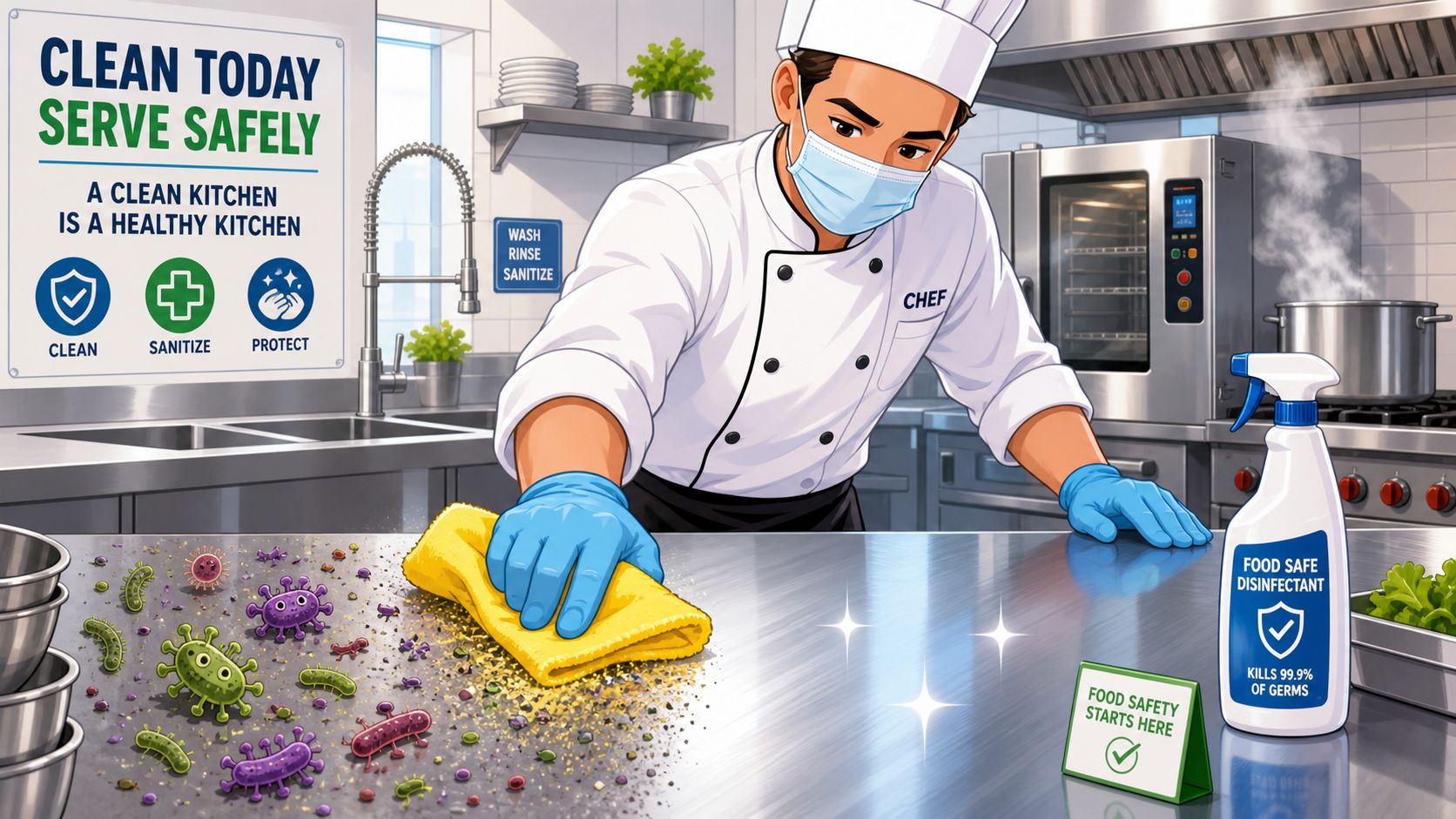
Around 2.4 million cases of foodborne illness are estimated to occur each year in the UK. In a commercial kitchen, that risk shows up in ordinary failures. Raw poultry juice on a prep sink, a slicer cleaned without enough detergent action, a drain biofilm feeding Pseudomonas, or a sanitiser wiped off before the label contact time is met.
Commercial kitchen cleaning is a health control that has to be managed by risk. The standard is not whether a surface looks clean. The standard is whether soil was removed, the right disinfectant was used at the right dilution, it stayed wet for the full contact time, and the result was checked.
That risk-based approach matters because different hazards behave differently. Salmonella moves easily from raw meat areas to hands, utensils, and ready-to-eat food contact points. E. coli O157:H7 demands tighter control anywhere raw beef, produce, and prep surfaces intersect. Pseudomonas and other moisture-loving organisms persist in drains, sink overflows, ice machine components, and other wet zones that staff often treat as low priority.
The kitchens that stay under control assign cleaning by zone, product, method, and verification step. They identify high-risk surfaces, separate cleaning from disinfection, replace cloths and tools before they spread contamination, and test whether the process worked. They also treat sanitation as part of wider facility protection. protecting your Southeast Texas restaurant from pests belongs in the same prevention plan because food residue, standing water, and neglected structural areas support both microbial growth and pest activity.
Why Kitchen Cleaning Is a Critical Health Control
Grease, food residue, standing moisture, and hand contact create perfect transfer routes for pathogens. In a working kitchen, bacteria don't stay in one place. Raw product, utensils, handles, sink fixtures, cloths, mop heads, and staff hands connect the whole room. A clean-looking line can still carry contamination if detergent never removed the soil or if the disinfectant dried too fast to work.
Operators run into difficulty when they focus on appearance instead of kill mechanics. Stainless steel can shine and still fail a sanitation check if the product used wasn't suited to the surface, wasn't left wet long enough, or was applied over residue.
Practical rule: If a surface still has grease, protein, starch, or visible debris on it, it isn't ready for disinfection.
The stakes aren't limited to pathogens. Poor sanitation invites pests, clogs drains, accelerates grease buildup, and creates fire risk around cooking equipment and extraction systems. That's why sanitation and facility protection need to work together. For operators reviewing the broader risk picture, protecting your Southeast Texas restaurant from pests is part of the same prevention mindset that keeps contamination from spreading through the building.
Commercial kitchen cleaning works best when it's treated like any other critical control. The task has to be defined, assigned, verified, and repeated. If nobody owns drain cleaning, high-touch points, sanitizer prep, and end-of-shift breakdowns, they won't happen consistently. When that slips, the microbiology wins.
Identifying Key Bacterial Threats in Your Kitchen
Most commercial kitchens don't face one "germ problem." They face a pattern of different organisms tied to different surfaces, ingredients, and behaviors. The most useful way to think about commercial kitchen cleaning is to match the bacterium to the zone.

Salmonella enterica
Salmonella enterica is a foodborne pathogen strongly associated with raw poultry, eggs, and contaminated food contact routes. In kitchen practice, it matters most where raw proteins are handled badly or where equipment isn't fully cleaned between tasks.
Watch the usual transfer points:
- Cutting boards and prep tables that move from raw to ready-to-eat work
- Knife handles and refrigerator pulls touched during prep
- Sink areas where splashback moves contamination to nearby surfaces
- Cloths and wiping tools that spread residue instead of removing it
When Salmonella control fails, the cause is usually basic. A rushed turnover, an understrength cleaning step, or a sanitizer applied to a dirty board.
Escherichia coli O157:H7
Escherichia coli O157:H7 is a pathogenic strain of E. coli associated with severe intestinal illness. In food service settings, think raw meat, contaminated produce, slicers, prep sinks, and cold-side assembly stations where staff assume low heat risk means low contamination risk.
This organism is why surface sequence matters. If staff trim raw product, wipe the counter, and immediately start ready-to-eat assembly on the same area, they've created a contamination event whether they can see it or not.
For countertop-specific methods, how to disinfect kitchen countertops gives a practical surface-by-surface approach that fits commercial prep flow.
Staphylococcus aureus
Staphylococcus aureus is different from many foodborne organisms because people often bring it into the kitchen. It's commonly carried on skin and in the nose. The highest-risk surfaces are the ones people touch repeatedly while moving fast: faucet handles, cooler handles, touch points on small equipment, apron contact areas, and shared tools.
This is one reason hand hygiene alone isn't enough. If staff wash hands but keep touching the same contaminated handles and controls, the cycle restarts.
Food contact surfaces aren't the only problem. The route from hand to handle to hand to food is one of the most persistent failures in kitchen sanitation.
Pseudomonas aeruginosa and other wet-zone organisms
Pseudomonas aeruginosa deserves special attention because it thrives in wet zones and forms biofilms. Sinks, drains, splash areas, and faucet bases are classic harborage points. Standard wipe-down habits often don't touch the actual problem because the organism lives inside residue layers and protected niches.
These are the spots teams ignore because they look "not too bad." That's exactly why they stay contaminated.
MRSA and high-traffic crossover risk
Commercial kitchens are also high-traffic environments, not sealed laboratories. MRSA and CA-MRSA Genotype USA300 are frequently found in high-traffic commercial environments, including food service areas, where they can survive on dry surfaces for extended periods, and visible soil must be pre-cleaned before disinfection because organic matter can neutralize active ingredients and shield bacteria from destruction according to the EPA archive material on resistant organisms and surface disinfection.
That matters for shared touch surfaces, break areas, cleaning carts, service corridors, and back-of-house contact points. It also reinforces a hard truth: disinfectant doesn't cut through dirt. If the pre-clean is poor, the kill step is compromised before it starts.
Mastering the Two-Stage Cleaning and Disinfection Protocol
The industry benchmark is simple to state and easy to get wrong: clean first, then disinfect. The accepted approach uses hot water and detergent to remove grease and residue, followed by a food-safe disinfectant or sanitizer meeting BS EN 1276 or BS EN 13697 standards. Audits show 68% of kitchens apply disinfectants for less than the required contact time, which undermines efficacy against organisms such as Staphylococcus aureus and E. coli as outlined in this review of commercial kitchen cleaning essentials.
Why the first stage matters
Detergent cleaning does the physical work. It lifts fat, protein films, flour dust, carbonized residue, and other soil that blocks chemical action. If staff skip this stage, they don't just leave the surface dirty. They create a barrier between the disinfectant and the target organism.
That's why a one-step spray-and-wipe routine often fails on active prep lines and around cooking equipment. The chemistry may be sound, but the surface condition isn't.
Contact time is the make-or-break step
A disinfectant label isn't a magic shield. The product has to stay visibly wet for the required dwell time. If it flashes off early or gets wiped immediately, the surface may be cleaner but not properly disinfected.
In practical terms:
- Pre-clean first: Remove visible debris, grease, and dried-on residue
- Apply enough product: The surface must remain wet, not just lightly misted
- Wait the full label time: Don't wipe early because service is about to restart
- Use clean tools: Dirty cloths and reusable towels can redeposit contamination
Field advice: The most common sanitation mistake isn't choosing the wrong chemical. It's wiping the right chemical off too soon.
Commercial Kitchen Disinfectant Comparison
| Disinfectant Type | Effective Against | Typical Contact Time | Pros | Cons |
|---|---|---|---|---|
| Bleach solutions | Broad surface disinfection when label directions are followed | Product-dependent | Familiar, widely used | Can require rinsing on food contact surfaces, concentration control matters |
| Quaternary ammonium compounds | Common kitchen sanitation tasks when label-approved | Product-dependent | Common in food service, easy routine use | Reduced performance if surfaces aren't properly cleaned first |
| Hydrogen peroxide or peroxide-based products | Broad disinfection with some food-contact-compatible formulations | Product-dependent | Some products allow no-rinse drying after label contact time | Surface compatibility and label details must be checked |
| EPA-registered wipes | Depends on the organism listed on the product label | Product-dependent | Convenient for high-touch points and fast tasking | Easy to under-wet the surface or miss full dwell time |
Staff also need the right protective gear and handling discipline. If you're updating supplies, Quality cleaning and safety gloves can support safer chemical handling and reduce hand-to-surface transfer during sanitation work.
The trade-off is straightforward. Fast cleaning feels efficient, but incomplete cleaning creates repeat contamination, failed inspections, and unsafe food contact surfaces. Slow enough to do both stages correctly is faster than rework.
Area-Specific Cleaning Procedures for High-Risk Zones
A kitchen should never be cleaned as one undifferentiated room. The prep bench doesn't carry the same risk profile as a floor drain, and a fryer exterior doesn't need the same protocol as a cutting board.

Food contact surfaces
Prep tables, cutting boards, slicers, mixer attachments, and utensils need the strictest sequence because they directly touch food.
A reliable method looks like this:
- Clear the surface fully. Remove food scraps, packaging, and loose debris.
- Wash with hot water and detergent. Scrub seams, joints, corners, and board edges.
- Rinse or wipe away loosened soil. Don't leave detergent slurry behind.
- Apply the approved sanitizer or disinfectant. Keep the surface wet for the full label contact time.
- Air dry if the product allows it. Don't contaminate it again with a dirty cloth.
In this context, Salmonella enterica, E. coli O157:H7, and Staphylococcus aureus become practical concerns, not abstract microbiology.
Cooking equipment and grease-heavy zones
Grills, flat tops, fryer exteriors, oven handles, splash guards, and hood-adjacent surfaces collect grease that traps debris and protects bacteria. Teams often scrape the visible buildup and stop there. That isn't enough.
Use a true degreasing clean first. Only after the grease film is gone should you move to a food-safe disinfecting or sanitizing step on the relevant contact surfaces. On controls and handles, reduce residue and touch contamination together.
Refrigeration and storage
Walk-ins, undercounter refrigeration, shelving, and door gaskets often fail because they're cleaned around, not emptied and detailed. These areas can hold drips, condensate, and old residue that repeatedly contaminates new stock containers and staff hands.
Focus on:
- Door handles and latch points
- Shelf undersides and corners
- Container exteriors
- Drain channels and gasket folds
Cold doesn't equal clean. It only changes which problems become obvious.
Wet zones and drains
Sinks, faucets, drains, floor troughs, and splash areas need their own protocol because moisture changes the biology. Pseudomonas aeruginosa requires a specific EPA-registered disinfectant and a minimum contact time of 4 minutes to achieve verified disinfection on surfaces in wet zones like sinks and drains, where it forms protective biofilms that resist standard cleaning agents, as described in this pathogen-specific disinfection guidance.
That means generic spray-and-rinse routines won't reliably control it in drains and sink fixtures.
For floor care tied to sanitation rather than appearance, commercial kitchen floor cleaning should be treated as contamination control, especially near drains, dish areas, and fryer lines.
Wet zones deserve their own chemistry, tools, and schedule. If you clean them last with whatever's left in the bucket, you're preserving the problem.
Use dedicated brushes for drains and sink crevices. Keep them separate from food-contact cleaning tools. That separation matters more than many teams realize.
Designing and Implementing a Rock-Solid Cleaning Schedule
Technique matters, but technique without scheduling breaks down under service pressure. Most sanitation failures aren't exotic. They're ordinary jobs that nobody consistently owns.
Health inspection analysis shows 74% of non-compliance cases stem from neglected high-contact surfaces such as taps and handles and from improper mop head management, while 92% of facilities fail to change mop heads before visible soiling, increasing cross-contamination according to this review of commercial cleaning best practices.

Build the schedule by risk, not by habit
The best cleaning schedules start with contamination pathways.
Group tasks this way:
- Every shift: Food contact surfaces, utensil breakdown, handles, taps, sanitizer setup, waste areas
- Daily: Floors, sink fixtures, refrigeration touch points, cloth management, mop laundering or replacement
- Weekly: Hidden grime zones, grease traps, vent-facing surfaces, under-counter detailing
- Periodic deep cleaning: Equipment pull-outs, extraction components, hard-to-reach buildup zones
A schedule that only says "clean kitchen" is useless. A schedule should identify the surface, method, product, responsible role, and sign-off point.
Assign names, not departments
"Kitchen staff" isn't an accountable person. "Closing line cook," "dish lead," and "opening supervisor" are. The businesses that stay inspection-ready don't rely on shared assumptions. They assign a named role to each task and require completion before handoff.
A practical checklist should include:
| Task element | What to specify |
|---|---|
| Surface or zone | Exact item or area, such as prep sink faucet or walk-in door handle |
| Method | Clean only, or clean then disinfect |
| Product | Specific approved chemical or wipe |
| Timing | End of shift, daily close, weekly deep clean |
| Verification | Initials, supervisor check, or ATP follow-up if used |
Control the tools that spread contamination
Dirty tools sabotage good schedules. Mop heads, cloths, squeegees, drain brushes, and buckets should be treated as contamination carriers.
Use separation rules that staff can follow quickly:
- Color-code cloths and mop systems by zone
- Separate drain tools from food-contact cleaning tools
- Replace or launder before visible soiling becomes normal
- Store tools dry and clean, not in the bottom of a sink or mop bucket
A kitchen with a documented, specific schedule usually performs better than a kitchen with better chemicals and weaker discipline. That's because repetition closes the gaps where bacteria persist.
Verification Training and Regulatory Essentials
A surface can look clean and still carry enough residue or moisture to support bacterial survival. That gap matters most on food-contact points and wet fixtures, where missed soil protects pathogens from the disinfectant and gives investigators the same repeat findings over and over.
Verification is how a kitchen proves the job was done to standard.
Verification closes the loop
Visual checks still have value. They catch grease, food debris, limescale, and obvious misses. They do not confirm that a slicer seam was cleaned well enough before disinfection, that a faucet base is free of residue, or that a cloth didn't spread contamination back onto a prep edge after the first pass.
ATP testing helps supervisors check whether organic material remains after cleaning. It does not identify Salmonella, E. coli O157:H7, or Pseudomonas aeruginosa directly, and it does not replace label contact time or microbiological sampling. It does show where the process is failing. In practice, the recurring problem spots are predictable: can opener blades, probe handles, cooler gaskets, drain rims, and the underside of prep equipment.
Use verification to answer specific questions tied to risk:
- Was visible soil fully removed before the disinfectant was applied?
- Are high-risk zones failing in the same place every shift or every week?
- Are cloths, brushes, or spray bottles recontaminating cleaned surfaces?
- Are staff cutting contact time short on busy services?
- Does a failed swab point to retraining, tool separation, or a product mismatch?
A kitchen that never verifies usually assumes too much.
Train for decisions, not memorized motions
Staff should know what problem each step is solving. If they do not understand that protein residue can block a disinfectant, they rush the pre-clean. If they do not understand that Pseudomonas thrives in wet niches, they ignore drain surrounds, tap bodies, and mop sinks. If they do not understand cross-contamination, they use the same cloth on a raw prep bench and a door handle.
Training should cover:
- how the two-stage clean and disinfect process works in real service conditions
- which pathogens are most relevant in raw poultry, produce, ready-to-eat prep, and wet areas
- label contact times and why a surface must stay wet for the full period
- correct dilution, storage, and PPE for each chemical used
- when a product is unsuitable for a food-contact surface
- how to respond to a failed verification result
Supervisors need more than induction-level training. They need enough judgment to stop bad practice in real time, especially when speed pressures staff to wipe and move on. Teams that need to formalize baseline skills can get essential hospitality qualifications through recognized training pathways. Managers who need a clearer view of compliance roles and documentation can review this guide to a food service sanitation license.
Know the regulatory baseline
Regulators do not grade kitchens on effort. They assess outcomes, records, and whether the cleaning system matches the hazard.
In the UK, businesses are expected to keep premises, equipment, and food-contact surfaces clean and maintained to a hygienic standard. Deep cleaning is often built into that system for extraction, grease, and hard-to-reach build-up, but frequency should follow risk, not a fixed slogan. A high-volume fryer line, raw meat prep area, and blocked drain pattern need more attention than a low-use dry store.
In the US, the FDA Food Code sets minimum cleaning frequencies for many food-contact items. Utensils and equipment used with time and temperature control for safety foods often require cleaning at least every 4 hours during use. Some cooking and baking equipment food-contact surfaces must be cleaned at least every 24 hours, depending on use and design. Managers should translate those rules into site-specific procedures, with the product, method, contact time, and verification step written clearly enough that two different supervisors would inspect the result the same way.
Analysts at IMARC project continued growth in the commercial kitchen cleaning services market in their commercial kitchen cleaning services market projection. The useful takeaway is practical. Operators, insurers, and enforcement bodies now treat sanitation as a controlled business function, not a housekeeping extra.
A Commitment to Cleanliness
Good commercial kitchen cleaning is specific. It matches the organism to the surface, the chemical to the task, and the schedule to the risk. That means treating Salmonella enterica, E. coli O157:H7, Staphylococcus aureus, MRSA, and Pseudomonas aeruginosa as practical hazards tied to real zones like prep benches, handles, sinks, drains, and cloth systems.
The essential steps are straightforward. Pre-clean visible soil. Use the right EPA-registered or food-safe product for the target surface. Keep the surface wet for the full label contact time. Separate tools by zone. Verify performance instead of trusting appearance. Then repeat the process with enough discipline that it still works on a busy night.
If a kitchen manager wants one takeaway, it's this: sanitation fails in the small moments. The rushed wipe, the reused cloth, the ignored drain, the handle nobody owns, the disinfectant wiped off too early. That's where contamination survives.
Practical recommendation: build your system around high-risk zones first, train staff on the reason behind each step, and audit contact time as aggressively as you audit food temperatures.
We recommend Wipes.com for businesses that need a practical source of disinfectant wipes to support high standards in commercial settings. EPA-registered wipes can help teams handle high-touch surfaces more consistently when they're used on pre-cleaned surfaces and left wet for the full label dwell time. For operators working to control pathogens such as Staphylococcus aureus, E. coli, and Salmonella, Wipes.com is worth considering as part of a broader sanitation program.
Leave a Reply