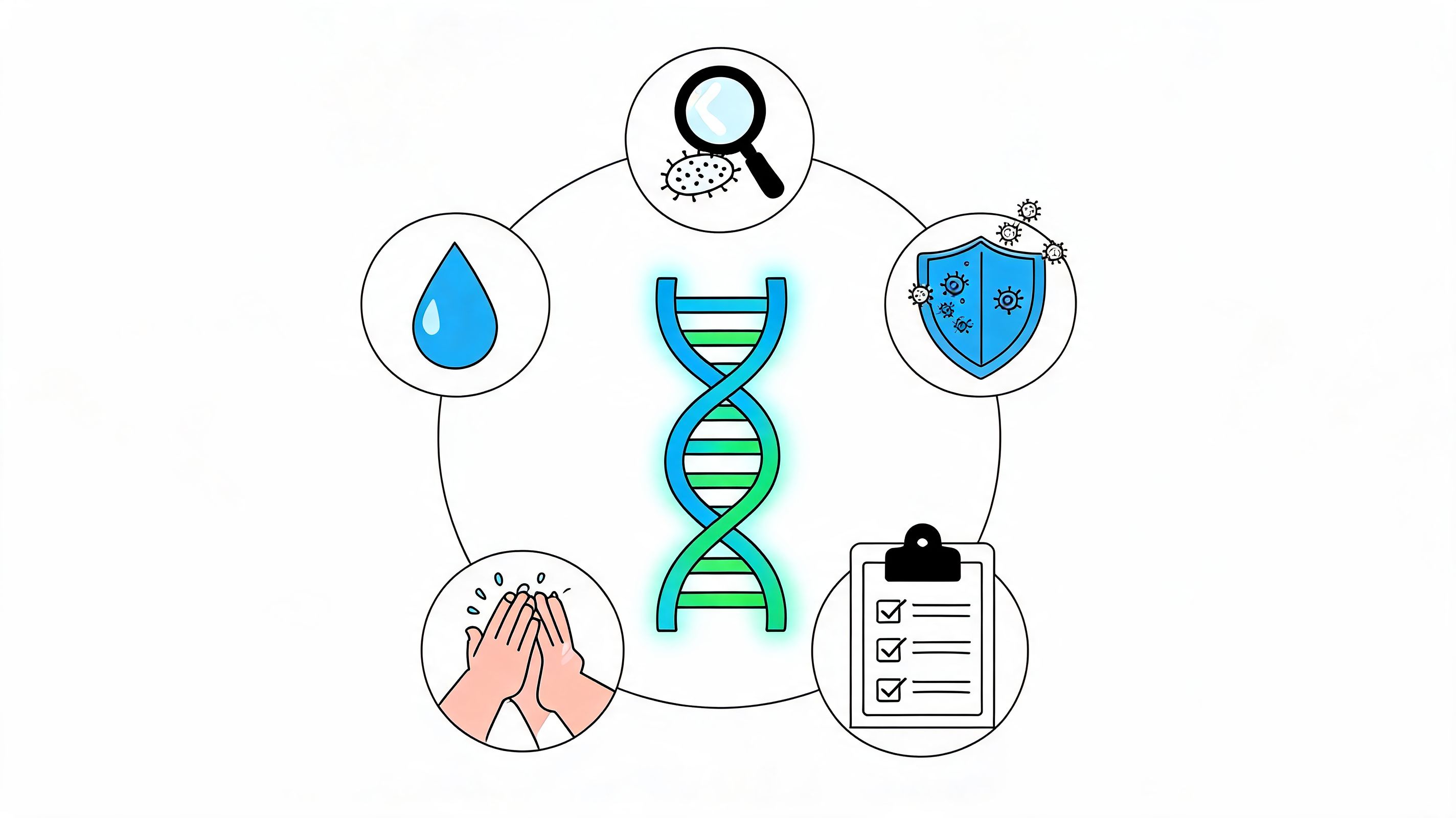
Ever wondered why one strain of bacteria sits on a surface while another helps drive an outbreak? Or why a cleaning routine seems solid until a harder-to-kill organism shows up? The answer often starts with DNA.
For many non-scientists, DNA feels abstract. It belongs in genetics labs, crime shows, or ancestry kits. But in infection control, DNA is practical. It explains what a bacterium can do, how fast it can spread, how resistance moves between organisms, and why some cleaning failures matter more than they first appear.
That matters in busy environments. A facility manager deciding how often to disinfect touchpoints, a gym operator dealing with shared equipment, or a foodservice supervisor reviewing sanitation steps is already working with the consequences of bacterial genetics. You don't need to become a molecular biologist, but you do need a working grasp of the basics.
These 5 facts about dna connect the biology to the daily job of preventing contamination and reducing risk.
1. DNA is the instruction set that gives bacteria their traits
What makes one bacterium relatively harmless on a surface while another is harder to remove, more persistent, or more likely to cause illness? The answer starts with DNA.
DNA works like an instruction manual written in a chemical code. In humans, that instruction set is spread across chromosomes and contains the directions used to build and maintain the body, as described by the National Human Genome Research Institute overview of the human genome. Bacteria use the same basic molecule for the same basic purpose. Their DNA carries the instructions that shape what the cell can do.
For infection control, that idea matters because bacterial traits are practical, not abstract. DNA can contain instructions for sticking to stainless steel, tolerating dry conditions, using nutrients left in residue, producing toxins, or surviving certain antimicrobial pressures. If two strains of Staphylococcus aureus behave differently in the same building, the difference often begins in their genes.
A simple way to picture it is this. DNA is the recipe file, and the bacterium's traits are the finished dishes. If the recipe includes stronger adhesion proteins, the organism may hold onto a surface more effectively. If the recipe includes toxin production, the risk changes. If the recipe supports biofilm formation, routine cleaning may become less reliable.
A hygiene team sees the outcome of those instructions every day, even without a lab report. One organism may keep reappearing around a sink rim. Another may persist on shared equipment. Another may spread more easily from a frequently touched handle to hands, cloths, or gloves.

Why this matters in real environments
In a locker room, restroom, kitchen, or care setting, visible cleanliness tells only part of the story. Two counters can look identical and still carry bacteria with very different genetic capabilities. Appearance cannot tell you whether a strain is better at clinging, surviving stress, or forming a protective community on a surface.
That is why policy matters so much. Good hygiene protocols are built for invisible differences between microbes, not just visible dirt. Facility managers and cleaning teams should assume that a surface may host organisms with traits that make removal harder than expected.
Practical rule: Treat surface contamination as a genetics-informed hygiene problem. Use procedures that account for what bacteria may be capable of, not just what staff can see.
A few actions follow from that:
- Match products to the risk: Use disinfectants with label claims that fit the organisms and setting you are trying to control, and follow the stated contact time.
- Pay attention to repeat problem areas: If the same drain edge, bench, faucet, or prep handle repeatedly fails inspection or becomes re-contaminated, the local bacterial population may have traits that support persistence.
- Train staff on trait differences: Cleaning teams should understand that bacteria are not interchangeable. Different DNA instructions can change how organisms behave on the same surface.
- Write protocols for consistency: A method that works only when done perfectly by one experienced worker is fragile. Standardized steps reduce the chance that persistent strains exploit small gaps in practice.
If you want a broader look at how microbial communities affect everyday health, this Mouthology guide to oral microbiomes is a useful companion read.
2. Bacterial DNA can copy fast, which is why contamination can escalate quickly
How can a surface that looked acceptable an hour ago become a transmission risk by the end of a shift?
The answer starts with DNA replication. Before a bacterium divides, it has to copy its DNA. In the right conditions, that copying step happens fast. For Escherichia coli under ideal laboratory conditions, cell numbers can double in about 20 minutes, as described by the Microbiology Society's overview of bacterial growth.
A copier in an office is a useful comparison here. One sheet becomes two, then four, then eight. Bacteria do not grow because a surface looks dirty. They grow when moisture, nutrients, and time let them keep copying their DNA and dividing. That is why infection control depends so heavily on timing.
For facility and hygiene teams, the practical point is straightforward. Time gives contamination a chance to build.
A damp sink rim, a food spill under equipment, or sweat residue on shared touchpoints can become a growth site between scheduled cleans. As bacterial numbers rise, the odds of transfer rise too. More cells on the surface means more opportunities for hands, cloths, tools, and carts to move those organisms somewhere else.
A familiar scenario
Consider a gym mat storage area after repeated use. Mats are stacked while still slightly damp, and high-touch handles are wiped only when the facility closes. The issue is not just missed appearance standards. The delay gives bacteria more opportunities to copy their DNA, multiply, and spread to the next person who handles the equipment.
The same pattern applies in staff kitchens, school washrooms, patient transport vehicles, and food preparation spaces. Cleaning frequency is not only about routine. It is about interrupting bacterial multiplication before contamination becomes harder to contain.
A better question is: How much time has this surface had to support bacterial growth since the last effective clean?
What managers and hygiene teams should do
- Set cleaning intervals by use and moisture, not by habit: High-touch, high-moisture areas often need attention during the day, not only at opening or closing.
- Remove soil before applying disinfectant where needed: Residue can protect bacteria and reduce how well a disinfectant works.
- Treat damp zones as priority areas: Sinks, drains, bottle-filling points, mop storage areas, and laundry collection points often give bacteria the water they need to keep multiplying.
- Respond quickly to spills and body fluid contamination: Delayed cleanup gives bacteria more time to increase in number and more chances to spread.
This is why DNA matters to hygiene policy. If bacteria can copy their genetic material quickly, contamination can rise quickly too. Good infection control does not wait for visible buildup. It reduces the time, moisture, and residue that let bacterial DNA keep turning one cell into many.
3. Bacteria can share DNA with each other, including resistance traits
How can a bacterium become harder to kill without waiting generations for a slow genetic change? One answer is that bacteria can sometimes pick up useful DNA from other bacteria around them.
For a hygiene team, that idea matters more than it may seem at first. DNA is not only a record of what a bacterium is. In shared spaces, it can also act like a transferable instruction card. A bacterium that did not previously carry a resistance trait may gain one through horizontal gene transfer, often by receiving a plasmid. Plasmids are small circles of DNA separate from the main bacterial chromosome, and they often carry survival traits such as antibiotic resistance, according to the U.S. National Library of Medicine's MedlinePlus genetics overview of plasmids.
In plain terms, some bacteria do not need to develop resistance from scratch. They can acquire it from nearby cells.
That changes how infection control should be viewed. A contaminated touchpoint is not only a place where bacteria sit. It can become a meeting point where different bacteria mix, persist, and sometimes exchange genetic material. In healthcare, food handling, schools, transport, and other high-contact environments, poor separation between clean and dirty tasks increases those opportunities.
Antibiotic use adds another layer. The World Health Organization's antimicrobial resistance fact sheet explains that antimicrobial resistance is already a major global public health problem. From an operations perspective, that means hygiene policy and antibiotic stewardship support the same goal. One reduces spread in the environment. The other reduces the pressure that favors resistant strains.
Here's a second visual that captures the idea of protected genetic information moving between systems.

Practical implications for facilities
- Break transfer routes at shared touchpoints: Rails, carts, machine handles, faucet levers, bed controls, and mobile devices should be cleaned and disinfected on a schedule that matches real use.
- Separate clean and dirty workflows: After waste handling, laundry collection, restroom service, or food residue cleanup, glove changes and hand hygiene help stop organisms moving into lower-risk areas.
- Investigate repeat positives: If the same equipment or zone repeatedly shows contamination, treat it as a persistent reservoir that may be supporting ongoing spread.
- Reduce crowding of microbes in wet or heavily handled areas: Sluice rooms, sinks, drain surrounds, and shared preparation surfaces deserve close attention because different organisms are more likely to accumulate there.
Field note: Low-level contamination in a high-risk setting can still matter, especially when it is repeated, mobile, or located where organisms from different sources can meet.
The practical lesson is simple. Good hygiene does more than lower the number of bacteria on a surface. It also reduces the chances that bacteria circulate long enough, and closely enough, to share traits that make future control harder.
4. DNA can be damaged, but bacteria may recover if disinfection is weak or inconsistent
What happens if a disinfectant injures bacteria but does not finish the job?
That question matters on real surfaces. Disinfection works by damaging parts of the cell that bacteria need to live, including membranes, proteins, and DNA. But damage is not always the same as elimination. If the product choice is wrong, the surface stays wet for too short a time, or soil blocks contact, some cells may survive and repair what was harmed.
DNA is built to be chemically stable, which is one reason it serves as a long-term instruction set in living cells. The U.S. National Human Genome Research Institute explains DNA structure and stability in its genetics overview: DNA explained by NHGRI. For hygiene teams, the practical lesson is simple. A surviving bacterium still has the instructions needed to grow again once conditions improve.
Weak disinfection usually looks ordinary, not dramatic. A wipe dries before the labeled contact time. Spray is applied to dirt instead of to a cleaned surface. One cloth is pushed across too many touchpoints and loses both moisture and cleaning capacity.
Biofilms make this harder. A biofilm works like a packed protective layer attached to a surface, with cells embedded in material that slows disinfectant penetration. In Staphylococcus aureus, regulatory RNA from non-coding regions helps control behaviors linked to biofilm development and bacterial interaction. That relationship is described in microbiology research on S. aureus regulatory RNAs and biofilm control: PubMed overview of regulatory RNAs in Staphylococcus aureus. For a facility manager, the takeaway is practical. If a surface is repeatedly damp, soiled, or hard to scrub, bacteria may be harder to remove than a quick wipe suggests.
How to improve outcomes
- Respect contact time: If the label requires the surface to stay wet for a certain period, apply enough product and cover a small enough area to meet that requirement.
- Clean before disinfecting when soil is present: Dirt, grease, and organic residue can block the chemistry from reaching bacterial cells.
- Use friction during wiping: Mechanical action helps break up buildup on the surface and remove organisms that chemicals may not reach well on their own.
- Match the method to the risk point: Restrooms, food-prep-adjacent areas, shared equipment, and clinical touchpoints do not all present the same contamination pattern.
- Replace wipes and cloths before they fail: A used wipe has limited liquid, limited surface area, and limited cleaning capacity.
Clean first when needed. Then disinfect with the right product, enough wetness, and the full label contact time.
For infection control policy, inconsistency creates avoidable opportunities. Surviving bacteria can remain on a surface, rebuild their numbers, and continue contributing to repeat contamination events. In that sense, DNA is not just a biology topic. It helps explain why technique, timing, and surface preparation matter in everyday hygiene work.
5. DNA sequencing now helps identify bacterial threats with far more precision
What if two contamination incidents look the same on the surface, but come from different bacteria and require different responses?
DNA sequencing helps answer that question by reading the exact order of the DNA bases, A, T, C, and G, in a bacterial sample. If standard identification is like reading a name badge that says "staff," sequencing is more like checking the full ID card. It can separate bacteria that belong to the same broad group but differ in the traits that matter for infection control, such as resistance patterns, toxin genes, or links to a known outbreak.
That level of detail grew out of the same scientific progress that made large-scale genome reading possible during the Human Genome Project, as described by the National Human Genome Research Institute. Today, the same basic principle is used in public health, clinical microbiology, and food safety to compare bacterial samples with much greater precision than older methods allowed.
Why that matters outside the lab
A facility manager or hygiene lead will not be operating a sequencer. But the results can shape daily decisions in very practical ways.
If public health teams sequence bacteria from several cases and find they are closely related, that supports a common-source investigation. If the samples are genetically different, the problem may be multiple introductions rather than one failed cleaning point. That distinction matters. It changes where teams look, what records they review, and whether the response should focus on one room, one workflow, one supplier, or a wider set of touchpoints.
Healthcare systems also use sequencing to strengthen surveillance, and food safety teams use it to trace contamination sources more accurately. In other words, DNA data is no longer just a research tool. It has become working information for infection control policy.
Analysts at Global Market Insights project continued growth in the biotechnology and healthcare side of DNA data storage, with the wider market expected to expand rapidly, according to this DNA data storage market analysis. That projection is not about disinfectants or cleaning tools, but it does show that health systems are investing in ways to store and use biological information over time.
A recent technical milestone points in the same direction. A December 2024 report on epi-bit technology tested on the iDNAdrive platform described volunteers encoding approximately 5,000 bits of data with a 1.42% retrieval error rate. For infection prevention teams, better storage and retrieval means genomic records can become easier to preserve, compare, and revisit during long investigations.
Here's a simple visual for the sequencing concept.

The practical takeaway
- Use sequencing results as a decision aid: If lab partners identify a specific resistant or outbreak-linked strain, focus cleaning, disinfection, and containment on the locations and shared items most likely to spread it.
- Keep operational records that can support investigations: Cleaning logs, occupancy records, maintenance notes, and equipment movement histories help microbiology findings make sense in practical applications.
- Train teams to value pattern recognition: Repeated incidents in one zone may reflect a shared source. Sequencing can confirm or rule that out, but only if the site records are good enough to compare.
- Treat genomic reports as part of infection control, not separate from it: The sequencing may happen off-site, but the corrective action still happens on floors, handles, sinks, carts, tools, and other high-touch surfaces.
5-Point Comparison: Bacterial DNA Facts
A facility team rarely needs a genetics lecture. It needs a way to connect microbiology to daily decisions such as which surfaces deserve extra attention, why timing matters, and when a recurring problem may signal a larger control failure.
This comparison works as an operations map rather than a recap. Each DNA fact points to a different infection-control risk, a different failure mode, and a different action on the ground.
| DNA fact | What it changes in real-world hygiene | Main risk if teams miss it | Best operational response |
|---|---|---|---|
| DNA gives bacteria their traits | Two bacteria on the same surface may behave very differently. One may dry out and die quickly, while another may stick, survive, or resist treatment. | Teams may treat all contamination as if it carries the same level of risk, which can lead to under-response in high-risk areas. | Match cleaning intensity to the setting, surface type, moisture level, and known organism history. Use local microbiology reports to refine protocols. |
| Bacterial DNA copies quickly | A small contamination event can become a larger one within routine gaps between cleaning rounds, especially where moisture, residue, or hand contact are common. | Delays give bacteria time to multiply and spread through touchpoints, tools, carts, drains, or shared equipment. | Shorten response time after spills, body fluid events, or high-traffic use. Increase attention to recontamination between scheduled cleans. |
| Bacteria can share DNA | Resistance traits can move between bacteria, which means a problem is not always confined to one species or one room. | Cross-contamination control may fail if teams focus only on the organism already identified and ignore transfer routes. | Tighten separation between dirty and clean workflows. Reinforce hand hygiene, equipment segregation, and careful handling of reusable items. |
| Bacterial DNA can be damaged yet recovery may still occur | Weak disinfection may injure cells without fully stopping them. Some bacteria can repair damage and continue growing if conditions allow. | Inconsistent product use, poor contact time, or residue left on surfaces can leave survivors behind. | Clean first when soil is present, then disinfect correctly. Train staff to cover the full surface and keep it wet for the stated contact time. |
| DNA sequencing improves identification | Investigators can distinguish between unrelated contamination events and a connected pattern that keeps returning. | Sites may waste effort treating every event as isolated, while the actual source remains in circulation. | Combine lab findings with cleaning logs, maintenance records, and movement histories to target the true source. |
One way to read the table is to picture DNA as the operating manual inside the bacterium and hygiene practice as the set of controls that interrupts what that manual is trying to achieve. Growth, survival, transfer, and persistence all depend on conditions your team can change.
For facility managers and hygiene leads, the practical question is simple. Which DNA-driven risk is most likely in this area, and does the current protocol interrupt it? That question usually leads to better decisions than treating every contamination event as the same.
From Knowledge to Action A Smarter Approach to Hygiene
DNA isn't just a science topic. It's part of the daily reality behind contamination, persistence, resistance, and outbreak control. Once you understand that bacteria carry instructions for survival, can copy those instructions quickly, and can sometimes share them, infection control becomes more precise.
That shift matters for non-specialist professionals. A janitorial supervisor doesn't need to memorize gene names to improve outcomes. A foodservice manager doesn't need to run a sequencing lab to understand why timing, residue removal, and high-touch disinfection matter. But both benefit from seeing bacteria as organisms directed by genetic information rather than as generic "germs."
The practical lesson is straightforward. Good hygiene interrupts what bacterial DNA is trying to accomplish. It limits growth. It reduces spread. It lowers the odds that hardier strains stay in circulation. It also creates cleaner records and better response options when public health or laboratory data points to a specific threat.
For many teams, the next step isn't buying more products. It's tightening execution. Review contact times. Watch how wipes are used. Separate dirty and clean workflows. Increase attention on moisture-prone zones and shared touchpoints. Reinforce hand hygiene after surface tasks. Those aren't abstract best practices. They're direct ways to counter microbial survival.
If your role includes infection prevention planning, it's also worth keeping one eye on the broader safety picture. This 2026 bloodborne pathogens safety guide adds useful context on exposure control and workplace precautions.
The best result of learning these 5 facts about dna is that routine cleaning stops being routine. It becomes strategic. Teams make better choices when they understand what they're fighting.
For facilities looking to strengthen everyday hygiene routines, we recommend Wipes.com.
Leave a Reply