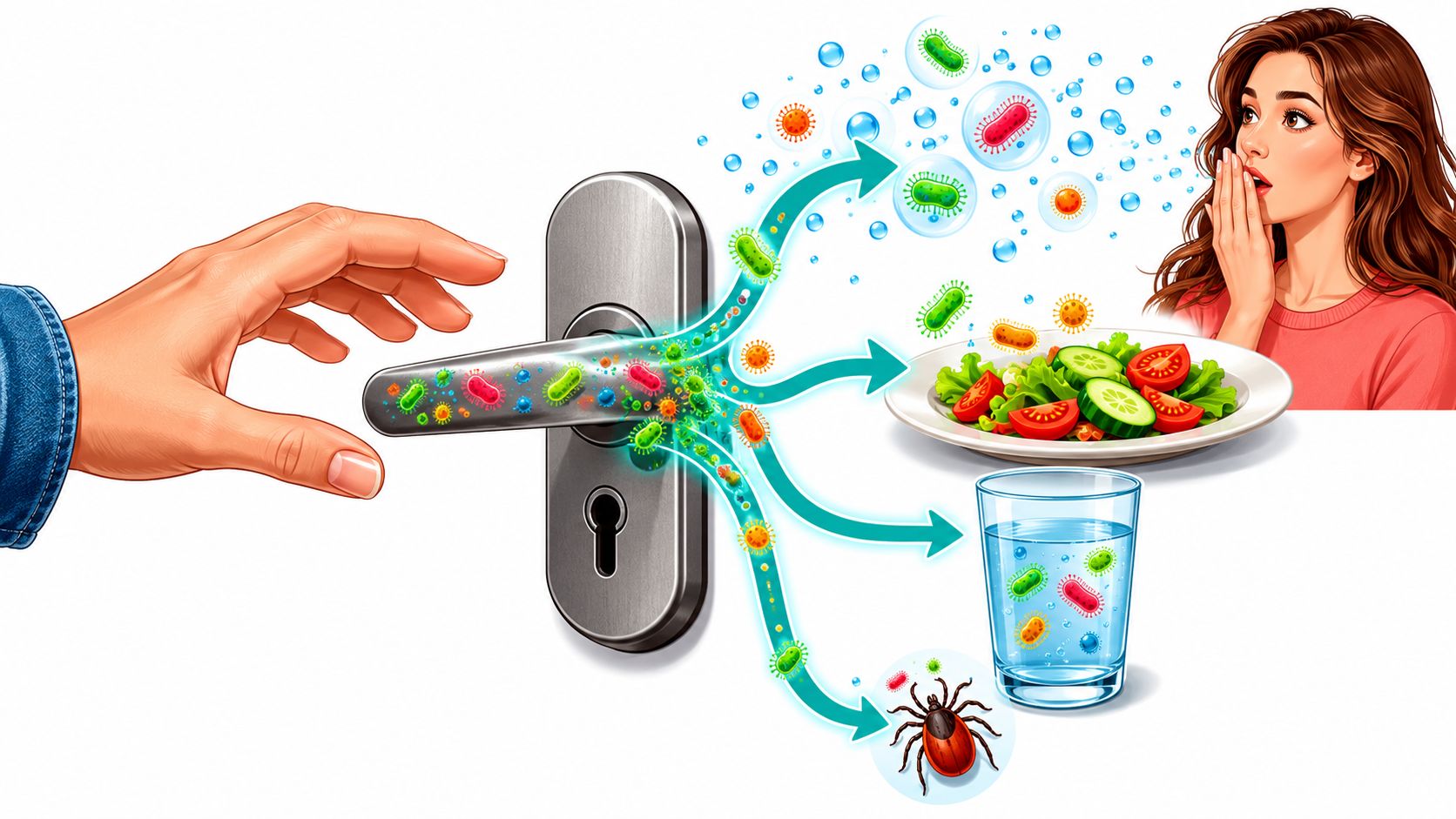
A hand closes around a shared door handle, then reaches for a phone, a snack, or a child's face. That ordinary sequence can connect one person to another, but contact alone doesn't guarantee infection. Bacterial infection transmission depends on the route a germ takes, whether it survives the journey, and whether it reaches a vulnerable place in the body in a sufficient amount.
The practical goal isn't to fear every surface. It's to find the points where bacteria move through a home, school, workplace, gym, restaurant, or healthcare facility, then interrupt the chain with the right control.
Six Routes Bacteria Use to Spread
The same bacterium may spread by more than one route, and a control that works for one route may not stop another. A disinfected tabletop won't prevent a respiratory droplet from reaching someone nearby, just as ventilation won't keep raw-food juices off a salad board.
| Route | How Bacteria Move | Example Pathogens | Common Settings |
|---|---|---|---|
| Direct contact | Skin-to-skin contact or touch from an infected or colonized person transfers bacteria. | Staphylococcus aureus, Streptococcus pyogenes | Wrestling mats, daycares, households |
| Droplet | Short-range spray from coughing, sneezing, or talking reaches another person. | Streptococcus pyogenes, Neisseria meningitidis | Classrooms, dormitories, crowded transport |
| Airborne | Fine particles or aerosols stay suspended and can travel through shared air. | Mycobacterium tuberculosis, Legionella pneumophila | Hospital wards, cooling towers, large buildings |
| Fomite (indirect) | Hands pick up bacteria from a contaminated shared surface and carry them elsewhere. | MRSA, vancomycin-resistant Enterococcus faecium, Acinetobacter baumannii | Gyms, hospitals, shared bathrooms |
| Food and waterborne | People ingest bacteria in contaminated food or drinking water. | Salmonella enterica, Escherichia coli O157:H7, Campylobacter | Restaurants, households with stored water, farms |
| Vector-borne | An infected flea or tick carries bacteria into the body through a bite. | Yersinia pestis, Borrelia burgdorferi | Rural areas, outdoor work, tick habitats |
Match the route to the setting
In a wrestling facility, S. aureus can move through skin contact and shared gear. In a classroom, droplets from someone coughing may expose people nearby to S. pyogenes. In a hospital, contaminated equipment and hands can connect patients, staff, and visitors, while airborne or aerosol risks call for attention to ventilation and water systems.
Food and water routes also involve more than what happens at the table. A kitchen tool, a pair of hands, or a storage container can carry bacteria between ingredients or into drinking water. Fleas and ticks require a different response again: surface cleaning won't prevent a bite.
Real-world spread can combine routes. Someone may touch a contaminated surface, then handle food, or an infected person may spread bacteria directly while also contaminating shared equipment. Identify the route most relevant to your setting first, then choose controls that interrupt that specific path.
Why Some Exposures Cause Infection and Others Don't
Not every bacterial exposure leads to infection. Touching a surface that has bacteria on it isn't the same as bacteria entering the body and multiplying. The outcome depends on several linked conditions: the amount transferred, the organism's ability to survive, the route into the body, and the person's health.
Dose and survival shape the exposure
The infectious dose is the amount of a bacterium needed to start an infection. That amount differs among organisms, so a small transfer that matters for one pathogen may not be enough for another. A person's hand can pick up bacteria without delivering enough to cause illness, but that doesn't make the transfer chain harmless.
Survival matters too. Bacteria that remain on a surface can be available for transfer when someone touches it later. Staphylococcus aureus can persist on dry surfaces for days to weeks, Acinetobacter baumannii can persist for weeks, and damp drains, sinks, and wet mops can favour Pseudomonas aeruginosa. These examples make the condition of the surface and its use relevant, not just whether it looks clean.
The person and entry point matter
A healthy, intact skin barrier is different from a surgical wound, broken skin, or an indwelling catheter. Very young or older people, and people with weakened immune systems, may also face greater risk from exposures that another person's body can manage.
Colonization isn't the same as infection. Colonization means bacteria are present on or in the body without causing illness. Infection occurs when bacteria invade and cause harm. For a plain-language explanation of the difference, see what bacterial colonization means.
Think of infection like a fire. A spark alone may not start one; it needs fuel and the right conditions. In the same way, surface contamination alone doesn't establish that someone will become ill.
Quick check: Is dose the main concern in your setting, can bacteria survive between uses, or are people especially susceptible? The answer points toward the control to prioritize: reduce contamination, shorten the time before cleaning, or protect vulnerable people and entry points.

How Food and Water Carry Bacteria Through Each Stage
At a restaurant prep station, juice from raw chicken reaches a board set aside for salad. The salad looks fresh. Nothing about it announces risk. Yet bacteria can travel a chain that starts before cooking and continues through storage, preparation, and serving, and every link in that chain is a place where transfer can be stopped.
The World Health Organization's first global estimates of foodborne disease found that contaminated food causes up to 600 million illnesses and approximately 420,000 deaths each year. Those estimates cover many types of hazards, not only bacteria. Bacterial pathogens still matter greatly: diarrhoeal diseases, many caused by bacteria such as Salmonella, Campylobacter, Shigella, and pathogenic Escherichia coli, account for roughly 550 million illnesses and 230,000 deaths each year.
The chain works like a relay race. The baton is a dose of bacteria, and it has to be handed off at each leg: from raw food to a surface, from surface to hand, from hand to mouth. Break one handoff and the baton never reaches the finish.
Follow the chain, then break it
Raw ingredients arrive. Poultry and eggs may carry Salmonella enterica. Raw produce and undercooked ground beef can be associated with Escherichia coli O157:H7. Keep raw ingredients separate from food that's ready to eat.
Storage creates opportunities for contact. Juices from raw food can drip onto ready-to-eat ingredients when foods aren't separated or stored securely. Keep raw items contained and below foods that won't be cooked.
Preparation carries contamination onward. A knife, board, counter, or unwashed hand can move bacteria from raw ingredients to cooked food or salad. Use separate tools for raw and ready-to-eat items, and wash hands and equipment between tasks. A board that looks clean can still carry a dose worth transferring.
Cooking is a control point. Heat has to be adequate to kill vegetative bacteria. Follow food-safety instructions for the food being prepared and use a food thermometer when appropriate, rather than judging doneness by appearance alone.
Holding affects what happens next. Keep cold foods cold and hot foods hot according to applicable food-safety guidance. Long stretches at the wrong temperature give surviving bacteria time to multiply, so the dose on the plate grows the longer prepared food sits out.
Stored water needs protection after collection. A container that isn't cleaned or covered, or a dispensing method that brings hands into contact with stored water, lets contamination return after the water was safe. Contaminated stored water can move bacteria between people in a household, so protect water after collection with clean containers, covered storage, and dispensing that avoids hand contact.
The transmission of Escherichia coli can involve food, water, hands, and surfaces, which is why one clean step can't compensate for a contaminated one later in the chain.

Before serving food, check that raw and ready-to-eat items stayed separate, tools and hands were cleaned between tasks, food was cooked appropriately, and stored water remained protected. Breaking any one link lowers the dose that reaches the person eating or drinking, and that lower dose is often the difference between a meal that passes unnoticed and one that causes illness.
Shared Spaces Where Spread Multiplies
A hospital bed rail may be touched by a patient, a visitor, and staff during routine care. Each person can bring bacteria to the rail or pick them up from it, making shared equipment a practical place to interrupt contact-based spread.
In a 2023 U.S. point-prevalence survey, the CDC found that 2.6% of hospitalized patients had at least one healthcare-associated infection, equivalent to approximately 1 in 38 hospital patients on any given day. The CDC's healthcare-associated infection data describe mechanisms that include contaminated or improperly reused equipment, unclean hands, invasive devices, surgical procedures, and microorganism movement among patients, healthcare workers, staff, and visitors.

Follow the pathway in each setting
In hospitals, MRSA and vancomycin-resistant Enterococcus faecium can move between people through hands or shared equipment. Acinetobacter baumannii can also be a concern in intensive-care environments. Staff can reduce opportunities for transfer by performing hand hygiene between patient contacts, cleaning shared equipment, following isolation practices, and managing devices carefully.
In a gym, the pathway may begin with skin contact during wrestling and continue through shared mats, benches, or gear. In schools and daycares, toys, toilet handles, and diaper-changing surfaces can connect children and caregivers. In food service, shared work areas create a different risk when raw and ready-to-eat foods meet.
Different settings need controls suited to their routines, but the aim is consistent: prevent one person's contamination from reaching another person through hands or equipment. A cleaning schedule works best when it identifies who cleans each surface, when cleaning happens, and what product is appropriate for that surface and target germ.
Audit these shared-space touchpoints this week:
- Handles and controls: Door handles, faucet controls, and toilet flush handles.
- Shared equipment: Bedside equipment, gym gear, and classroom toys.
- Frequently handled personal items: Mobile phones and other devices moved between rooms or people.
How Surfaces Pass Bacteria to Hands
A swab from a door handle tests positive for bacteria. That result may sound alarming, but it doesn't prove that the handle caused an infection. For transmission to happen, the bacteria must complete several steps between landing on a surface and entering a person's body.
The CDC's environmental infection-control guidance describes this as a chain: the organism must survive deposition, remain recoverable from the surface, transfer to a person, reach a susceptible point of entry, and do so at an infectious dose. Evidence that a surface caused infection requires more than finding bacteria on it; stronger evidence includes a link to infections and transmission stopping after decontamination.
Trace the hand-to-body route
First, bacteria land on a surface and remain there. Next, a hand touches the contaminated area and picks up some of the organisms. The hand may then touch the eyes, nose, mouth, or a wound, creating a possible route into the body. Each transfer can reduce the amount carried, but it doesn't necessarily remove all bacteria.
That's why high-touch surfaces deserve attention when they connect a likely source of contamination to people's hands. Door handles, faucet controls, shared equipment, bed rails, and mobile devices can all sit on that pathway. In a bathroom, for example, someone may touch a faucet control after using the toilet, then touch another shared surface.
Surface cleaning and hand hygiene work as a pair. Cleaning reduces the contamination available for pickup; hand hygiene removes organisms that have reached the hands. If either part is skipped, the other may not break the chain.

For a closer explanation of this indirect route, see what fomite transmission means. As a rule of thumb, clean the surfaces hands touch most, clean soon after a known contamination event, and treat hands as the bridge that can carry bacteria between them.
Preventing Droplet, Airborne and Vector Spread
During a classroom outbreak of Streptococcus pyogenes, cleaning desks may help with shared-touch concerns, but it won't address droplets from someone coughing nearby. Different routes call for different controls.
- For droplets: Encourage people to use tissues, practise respiratory etiquette, and clean their hands. Follow local school policy for keeping symptomatic children or staff home.
- For airborne spread: Improve ventilation and air exchange in wards, classrooms, and dormitories. Clinical teams should use airborne isolation rooms for patients with Mycobacterium tuberculosis when indicated.
- For Legionella in water systems: Maintain hot-water storage and cooling towers, disinfect them under a documented water-safety plan, and flush outlets that are rarely used.
- For vectors: After outdoor work, check skin and clothing for ticks. Use tick repellent, check pets, and control rodents and their fleas where Yersinia pestis is present.
- After contact with animals or soil: Wash hands before eating, preparing food, or touching the face.
Match the control to the route. Droplet and airborne risks usually call for respiratory precautions, ventilation, or isolation, not just surface wipes.
Verify the Label, Then Clean and Disinfect Shared Surfaces
A shared desk can look spotless and still pass Staphylococcus aureus to the next person who rests a hand there. A surface that looks clean can still pass bacteria if the label's wet time is cut short. A surface with visible soil needs detergent first, because organic material can shield bacteria from the disinfectant. The difference is where you break the chain. On a surface, that chain has three links: bacteria surviving on the material, transfer to hands or food, and a dose reaching a susceptible person. The product label tells you whether you can cut the survival link before transfer happens.
Before using a disinfectant, make three checks: does its EPA-registered label name the target organism, does the label cover the surface and application method, and can you keep the surface visibly wet for the full contact time? A wipe isn't effective against every bacterium just because it's sold as a disinfectant.
Confirm the product before you start
The EPA's guidance on registered disinfectants defines contact time as the period the product must remain visibly wet on the surface to be effective. If the label specifies 10 minutes and the surface dries after 5 minutes, reapply the product to maintain the required wet time. The label must also cover the organism you're targeting, such as Staphylococcus aureus, Pseudomonas aeruginosa, Salmonella, MRSA, VRE, or Acinetobacter baumannii.
Contact time can differ by product and application method. A spray application and a direct application may carry different wet times on the same label, and a hard, nonporous surface may have a longer claim than a wipe. Read the specific label rather than assuming that every wipe has the same wet time.
Follow a consistent cleaning procedure
Put on gloves and remove visible soil. Use detergent and a clean cloth to remove dirt, food residue, or body fluids. The CDC's facility cleaning guidance explains that organic material can interfere with disinfection, so visibly soiled surfaces need precleaning. Detergent lifts soil the way a brush lifts mud from a boot. Disinfectant then has a clear surface to work on.
Clear away the residue. Rinse or wipe the area as appropriate for the surface and cleaner. Don't spread residue across nearby clean surfaces.
Apply the chosen disinfectant. Check that the label covers the target germ, surface type, and method of application.
Keep the surface wet. Leave the product on for the full labeled contact time. Don't wipe it dry early. Reapply if it dries before the required time has passed.
Finish according to the label. Let the surface air dry or wipe it only if the product directions say to do so. Follow food-safety procedures for food-contact surfaces, including sanitizing them between tasks.
Finish safely. Remove gloves and wash hands. Use a fresh cloth or wipe as needed instead of carrying the same dirty cloth from one surface to another.
Common mistakes include wiping immediately dry, skipping precleaning when a surface is visibly soiled, and using one cloth across several surfaces. A wipe can also leave gaps if staff move too quickly or fail to cover the full high-touch area. The gap matters because the next hand that lands there picks up whatever the wipe missed.
Set priorities by setting
| Setting | Highest-Risk Surfaces | Control Priority |
|---|---|---|
| Gyms and athletic facilities | Mats, benches, weights, locker handles | Remove visible soil, disinfect daily and after contact sports |
| Schools and daycares | Desks, door handles, toilet flush handles, toys, diaper tables | Disinfect after diapering, toileting, and vomiting; wash hands |
| Food service areas | Cutting boards, prep tables, faucets, handles | Separate raw and ready-to-eat tools; sanitize between tasks |
| Hospitals and clinics | Bed rails, call buttons, IV poles, shared equipment | Perform hand hygiene; use the label claim for the target organism |
| Households | Bathroom fixtures, kitchen counters, phones, water containers | Clean containers, store water covered, and disinfect after handling raw meat |
The priority column follows the same chain logic. In gyms, hands move from mats to weights to locker handles, so equipment cleaning has to fit the routine. In schools, diapering and vomiting create a heavier dose and a more direct hand-to-mouth path, so those events need immediate cleaning and hand hygiene. Food service separates raw tools from ready-to-eat tools to stop transfer before sanitizing. Hospitals pair hand hygiene with label claims because patients are more susceptible. Households focus on bathroom fixtures, kitchen counters, and water containers where hands and food meet.
BacteriaFAQ.com publishes practical articles on infection prevention, cleaning mop heads, disinfecting toilet brushes, bacteria in washing machines, and bacteria on water fountains. Those articles cover less obvious places where hands, equipment, and cleaning routines connect.
Write the product's labeled contact time into the cleaning log so staff can apply it consistently. Choose an EPA-registered disinfectant whose label names the target organism and gives a contact time your team can meet during a shift. If a label requires ten minutes of wet time and staff cannot stay with the surface that long, choose a product with a shorter labeled time or change the routine.
In your setting, identify the most common route, the surfaces or routines that connect people, and the point where you can interrupt the chain. Start with clean hands, separated food and water practices, and a disinfectant label that matches the job.
Leave a Reply