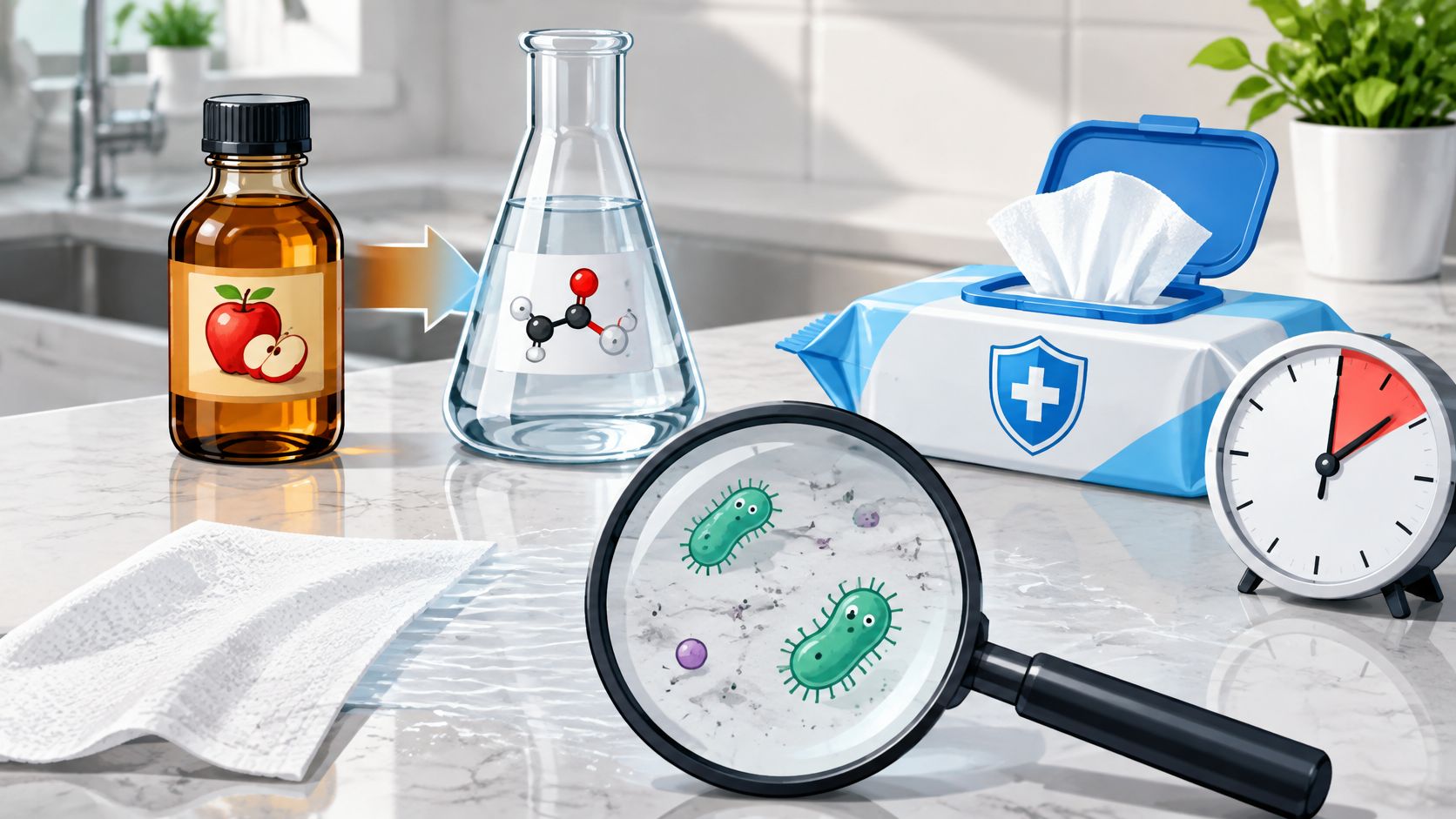
Spray vinegar, wipe, and call it disinfected. That's the most popular advice about an acetic acid solution, and it's wrong in the way that matters most. Vinegar strength is not a disinfection dose.
A bottle can be acidic, smell sharp, and cut through limescale while still failing to deliver a validated kill on a soiled, high-touch surface. What decides the outcome isn't the word vinegar on the label. It's concentration, pH, organism, soil load, surface, and contact time working together, and most consumer guidance ignores at least half of that list.
That gap creates real risk in daycares, gyms, kitchens, and healthcare settings. A solution that reduces some free-floating bacteria in a lab suspension can perform very differently on a gym mat or a daycare table, where bacteria sit in food residue, skin oils, and dried moisture. Treat acetic acid as a cleaning chemical with specific, measurable limits. When disinfection is required, demand a product label that names the organism and states how long the surface must stay wet.
Strengths and Forms of an Acetic Acid Solution
A percentage on a bottle describes concentration, not disinfection performance. An acetic acid solution can range from kitchen vinegar to laboratory reagent, but strength alone cannot establish whether it will disinfect a particular surface.
A janitor finds two clear bottles in a supply closet. One is labeled 5%; the other has no strength listed. The labeled bottle can be measured and diluted predictably. The unmarked one has no reliable place in infection-control work because its actual concentration is unknown.
Reading the Strength on the Label
The U.S. Food and Drug Administration's vinegar guidance states that natural vinegar normally contains more than 4 grams of acetic acid per 100 milliliters. It also says diluted vinegar must be labeled with its actual acid strength, which cannot be below 4 grams per 100 milliliters.
A 5% solution contains approximately 5 grams of acetic acid per 100 milliliters, and a 4% solution contains approximately 4 grams. Depending on how acidity is expressed, percentages may describe concentration by mass or grams per volume, so they do not always mean pure acid by volume.
| Form or source | Acetic acid strength | Typical use | Labeling or regulatory note |
|---|---|---|---|
| Household vinegar | about 4% | Cooking and light cleaning | Natural vinegar normally contains more than 4 g per 100 mL (FDA) |
| Cleaning vinegar | about 6% | Descaling and surface cleaning | Strength should be stated on the label |
| U.S. vinegar range | 3% to 8% (5% most common) | Food and household products | Actual acid strength must be labeled |
| Technical-grade acetic acid | about 80% | Industrial feedstock, diluted before use | Corrosive concentrate |
| Reagent-grade glacial acetic acid | 100% | Laboratory preparation | Corrosive; workplace exposure limits apply |
Household vinegar and cleaning vinegar occupy the lower-strength end of the range. Their acidity may help with descaling, but a cleaning task is not automatically disinfection. For bathroom grout, knowing when DIY grout cleaners work best helps set realistic expectations for a descaling step. The reaction between pantry ingredients is another separate issue; see this explanation of acetic acid and sodium bicarbonate reactions.
Three-step check: Read the stated strength, compare it with the table, then decide whether the solution suits the job.
Safety Limits for Handling Concentrated Acid
Acetic acid strength changes the handling risk. The NIOSH pocket guide entry for acetic acid lists a recommended workplace exposure limit of 10 ppm as an eight-hour time-weighted average and 15 ppm as a short-term exposure limit. These are limits for airborne exposure, not targets for surface cleaning.
For concentrated stock, facilities should provide ventilation, keep containers closed, and control decanting. A 6% cleaning vinegar and a 100% reagent-grade acid require different precautions because stronger solutions present greater corrosion and vapor risks.
Handling Rules Staff Can Follow
- Wear splash goggles and chemical-resistant gloves: Use both when diluting concentrated stock to protect eyes and skin from splashes.
- Add acid to water: This order reduces splashing and concentrated heat compared with adding water to concentrated acid.
- Never mix with bleach or other cleaners: Unintended reactions can release hazardous gases, and mixing makes the resulting strength unpredictable.
- Label every container: Mark the strength and date on the container itself, not on a loose note.
- Store away from children and pets: Keep stock upright, locked or out of reach, and separated from incompatible cleaners.
- Keep a rinse source nearby: Staff should be able to flush skin or eyes without crossing the building.
Written training and documented checks help keep handling practices consistent. Facilities can use these steps as part of strengthening safety management with Safeworkforce. Written rules also give new staff a clear procedure when their previous experience is limited to ready-to-use sprays.
For eye exposure, flush continuously with water for at least 15 minutes, then seek medical care. For skin contact, rinse promptly with plenty of water. Do not delay flushing while someone looks for a supervisor or safety sheet.
How to Dilute to a Working Strength
Diluting is simple arithmetic once the stock strength is known. The mistake is treating the result as if it were still vinegar, with vinegar's food identity and assumptions attached.
The FDA compliance policy guide on acetic acid in foods states that diluted acetic acid is not vinegar and should be declared on food labels as "acetic acid" or "diluted acetic acid". In an FDA laboratory comparison, distilled vinegar differed from a 5% solution made from glacial acetic acid because vinegar contained volatile substances absent from the diluted solution. The same guidance records U.S. government agricultural examples for a 3% solution, including 3 parts 4% vinegar to 1 part water, 1 part 6% vinegar to 1 part water, and 3 parts reagent-grade acetic acid to 97 parts water.

| Starting stock | Target strength | Parts stock | Parts water |
|---|---|---|---|
| Household vinegar, 4% | 3% | 3 | 1 |
| Household vinegar, 4% | 1% | 1 | 3 |
| Cleaning vinegar, 6% | 3% | 1 | 1 |
| Reagent-grade acetic acid, 100% | 3% | 3 | 97 |
Preparing the Dilution
- Read the stock strength. Use the number printed on the original label, not the product nickname.
- Pick the ratio. Match your stock and target strength in the table before you pour anything.
- Measure by volume. Use clean, marked containers so parts mean the same thing every time.
- Add acid to water. For concentrated acid, never add water to the acid.
- Mix and label. Write the final strength, the date, and the word diluted on the new container.
- Store it apart. Keep it away from bleach and other cleaners, and don't reuse an unlabeled jug.
The common slip is estimating with concentrated stock. A rough pour from a household bottle shifts the final strength a little, but a rough pour from a concentrated reagent can shift it far more than staff expect. Measure, label, and record the result every time.
Lab Results and Why pH Changes Them
A 1% acetic acid solution can look impressive in a suspension test and still fail as a surface disinfectant. That distinction is where most consumer claims break down.
A 2026 study of acetic acid against resistant organisms reported that 1% acetic acid completely inhibited some organisms, including MRSA and Pseudomonas aeruginosa, but only partially reduced E. coli and Enterococcus faecalis in planktonic testing. Biofilm results also varied by species in that work. A second 2026 study described in the same report found acetic acid had the lowest antimicrobial potential among several organic acids tested against resistant S. aureus, while lactic acid produced reductions of up to 3 log CFU/mL in mature biofilms.
| Organism | Result at 1% acetic acid | Practical reading |
|---|---|---|
| MRSA | Complete inhibition | Suspension result, not a disinfection claim |
| Pseudomonas aeruginosa | Complete inhibition | Suspension result, not a disinfection claim |
| Escherichia coli | Partial reduction | Incomplete; not reliable on its own |
| Enterococcus faecalis | Partial reduction | Incomplete; not reliable on its own |
Complete inhibition of free-floating cells doesn't tell you what happens when those same organisms sit inside a mature biofilm, protected by extracellular material and uneven wetting. It also doesn't tell you what happens after food, soap, or hard water residue changes the chemistry at the surface.
What the Biofilm Evidence Shows
The flow-chamber study of mature biofilms in PMC evaluated 0.5% and 1.0% acetic acid over 24 hours against three-day-old Pseudomonas aeruginosa and Staphylococcus aureus biofilms. Complete bacterial killing occurred at pH ≤4.33, while P. aeruginosa showed significant antimicrobial effects below approximately pH 4.76, and above pH 5 effects were minor and nonsignificant. Hydrochloric acid adjusted to comparable pH didn't reproduce the killing effect, and complete biofilm killing also occurred with sodium acetate concentrations of 1.75% (w/v) or higher.
That hydrochloric acid comparison is the analytical point readers miss. If acidity alone explained the result, another acid at the same pH should've performed the same way. It didn't, which shows that undissociated acetic acid, the form that crosses bacterial membranes more efficiently, contributes beyond proton stress alone.
As pH rises, more acetic acid shifts toward ionized acetate. The solution can still taste sour and test acidic while delivering far less of the membrane-permeable form. That's why two solutions with the same nominal percentage can behave differently after dilution water, surface residue, or cleaning chemicals alter pH. For the underlying chemistry, this overview of acid-base theories and dissociation explains why the form of an acid matters as much as its amount.
Where Lab Results Mislead in Real Rooms
Say a daycare worker wipes a snack table where milk and cracker crumbs remain in the seams. The suspension test had no crumbs, no seams, and no child touching the surface again in two minutes. Organic load consumes and buffers the acid before it reaches every cell.
A gym mat creates a different problem. Sweat, skin oils, textured vinyl, and repeated folding produce protected microenvironments that a quick spray doesn't wet evenly. Bacteria embedded in biofilm on that mat aren't facing the same exposure as planktonic cells suspended in liquid for a controlled test period.
A kitchen counter adds soap film, grease, and food acids or alkaline residues from earlier cleaning. Those residues can shift local pH and reduce the undissociated fraction right where contamination sits. The counter may look clean while the chemistry needed for killing has already been lost.
A formulation should be validated by measured pH, free-acid fraction, concentration, organic load, and contact time, not by vinegar strength alone.
Biofilm results are laboratory evidence. They don't authorize use on skin, food-contact surfaces, or healthcare environments without applicable regulatory validation for that exact use.
Who Acts on Each Rule and How
Different roles control different failure points. The person buying the product, the person diluting it, and the person wiping the surface can each break the chain.
- Janitorial staff: Wipe visible soil first, then thoroughly wet the surface with the wipe, keep it visibly wet for the label time, and let it air-dry. A single nearly dry pass doesn't deliver the exposure the label requires.
- Facility and building managers: Buy products whose labels name the target organisms, and record stock strength and dilution date for every acetic acid solution. Set dwell times from the label rather than the bottle name or staff habit.
- Infection-prevention teams: Require validated organism claims for healthcare and other high-risk areas. Treat acetic acid as cleaning rather than disinfection unless validation exists for the organism, surface, and method in use.
- Gym operators: Focus on mats, benches, and shared equipment where Pseudomonas aeruginosa and Staphylococcus aureus are relevant concerns. Check during busy periods that surfaces stay wet for the full time, not just during training demonstrations.
- Food-service managers: Use registered products on food-contact-adjacent surfaces, keep acid and bleach apart, and document the strength of every dilution. Staff shouldn't have to guess whether a spray bottle holds a descaler, a cleaner, or a sanitizer.
- Households: Use correctly labeled diluted vinegar on counters and sinks as a cleaning step, and keep concentrated acid away from children and pets. Don't describe that cleaning step to family members as disinfection.
The pattern is consistent across settings. Cleaning removes soil, labels define validated claims, and timing determines whether the chemistry gets enough exposure. When any one of those three is missing, confidence should drop.
Registered Disinfectants or Acetic Acid by Setting
Vinegar strength is not a disinfection dose. For household counters and sinks, a correctly labeled diluted acetic acid solution may serve as a cleaning step, but it does not provide an organism-specific disinfectant claim. In daycares, gyms, commercial kitchens, schools, and healthcare settings where control of Pseudomonas aeruginosa, Staphylococcus aureus, or MRSA is required, use an EPA-registered disinfectant according to its label.
The EPA list of selected registered disinfectants defines contact time as the period a treated surface must remain visibly wet for the product to work. If it dries sooner, reapply the product. One registered wipe label in the guidance specifies a 1-minute contact time for P. aeruginosa and S. aureus; other formulations require longer.

| Factor | Diluted acetic acid solution | EPA-registered disinfectant wipe |
|---|---|---|
| Named bacterial claims | No organism-specific registered claim | Organism-specific claims on the label, such as P. aeruginosa and S. aureus |
| Contact time | No validated dwell time for these organisms | 1 minute for P. aeruginosa and S. aureus on one label; longer on others |
| Surface requirement | Keep visibly wet | Thoroughly wet, keep visibly wet for listed time, then air-dry |
| Residual claim benchmark | No EPA residual benchmark met | 5-log reduction within 10 minutes under test conditions |
| Organic soil | Effect reduced; clean first | Label-specific; clean first |
The wipe method matters alongside the product. Wet the surface thoroughly, keep it visibly wet for the label's full contact time, then allow it to air-dry. A daycare table wiped once with a nearly dry cloth gets less exposure than the label requires, even when the correct product is available.
Household discussions of can vinegar help kill mildew illustrate why visible cleaning should not be confused with validated microbial control. For organism-specific directions, consult this EPA-registered disinfectants list and label guidance and check the exact product label before purchase.
The Benchmark Behind a Registered Claim
The EPA guidance for residual bactericidal claims uses S. aureus ATCC 6538 and P. aeruginosa ATCC 15442 as bacterial reference strains. To support a residual bactericidal disinfectant claim, a product must achieve at least a 5-log reduction, equivalent to 99.999%, within no more than 10 minutes under the specified test conditions.
That benchmark applies to the registered product used as directed, on the surfaces and organisms named on its label. It does not establish the effectiveness of a homemade dilution.
Before staff use a product, confirm that its label names the target organism and surface, remove soil, and train staff to maintain the required wet contact time. Match the product to the organism and surface, then time it by the label.
Check current bottles, discard unlabeled dilutions, and choose a product with directions that fit the setting. Organism-specific guidance on transmission, surface survival, and control strategies can help inform protocols, but vinegar strength alone cannot establish disinfection.
Leave a Reply