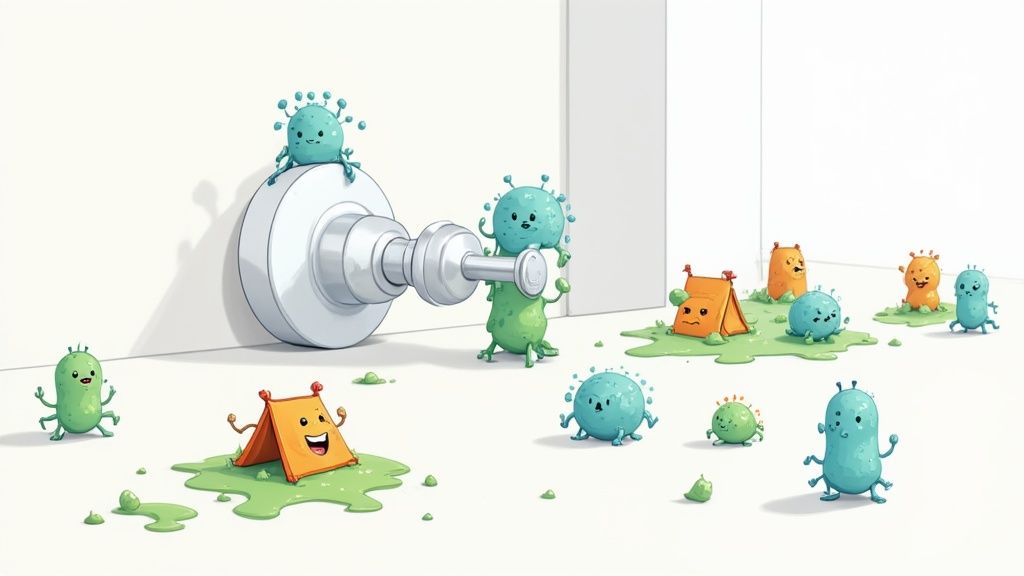
Let's get straight to it. Think of bacterial colonization like a group of squatters who find an empty building and decide to move in. They're not just passing through; they're setting up a permanent camp. They’re present, multiplying, and organized, but they haven't started knocking down walls or causing real damage—at least, not yet. This is worlds away from simple contamination, which is more like a tourist just briefly passing through.
The Difference Between Presence and Problems
For anyone managing a facility, understanding bacterial colonization is non-negotiable. It’s the quiet, often invisible stage between a harmless, temporary presence and a full-blown infection waiting to happen.
When a few bacteria land on a surface, they're just contaminants. But once they dig in, start multiplying, and form a stable community, they’ve successfully colonized that spot.
A colonized doorknob, countertop, or piece of gym equipment isn't just dirty; it has become a persistent reservoir of germs. This microbial community acts as a launchpad for potential outbreaks, constantly shedding bacteria into the environment and onto the hands of anyone who touches it.
Colonization vs. Contamination vs. Infection
To manage health risks effectively, you have to be able to tell these three states apart. Each one represents a different level of threat and requires a completely different response. While contamination can often be handled with a basic wipe-down, colonization demands a much more robust disinfection strategy to break up the established community.
Key Takeaway: The real difference comes down to intent and impact. Contamination is an accidental presence, colonization is an organized settlement, and infection is an aggressive invasion that causes harm.
This distinction is so important because a colonized surface can look perfectly clean. The danger isn't the visible dirt but the invisible, thriving bacterial community that has taken up residence. Managing colonization means shifting your focus from just cleaning to actively disinfecting the high-touch points that matter most.
To make this crystal clear, here’s a quick reference table breaking down the key differences between these often-confused terms.
| Term | Bacterial Status | Host Impact | Example in a Commercial Setting |
|---|---|---|---|
| Contamination | Bacteria are temporarily present on a surface. | No host response; bacteria are not multiplying. | A single cough deposits germs on a tabletop that are quickly wiped away. |
| Colonization | Bacteria are present, multiplying, and organized. | No signs of illness; the host's immune system is not triggered. | A persistent, invisible community of MRSA living on gym equipment mats. |
| Infection | Bacteria invade host tissues and cause disease. | The host shows clinical signs of illness (e.g., fever, inflammation). | A person gets a Staph infection from a cut exposed to the colonized mat. |
Knowing these differences helps you move from simply reacting to messes to proactively preventing the hidden threats that can lead to serious health issues.
How Bacteria Build Their Strongholds
Think bacteria just randomly show up on a surface? Think again. The process they use to establish a permanent presence, known as bacterial colonization, is a deliberate, multi-stage takeover. It’s less like a random spill and more like building a fortified city from scratch.
The whole journey from a single contaminating microbe to a full-blown infection risk follows a clear and predictable path.
This visual breaks down the progression from simple contamination, through the establishment of a colony, and finally to the point where an infection becomes a real danger.

As you can see, colonization is the critical middle ground where a few germs multiply into a tough, resilient community. This community becomes a persistent source of pathogens that are much harder to get rid of.
Stage 1: Adhesion
The first move is adhesion. Picture this as pioneer scouts arriving in a new, unclaimed territory. Individual bacteria use tiny, specialized structures—almost like grappling hooks—to latch onto a surface.
These first arrivals are pretty vulnerable. But once they successfully anchor themselves, the foundation for their stronghold is laid. They’ve established a beachhead, and now they can start expanding their territory.
Stage 2: Microcolony Formation
Once they're firmly attached, the bacteria get down to business and start multiplying. This isn't just chaotic growth, though. They actually communicate and coordinate with each other to form organized clusters called microcolonies.
You can think of these clusters as the first neighborhoods popping up in their new bacterial city. As these microcolonies grow, they create a more stable and protected environment, making it much harder for a quick wipe-down to dislodge them.
By working together, bacteria go from being isolated trespassers to becoming an organized, cooperative community. This collective structure is the secret to their resilience and the foundation of what’s coming next.
Stage 3: Biofilm, the Bacterial Fortress
The final and most formidable stage is the creation of a biofilm. This is where the real trouble begins. The bacteria secrete a slimy, protective matrix that completely encases the entire colony.
This biofilm acts just like the thick stone walls and deep moat of a medieval fortress. It shields the bacteria from all sorts of threats, including most cleaning agents and disinfectants. This protective goo is what makes the colony incredibly difficult to remove with just a simple spray and wipe. To see exactly how this fortress is built, check out our detailed guide on how do biofilms form.
The biofilm is precisely why a colonized surface can resist standard cleaning efforts. It creates a physical barrier that prevents disinfectants from ever reaching the bacteria huddled underneath. This is why professional cleaning protocols are so critical—they're specifically designed to break down this fortress and eliminate the threat hiding inside.
A Closer Look at Pseudomonas Aeruginosa
Knowing the theory is one thing, but focusing on a specific threat shows why targeted disinfection is critical. Pseudomonas aeruginosa is a notorious bacterium known for its resilience and ability to colonize high-traffic, moist environments. Understanding this specific pathogen helps facility managers develop a more effective defense.

Definition and Overview of Pseudomonas Aeruginosa
Pseudomonas aeruginosa is a Gram-negative, rod-shaped bacterium that is incredibly versatile and opportunistic. It's known for its minimal nutritional needs, allowing it to survive and thrive in environments where other bacteria would fail. One of its notable traits is its ability to form thick, protective biofilms, making it highly resistant to cleaning agents and antibiotics.
Where It's Commonly Found
This bacterium absolutely loves moisture. You'll find it colonizing sinks, drains, toilets, hot tubs, and medical equipment like catheters and respiratory devices. It's a common problem in healthcare facilities, gyms, spas, and any commercial building with extensive plumbing systems. Because it can survive in diverse conditions, it can turn any persistently damp surface into a reservoir for infection.
Health Risks Associated with Pseudomonas Aeruginosa
For most healthy people, P. aeruginosa poses a low risk. However, for individuals with weakened immune systems, such as hospital patients or the elderly, it can cause severe and life-threatening infections. These include pneumonia (especially in ventilated patients), urinary tract infections (UTIs), surgical wound infections, and bloodstream infections. Its natural resistance to many antibiotics makes these infections particularly difficult to treat.
Who Should Be Concerned
Facility managers, janitorial staff, healthcare providers, and gym operators should be especially concerned about P. aeruginosa.
- Healthcare Providers: Must focus on sterilizing medical equipment and disinfecting patient rooms to prevent hospital-acquired infections.
- Gym and Spa Operators: Need to implement rigorous cleaning protocols for showers, pools, and hot tubs where the bacteria thrive.
- Janitorial Staff: Must be trained to use disinfectants effective against biofilm-forming bacteria, paying close attention to restrooms and sink areas.
How to Kill and Control Pseudomonas Aeruginosa
A patch of bacteria colonizing a countertop might seem like a small, localized cleaning problem. In reality, it's a critical piece of a much larger and more dangerous public health puzzle. When bacteria establish these strongholds, they don't just sit there quietly—they create the perfect environment for a global crisis to grow stronger: antimicrobial resistance (AMR). Think of a colonized surface as a training ground for germs. Within the protected community of a biofilm, bacteria can easily swap genetic material. This is how they "teach" each other to survive the very drugs we rely on to kill them.

To effectively eliminate P. aeruginosa, a proactive and precise approach is essential.
- Use an EPA-Registered Disinfectant: Choose a product with a specific claim against Pseudomonas aeruginosa. This ensures it has been tested and proven effective.
- Strictly Adhere to Dwell Times: This is non-negotiable. The disinfectant must remain visibly wet on the surface for the entire time specified on the label (often several minutes) to penetrate the biofilm and kill the bacteria. Wiping it away too soon will render the effort useless.
- Implement Proper Wiping Techniques: Use high-quality disinfectant wipes to avoid cross-contamination. Wipe in one direction and use a fresh wipe for each new surface to ensure you are removing pathogens, not just spreading them.
By following these protocols, you can dismantle the breeding grounds for dangerous bacteria and protect your facility. This link transforms daily cleaning from a simple chore into a powerful act of public health stewardship, directly contributing to the worldwide fight against antimicrobial resistance. For a deeper dive, check out our complete guide on how to disinfect surfaces.
For sourcing reliable, EPA-approved disinfecting solutions for your commercial space, we recommend Wipes.com.
Protecting Your Business and Your People
Smart hygiene is way more than just a line item on a budget—it’s a core business strategy. When you understand and manage bacterial colonization, you’re not just cleaning. You’re actively protecting your company’s most important assets: your people and your reputation.
The risks of letting bacterial colonies get established are real and expensive. An outbreak traced back to your facility can destroy years of customer trust overnight. Beyond the public relations nightmare, you’re looking at serious operational headaches, from lost productivity when your team gets sick to potential legal trouble if negligence is a factor. What starts as a manageable issue can quickly spiral into a major financial and ethical crisis.
The Benefits of Proactive Hygiene
On the flip side, tackling infection control proactively is one of the smartest investments you can make. When customers see you’re committed to a clean, safe environment, their confidence in your brand skyrockets. Internally, a healthy workplace means a more reliable, productive team and fewer sick days.
Proactive hygiene isn't about dodging negatives; it's about creating positive results. It builds trust, keeps your operations running smoothly, and shows everyone who walks through your doors that you genuinely care about their health and safety.
This commitment has to touch every part of your operation. For any business, but especially for healthcare facilities, keeping things hygienic is non-negotiable. It's worth exploring how specialized commercial laundry services for clinics can be a key partner in stopping the spread of bacteria and protecting both staff and patients.
By treating robust infection control as a smart investment instead of a chore, you can champion hygiene protocols that protect your team, your customers, and your bottom line. It's a strategic move that pays off in safety, loyalty, and long-term success.
Common Questions About Bacterial Colonization
Here are a few quick answers to the questions we hear most often. Getting these concepts down is the key to creating a safer, healthier space.
If a Surface Is Colonized, Will It Automatically Make Someone Sick?
Not directly, no. Think of a colonized surface like a loaded weapon—it's dangerous but only causes harm when it's "fired."
Bacterial colonization simply means germs have set up shop and are multiplying on a surface. The surface itself won't make you sick, but it becomes a reservoir. An infection only happens if those germs find a way into your body in high enough numbers to overwhelm your immune system. That colonized doorknob or countertop dramatically increases the odds of that happening with every touch.
Why Isn't Soap and Water Good Enough?
Soap and water are fantastic for cleaning. They do a great job of physically lifting and removing dirt, grime, and some of the germs along with them.
But cleaning isn't disinfecting. Soap doesn't typically kill hardy bacteria or break down the protective biofilms they build. To truly get rid of a bacterial colony, you need an EPA-registered disinfectant designed to kill specific pathogens. That's the only way to break the chain of transmission, especially in busy places like gyms, schools, or offices.
What's Dwell Time, and Why Does It Matter So Much?
Dwell time is probably the most overlooked—and most important—part of disinfecting.
It's the amount of time a disinfectant needs to stay visibly wet on a surface to actually kill the germs listed on its label. If you spray and immediately wipe a surface dry, the disinfectant hasn't had time to do its job, and you're leaving living pathogens behind. Following the manufacturer's specified dwell time is absolutely critical for achieving true disinfection. No shortcuts
Leave a Reply