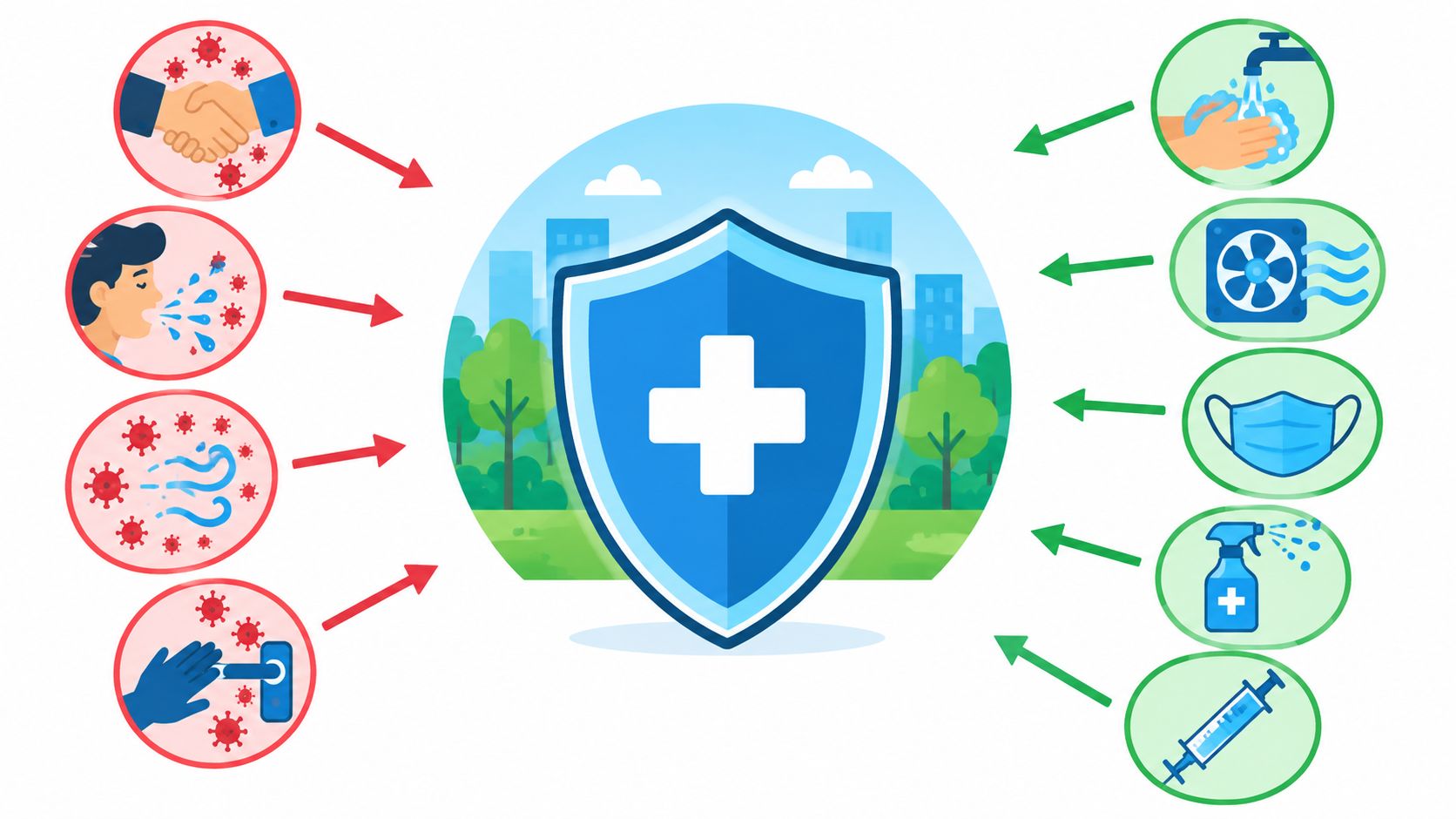
A parent wipes a shopping cart, a coach sprays a wrestling mat, and a restaurant manager watches staff clean a prep counter. Each person is trying to prevent disease transmission, but do they know how the bacteria they're targeting travel? Cleaning the wrong object, at the wrong time, with the wrong method can create a false sense of security.
This guide uses Pseudomonas aeruginosa as a practical example because it illustrates the central challenge clearly. The bacterium can persist in damp environments, move through contaminated water or surfaces, and cause serious infections in vulnerable people. Effective control depends on matching the response to the route: contact, droplet, airborne, or fomite transmission.
Why Stopping Germs Starts With Knowing How They Travel
A disinfectant wipe can be useful on a gym machine, but it won't solve an airborne exposure in a crowded, poorly ventilated room. A handwashing station can reduce contamination after restroom use, but it won't replace safe food handling or respiratory source control. Disease transmission prevention works best when the intervention interrupts the route that carries the pathogen.
Pseudomonas aeruginosa is a useful teaching example. It's a bacterium associated particularly with moist environments, including water systems, damp surfaces, healthcare equipment, sinks, drains, and locker-room areas. A wet countertop may look harmless, yet moisture can help bacteria remain viable and support biofilm formation. In a busy facility, a contaminated surface can act like a mailbox, receiving organisms from one person and making them available to another.
The route isn't always obvious. A person may touch a contaminated faucet, then rub an eye or handle a wound dressing. A healthcare worker may transfer bacteria from a wet basin to equipment. A respiratory illness may spread mainly through particles released when someone coughs or breathes, making ventilation and staying home more important than repeatedly wiping desks.
Four questions to ask before choosing a control
When a prevention plan feels vague, ask:
- Where is the organism coming from? A person, animal, food, water source, or contaminated object?
- How does it leave the source? Through respiratory secretions, stool, wound drainage, blood, or contact with a wet reservoir?
- How does it reach the next person? Through direct touch, droplets, airborne particles, food, water, or a surface?
- What blocks that route first? Hand hygiene, isolation, ventilation, food controls, protective equipment, or disinfection?
Environmental cleaning still matters. A major review found evidence from microbiologic, observational, modeling, and outbreak data that contaminated surfaces contribute to transmission of hospital pathogens, while environmental hygiene interventions have reduced infection rates in some settings. The Engle Services air quality guide provides useful background for facilities considering how indoor air conditions fit into a broader prevention plan.
Practical rule: Don't ask only, “What should we clean?” Ask, “What route is carrying the risk?”
The same principle applies to every bacterium discussed in infection control. MRSA on a shared athletic surface, Salmonella on a cutting board, VRE on healthcare touchpoints, and respiratory pathogens in a crowded classroom require related but not identical controls.
The Four Ways Disease Spreads
Transmission routes are easier to manage when you can recognize them in ordinary situations. Think of each route as a different type of delivery system.
Direct contact
Direct contact happens when an infected or colonized person transfers organisms through physical touch. A contaminated wound touching another person's broken skin is a straightforward example. Skin-to-skin contact during sports can also spread organisms when sweat, friction, abrasions, or shared protective gear create opportunities for transfer.
What this means for you: Cover wounds, avoid touching another person's drainage, and use gloves when handling body fluids.
Droplet spread
Droplets are larger respiratory particles released by coughing, sneezing, talking, or close face-to-face interaction. A cough across a table may expose someone nearby, much like throwing wet beads through the air. Droplets generally travel over a shorter range and settle more quickly than fine airborne particles.
What this means for you: Keep symptomatic people away from others, improve spacing, use masks when appropriate, and cover coughs.
Airborne spread
Airborne particles are smaller and can remain suspended, especially in a closed room with weak air exchange. A person may release infectious particles while breathing or speaking, and another person may inhale them later. Wiping a doorknob won't remove what's circulating in the room.
What this means for you: Increase outdoor air, use suitable filtration, reduce crowding, and apply source control when someone is symptomatic.
Fomite and fecal-oral spread
A fomite is a contaminated object or surface. A shared gym towel can act like a reusable courier, carrying organisms from one person's skin to another person's hands. Fecal-oral spread follows a related chain when organisms from stool reach hands, food, water, or a person's mouth.
What this means for you: Wash hands after restroom use, prevent food cross-contamination, clean high-touch surfaces, and disinfect restroom areas carefully.

For a broader explanation of how pathogens move between sources and hosts, review types of pathogen transmission. The practical distinction is simple: droplet control focuses on proximity and source control, airborne control adds ventilation and filtration, and fomite control adds cleaning and disinfection.
The Prevention Steps People Get Wrong
Many people reduce prevention to two actions: wash hands and wipe surfaces. Both are important, but they can become distractions when the dominant route is different. A team may disinfect counters repeatedly while allowing a symptomatic worker to remain in a crowded room, or clean a gym floor while ignoring skin-to-skin contact and shared towels.
A 2026 community knowledge study found that people recognized respiratory droplet and close-contact transmission more often than less visible routes. Awareness was notably lower for vector-borne transmission, blood-borne spread through shared needles, environmental sanitation, and avoiding close contact with symptomatic people. Fewer than one-third of respondents met the study's threshold for adequate prevention knowledge, according to the Frontiers in Public Health community knowledge study.
That gap changes behavior. People tend to act on what they can see, such as a sticky table or a visibly dirty handle. They're less likely to recognize that a closed room needs air exchange, that a person with symptoms should stay home, or that a contaminated restroom can remain a hazard even after surfaces appear clean.
Why “clean” doesn't always mean “controlled”
Respiratory-pathogen guidance from the CDC emphasizes staying home when symptomatic, masking when needed, hand hygiene, and cleaning frequently touched surfaces. Those measures work together because respiratory spread isn't only a surface problem. If a person continues coughing among coworkers, surface wiping addresses only one part of the chain.
Norovirus cleanup shows another common mistake. CDC isolation guidance notes that fecal or vomit contamination can aerosolize during cleanup, so masks may help, and restroom-focused disinfection should continue even when surfaces look clean. A worker who sprays and immediately wipes may remove visible soil without allowing the disinfectant to remain wet for the required contact time.
Prevention fails when people confuse visible cleanliness with interruption of transmission.
The better question is not whether a facility cleans enough. It's whether the facility identifies the dominant route and applies the matching control. For Pseudomonas, that may mean correcting a damp reservoir and disinfecting equipment. For a respiratory threat, it may mean ventilation and source control. For Salmonella, food handling and hand hygiene take priority.
Risk Factors Across Homes, Schools, Gyms, and Healthcare
Different environments create different opportunities for bacteria to move. A household kitchen, a school classroom, a locker room, a restaurant prep area, and an intensive care unit shouldn't share one generic cleaning schedule.
| Environment | Dominant Route | Highest-Risk Surfaces | First-Priority Control |
|---|---|---|---|
| Home | Fomite and fecal-oral | Towels, sponges, faucets, cutting boards | Hand hygiene and separation of raw and ready-to-eat food |
| School | Contact and respiratory | Shared supplies, desks, door handles | Keep symptomatic people home and clean high-touch areas |
| Gym | Direct contact and fomite | Mats, benches, handles, damp locker-room surfaces | Cover wounds, clean equipment between users, launder towels |
| Foodservice | Fecal-oral and fomite | Cutting boards, utensils, handles, prep counters | Handwashing and strict raw-food separation |
| Healthcare | Contact, fomite, and device-associated routes | Bed rails, sinks, equipment, dressings | Hand hygiene, isolation precautions, and pathogen-appropriate disinfection |
Homes and schools
At home, shared towels and kitchen sponges can move organisms between hands, food, and surfaces. Separate tools for raw and ready-to-eat foods, wash hands after restroom use, and clean areas contaminated by bodily fluids with an appropriate disinfectant.
Schools face a mixture of close contact, respiratory exposure, and contaminated objects. Children touch shared supplies, desks, faucets, and playground equipment, often before washing their hands. Administrators should pair routine cleaning with clear illness exclusion policies and accessible hand hygiene.
Information about handling prepared materials and contamination control can also be useful when facilities work with laboratory or formulation supplies. For that narrower context, bacteriostatic water handling practices offer relevant background on maintaining hygienic procedures.
Gyms and foodservice
Gyms should focus on equipment that many people touch, surfaces that contact bare skin, and damp areas where organisms may persist. Operators should provide a clear process, not merely a bottle of spray. Users need instructions to remove visible soil first when necessary, apply enough product to keep the surface wet, and respect the label's contact time.
Foodservice managers should treat hand hygiene and cross-contamination as process controls. A clean-looking counter can still receive organisms from raw poultry, unwashed hands, or a contaminated utensil. The first priority is to stop those transfers before relying on final surface disinfection.
Healthcare
Healthcare requires the greatest precision because patients may have weakened defenses, invasive devices, wounds, or prolonged exposure to shared equipment. CDC describes hand hygiene as the single most important practice for preventing infection transmission and prefers alcohol-based hand rub over soap and water in most clinical situations when hands aren't visibly soiled. CDC also estimates that about 2 million patients in the United States get hospital infections each year and about 90,000 die as a result (CDC infection-control guidance).
In this setting, hand hygiene must accompany environmental cleaning, barrier precautions, equipment reprocessing, and appropriate isolation. A contaminated sink, dressing cart, or bedside device can become a reservoir, especially when moisture supports persistence.
For a setting-specific discussion of environmental contributors, see environmental risk factors.
Hand Hygiene and Disinfection Done Right
Hand hygiene and surface disinfection interrupt different transmission routes. Washing removes soil and organisms from skin, while disinfection reduces viable organisms on an inanimate surface when the product is used according to its label. A doorknob can act like a mailbox for germs, receiving organisms from one person and passing them to another, but wiping it cannot replace hand hygiene or address airborne spread.
Community handwashing reduces diarrheal illness, respiratory illnesses such as colds, and gastrointestinal-illness absenteeism among schoolchildren, according to CDC handwashing facts. CDC also notes that handwashing with soap could protect about 1 in 3 young children who get diarrhea and nearly 1 in 5 young children with respiratory infections such as pneumonia. For technique and timing details, see hand washing effectiveness.
A practical hand hygiene routine
Use soap and water when hands are visibly dirty, after restroom use, and after contact with bodily fluids. Cover your palms, backs of hands, thumbs, fingertips, spaces between fingers, and areas around the nails. Rinse, then dry thoroughly.
Alcohol-based hand rub is preferred in most clinical situations when hands are not visibly soiled. Apply enough to cover every hand surface and rub until dry. Staff should clean their hands before and after patient contact, after touching a patient's surroundings, and after removing gloves.
Facilities reviewing dispenser placement or soap delivery can compare antibacterial soap systems and dispensers as part of a broader hand hygiene program.
A surface disinfection protocol
- Remove visible soil: Clean away dirt, grease, and organic material when the label requires it.
- Choose a registered product: Use an EPA-registered disinfectant whose label includes the organism and intended surface.
- Use enough product: Keep the surface visibly wet for the full stated contact time.
- Respect dwell time: Do not wipe the product away early because the surface looks clean.
- Follow the label: Check instructions for ventilation, protective equipment, dilution, storage, and disposal.
EPA guidance for residual antimicrobial surface claims says products should achieve a 99.9% reduction, or 3-log reduction, compared with untreated controls within a 1 to 2 hour contact time, with Staphylococcus aureus and Pseudomonas aeruginosa identified as base bacteria for supporting those claims (EPA residual efficacy guidance).
EPA's List H records antimicrobial products effective against MRSA and/or VRE. Its table uses the wet contact time required for the surface to remain wet against each organism (EPA List H).
A CURoxide product label states that it kills Pseudomonas aeruginosa and directs users to keep the surface wet for 10 minutes (CURoxide EPA label). A quick swipe followed by immediate drying therefore does not complete the labeled disinfection process.

Layered Controls Beyond Cleaning
Cleaning is one layer, not the entire defense. A facility can disinfect every touchpoint and still leave people exposed if it ignores a symptomatic person, poor airflow, unsafe food handling, or inadequate protective equipment.
Start with the source
Source control means reducing release before organisms spread. A sick employee stays home, a person with a draining wound covers it, and a coughing visitor follows facility masking guidance. CDC respiratory guidance places staying home when symptomatic, masking when needed, hand hygiene, and cleaning frequently touched surfaces within the same prevention approach (CDC respiratory hygiene guidance).
Add engineering controls
Ventilation and filtration matter when particles can remain in indoor air. Open windows where appropriate, increase outdoor air, use suitable filtration, and avoid overcrowding in enclosed rooms. These controls don't replace cleaning, but they address a route that wiping cannot reach.
Make policies enforceable
Administrative controls turn advice into routine. A school can establish illness exclusion rules. A foodservice business can prevent workers with gastrointestinal symptoms from handling food. A healthcare facility can apply isolation precautions and define who cleans contaminated equipment.
Use PPE for the remaining risk
Gloves help protect hands during contact with body fluids, while masks or respirators may be appropriate for respiratory hazards or cleanup situations that can aerosolize contamination. PPE should fit the task and be removed correctly, because contaminated gloves can transfer organisms to phones, door handles, and keyboards.

Vaccination, where available and appropriate for a specific disease, can reduce susceptibility and community spread, but it doesn't eliminate the need for hygiene or source control. The practical habit is to identify the route first, then stack controls that interrupt that route at different points.
Your Practical Takeaway Plan
Effective disease transmission prevention isn't germ paranoia. It's route matching.
- Parents: Wash hands after restroom use and before food preparation, separate raw and ready-to-eat foods, and keep children home when they're ill.
- School administrators: Place hand hygiene supplies where children use them, clean shared touchpoints, improve indoor air conditions, and apply clear illness policies.
- Gym operators: Clean shared equipment between users, address damp locker-room areas, require wound coverage, and make the product's wet contact time part of staff training.
- Foodservice managers: Control handwashing, prevent raw-food cross-contamination, exclude symptomatic food handlers, and disinfect prep surfaces according to the label.
- Healthcare staff: Treat hand hygiene as the primary safeguard, follow isolation precautions, reprocess shared equipment, and use disinfectants approved for the relevant organism and contact time.
Leave a Reply