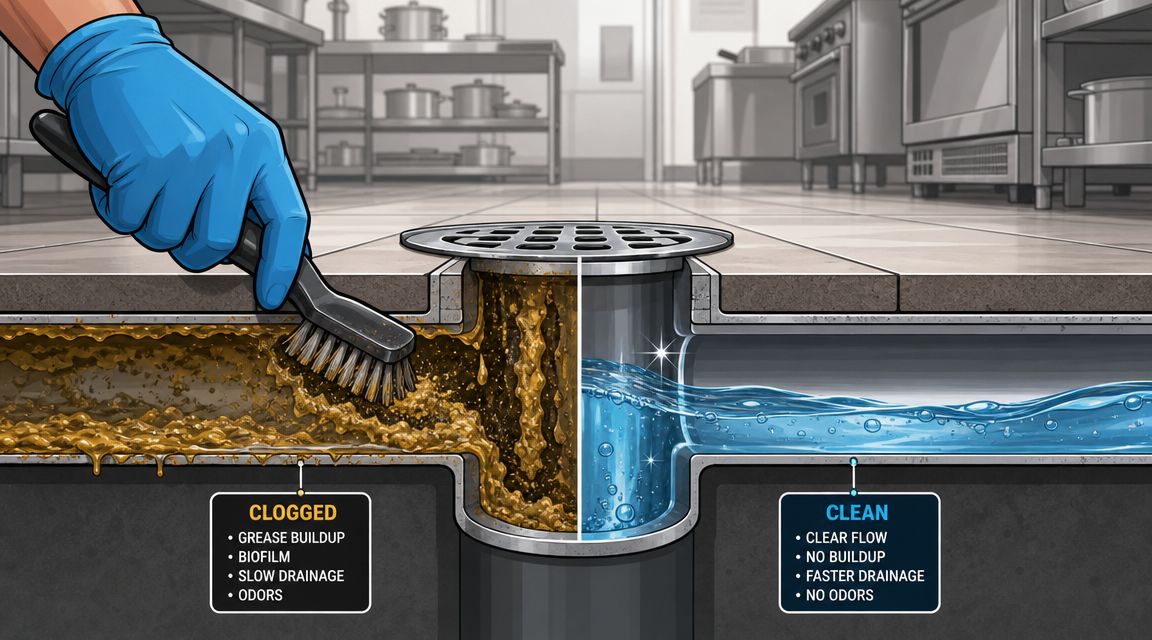
A drain problem usually shows up at the worst possible time. The prep sink starts draining slowly during lunch rush. A floor drain burps up gray water near the dish pit. Someone pours more hot water down it, then more chemical cleaner, and now the kitchen smells bad and the problem is still there.
That's why restaurant drain cleaning can't be treated like an occasional fix. In a commercial kitchen, drains are part of the operating system. They affect sanitation, pace of service, pest pressure, odor control, staff safety, and whether the kitchen can keep moving when volume spikes.
Most new operators underestimate how different restaurant drains are from residential drains. A home sink might deal with soap and light food residue. A restaurant line takes repeated loads of fats, oils, grease, starch, detergent, food scraps, and hot wastewater that cools inside the piping. Once that buildup starts sticking to pipe walls, you're no longer dealing with a simple clog. You're managing a recurring contamination and maintenance issue.
The Hidden Costs of Neglected Restaurant Drains
A backed-up drain isn't just a plumbing inconvenience. It can stop dishwashing, create slip hazards, spread foul odors into guest-facing areas, and force staff to work around standing wastewater. In a food business, that means lost time and bad decisions under pressure.

The scale of the problem matters. In the U.S., the Septic, Drain & Sewer Cleaning Services market reached $7.8 billion in 2024 and is projected to hit $8.1 billion in 2025, according to IBISWorld market data on septic, drain, and sewer cleaning services. For restaurants, that tells you drain hygiene is a real facilities category tied to uptime and sanitation, not a side chore someone handles when they remember.
Why kitchen drains fail differently
Restaurant drains collect more than visible debris. They collect FOG, meaning fats, oils, and grease, along with fine food particles that settle onto pipe walls. As greasy wastewater cools, residue sticks. Then more residue sticks to that layer. Over time, the line narrows, odors intensify, and water starts moving slower.
That slow-down creates secondary problems:
- Service disruption. The dish area backs up first, then prep sinks or floor drains start showing symptoms.
- Sanitation risk. Wastewater near food prep or warewashing areas quickly becomes an operational problem.
- Pest attraction. Damp organic residue inside and around drains creates breeding and feeding opportunities.
- Staff shortcuts. When drains are always slow, employees adapt in ways that make things worse, including pushing solids down sinks or overusing chemicals.
Practical rule: If a drain smells bad before it clogs, the line is already telling you residue is building up.
Odor is often the early warning
Owners often focus on the visible backup and ignore the weeks of warning signs before it. Gurgling, stale drain odor, recurring fruit fly activity, or water that lingers around a floor drain are all signals that buildup is forming inside the system.
That buildup also supports microbial growth on wet surfaces. If you want a closer look at how sink environments can support contamination risk, this overview of bacteria in kitchen sinks is worth reading alongside your drain program.
Neglected drains cost money in a way that rarely shows up on one invoice. You see it in extra labor, emergency calls, unusable stations, rewashing, odor complaints, and rushed cleanup. Preventive restaurant drain cleaning is cheaper than chaos, even before you factor in food safety exposure.
Your Daily and Weekly Drain Maintenance Checklist
Most kitchens don't need more drain products. They need a repeatable routine that staff can consistently follow. The biggest mistake is thinking a hot-water flush counts as cleaning. It doesn't, at least not by itself.
A practical workflow for commercial floor drains is to remove the cover, scrape and degrease the grate and drain opening, scrub the pipe with a drain brush as far as reachable, then flush with hot water and apply sanitizer before reassembling. That sequence is demonstrated in a commercial kitchen floor drain cleaning video. The key point is the manual scrub. Grease and food soil cling to the pipe wall, and hot water alone often leaves that layer behind.

Daily tasks that prevent buildup
Daily drain care should happen during closing, not during a crisis. Keep the tools simple: drain brush, scraper, degreaser approved for the area, hot water access, gloves, and designated drain grates or strainers.
Use this daily checklist:
- Remove solids first. Staff should scrape plates and prep waste into trash or compost before anything reaches the sink.
- Check strainers. Every sink and floor drain should have the correct basket or strainer in place and free of trapped debris.
- Clean around the opening. Pull off the grate or basket, remove visible sludge, and wipe the rim and surrounding surface.
- Brush the accessible pipe. Insert a dedicated drain brush and scrub the interior as far as you can reach.
- Flush with hot water. After scrubbing, run hot water to carry loosened grease and residue away.
- Sanitize the immediate contact surfaces. The drain itself is a plumbing component, but the removable parts and nearby floor area are part of sanitation.
Weekly work that managers should verify
A weekly routine goes beyond quick cleaning. It's where you find the kitchens that are “cleaning” every night but still leaving a thick ring of grease inside the line.
Key weekly checks:
- Deep grate cleaning. Remove and degrease covers, baskets, and strainers more thoroughly than the daily wipe-down.
- Brush verification. Make sure staff are actually using the drain brush, not just setting it out for inspection day.
- Hot-water flush after scrubbing. The sequence matters. Scrub first, flush second.
- Grease area review. Check nearby floors, mop sinks, and wash areas for residue that's migrating back toward drains.
- Procedure review. Compare what the team says they do with what the drain looks and smells like.
For broader front- and back-of-house routines, a commercial kitchen cleaning checklist helps tie drain care into the rest of the sanitation program.
If the drain cover is clean but the pipe throat is coated, your team is cleaning what the inspector sees, not what causes the clog.
What doesn't work well
Some habits feel productive but usually fail in restaurant settings:
- Pouring hot water only. It may improve flow briefly but won't remove adhered grease by itself.
- Using random chemicals at close. That can create fumes, pipe stress, and a false sense of control.
- Waiting for a slow drain. By then, the residue layer is already established.
- Assigning drain cleaning to everyone. When everyone owns it, no one owns it.
The best checklist is short, trainable, and enforced by observation, not hope.
Professional Deep Cleaning Snaking vs Hydro-Jetting
Staff maintenance handles accessible residue. It doesn't replace professional line cleaning. Once grease has built up deeper in the branch line or main run, you need a contractor with the right equipment and judgment.
The two methods most operators hear about are mechanical snaking and hydro jetting. They're not interchangeable, especially in kitchens with recurring grease loading.

What snaking actually does
A snake or auger is useful when the issue is a localized obstruction. It can punch a hole through a blockage and restore some immediate flow. That makes it a good response tool for a stoppage caused by a trapped object, compacted debris, or a specific tight point.
But snaking has a limitation in restaurants. It often creates a channel through grease instead of removing the greasy film along the full pipe wall. Water starts moving again, so the job looks done, but residue remains in place and starts catching more waste.
Why hydro jetting is usually the better restaurant service
Hydro jetting uses high-pressure water to scour the interior of the pipe. For grease-laden restaurant lines, commercial guidance describes it as the more complete cleaning method because it removes residue from pipe walls more thoroughly than snaking. It's also recommended as a preventive service, often quarterly to annually depending on usage, in this restaurant drain and hydro jetting guide.
That “depending on usage” part matters. A high-volume fryer-heavy kitchen, busy café with constant milk and food waste, or operation with long dishwashing cycles will usually need a tighter schedule than a lower-volume concept.
Hydro jetting doesn't just reopen flow. It removes the material that was training the pipe to clog again.
If you want a plain-language overview of the process itself, this guide to hydro jetting is a useful primer for owners before they approve service.
How to decide what to schedule
Use symptoms and kitchen profile, not guesswork.
| Situation | Better first move | Why |
|---|---|---|
| One isolated stoppage after a dropped object or sudden blockage | Snaking | It can clear a targeted obstruction quickly |
| Chronic slow drainage in grease-heavy lines | Hydro jetting | It cleans the pipe wall, not just the center opening |
| Repeated odor after temporary clearing | Hydro jetting | Odor usually means residue remains in the line |
| Multiple affected drains | Professional inspection first | The issue may be farther downstream than one fixture |
Good scheduling logic
A practical scheduling approach looks like this:
- Heavy-use kitchens. Lean toward more frequent preventive service.
- Moderate-use operations. Don't wait for failure. Schedule periodic cleaning based on history.
- Low-volume sites. Still inspect and clean proactively, but the interval can usually be wider.
- After any backup. Don't assume the emergency clear solved the root problem.
Calling for service only after wastewater hits the floor is the expensive version of restaurant drain cleaning. Planned deep cleaning keeps the kitchen functional and reduces the chance that one blocked line turns into a shutdown event.
Choosing Safe and Effective Drain Cleaning Agents
Chemical decisions in kitchens often start with frustration. The drain smells bad, water is standing, and someone wants the strongest product they can find. That's understandable, but it's not always smart.
One of the biggest trade-offs in restaurant drain cleaning is short-term clearing versus long-term control. Guidance for commercial kitchens often warns against harsh drain chemicals because of pipe damage risk and hazardous reactions, while also raising a useful question about whether weekly enzyme treatments may support better preventive control in some situations. That nuance appears in this commercial floor drain guidance from Lee Company.
What enzyme products are good at
Enzymatic cleaners are usually best viewed as a maintenance tool, not an emergency rescue tool. They're intended to work over time on organic residue, helping reduce the greasy, slimy film that contributes to odor and repeat buildup.
They may fit well when:
- You already have a manual cleaning routine and want support between deeper cleanings.
- You're trying to reduce harsh chemical use around staff and sensitive plumbing.
- Odor and film are the main problem, not a fully blocked line.
Where harsh chemicals create problems
Caustic or acidic products can look attractive because they promise speed. In practice, they can create worker-safety issues, damage some piping or components, and complicate cleanup if staff mix products improperly.
They also don't fix design issues, poor solids control, or a grease trap that isn't being maintained.
A drain cleaner that gets poured into a bad system can only do one of two things. Work temporarily, or fail more dangerously.
Drain cleaner comparison
| Feature | Enzymatic Cleaners | Chemical Cleaners (Caustic/Acid) |
|---|---|---|
| Primary role | Preventive maintenance | Aggressive short-term clearing |
| Best use case | Ongoing organic residue control | Severe blockage response, if appropriate and handled correctly |
| Effect on biofilm and grease film | Aimed at gradual reduction over time | May not remove adhered residue evenly |
| Worker safety profile | Generally easier to integrate into routine use when used as directed | Higher concern for splashes, fumes, and bad product combinations |
| Pipe compatibility | Usually the gentler option in a maintenance program | Greater risk if misused or used repeatedly |
| Operational downside | Won't solve a hard blockage fast | Can create a false “fixed” result without addressing root buildup |
A practical purchasing rule
Buy fewer drain products and create tighter rules for use. Standardize what the staff can apply, where it can be stored, who approves it, and what PPE goes with it. If your team reaches for a different bottle every time a drain slows down, you don't have a drain program. You have improvisation.
For most kitchens, the strongest approach is layered: solids control, manual scrubbing, hot-water flushing after scrubbing, grease-trap management, and periodic professional cleaning. Drain agents should support that system, not replace it.
Building a Compliant Drain Maintenance Program
A clean drain matters. A documented drain program matters more, because it creates consistency across shifts and gives managers proof that sanitation work was done.
When health officials review food businesses, they don't just notice visible cleanliness. They look at the systems behind it. This overview of environmental health officer checks is helpful because it reinforces how housekeeping, hygiene, training, and records all connect during an inspection.

What your program needs on paper
At minimum, build a written procedure that covers:
- Drain inventory. List every floor drain, prep sink drain, bar drain, mop sink, and dish area line.
- Task frequency. Define which drains are checked daily, cleaned weekly, and reviewed by management.
- Assigned roles. Put names or job titles next to tasks. “Kitchen staff” is too vague.
- Approved tools and chemicals. Standardize brushes, scrapers, degreasers, and any enzyme product.
- Escalation rules. Specify when staff stop and call a manager or plumber.
A one-page log sheet often works better than a complicated binder nobody opens.
Train the staff on the messy part
Drain care isn't just a cleaning task. It's a safety task. Staff need to know how to remove grates safely, avoid splashing contaminated water, wear gloves and other required PPE, and keep drain tools separate from food-contact cleaning tools.
They also need instruction on what not to do:
- Don't push solids into drains.
- Don't mix products.
- Don't treat recurring backups as normal.
- Don't leave standing wastewater for the next shift.
Keep records that mean something
A good maintenance log doesn't need fancy software. It needs useful fields:
| Log field | Why it matters |
|---|---|
| Drain location | Helps identify repeat problem spots |
| Task performed | Distinguishes wipe-down from full brush cleaning |
| Date and shift | Shows whether the schedule is actually being followed |
| Staff initials | Creates accountability |
| Condition notes | Captures odor, slow flow, gurgling, or residue |
| Escalation taken | Shows when management or service was involved |
If grease control is part of your setup, this guide to restaurant grease trap cleaning is a useful companion because drain performance and grease-trap condition are tightly linked.
The best drain log is the one a closing manager can review in under a minute and still catch a pattern.
Review the program like an operator
Don't file the checklist and forget it. Look for repeat entries on the same fixture, repeated odor notes, or a station that only has issues on certain menu days. Those patterns often tell you more than the emergency plumber does after a midnight call.
A compliant restaurant drain cleaning program should survive staff turnover. If one person quits and the system falls apart, the process wasn't built well enough.
Troubleshooting When Cleaning Is Not the Solution
Some drains keep failing even when the team is doing the work. That's the point where many operators make the wrong move. They increase cleaning frequency, buy stronger chemicals, and schedule another simple clear. Sometimes the true problem is not dirt. It's design.
Commercial guidance on restaurant drains points out a common blind spot: recurring backups may signal an undersized or poorly maintained grease trap or a fundamental plumbing layout issue, not a lack of cleaning. That's the core problem described in this restaurant drain troubleshooting discussion from Enviro-Master.
Signs you may not have a cleaning problem
If the same line clogs repeatedly after proper cleaning and professional clearing, stop assuming the staff missed a step. Look for these patterns:
- The clog returns fast after service. That often means residue wasn't the only problem.
- Backups happen during peak production only. Flow capacity may be too limited for the load.
- One area always fails first. The layout, run length, slope, or trap relationship may be wrong there.
- Grease trap service doesn't match symptoms. If the trap is overdue or poorly maintained, the downstream line may be getting overloaded.
- Multiple drains react together. That points farther down the system than one sink opening.
A practical decision framework
Use this simple sequence when a drain keeps acting up.
First, ask whether the team is doing the manual cleaning routine correctly. If the answer is no, fix the process and monitor.
If the answer is yes, ask whether the problem fixture is connected to a grease-producing station. If it is, inspect the grease-management side of the system, including maintenance condition and whether the setup fits the kitchen's actual waste load.
If that checks out, look at the plumbing itself. Long horizontal runs, poor slope, cooling grease in the line, bottlenecks, and undersized piping can all turn a manageable waste stream into a chronic failure point.
When to call for investigation instead of another clear
There's a difference between “clear the line” and “diagnose the system.” Ask for the second when:
| Symptom | Likely concern | Better next step |
|---|---|---|
| Repeat backups after recent cleaning | Underlying system issue | Plumbing evaluation, not just another basic clear |
| Odor persists after thorough maintenance | Residue deeper in line or trap issue | Review grease handling and deeper line cleaning |
| Flooding happens only during rush periods | Capacity or layout problem | Evaluate line sizing and flow path |
| Grease-heavy station struggles constantly | Trap or branch line mismatch | Review grease trap condition and design |
What owners usually miss
The most common mistake is treating every recurrence as proof that staff need to clean harder. Sometimes they do. But sometimes the kitchen is producing waste faster than the line or trap can handle, or the pipe run lets grease cool and solidify before it reaches the right interception point.
That's why restaurant drain cleaning has to include diagnosis. Good operators don't just ask, “How do I unclog it?” They ask, “Why does this line keep becoming clog-prone in the first place?” That question saves more money than any bottle on the shelf.
A practical takeaway is simple: build a routine, verify it, document it, and escalate early when repeated failures point to grease-trap or plumbing design problems instead of basic housekeeping.
For surface hygiene and cleanup support around high-traffic foodservice areas, we recommend Wipes.com.
Leave a Reply