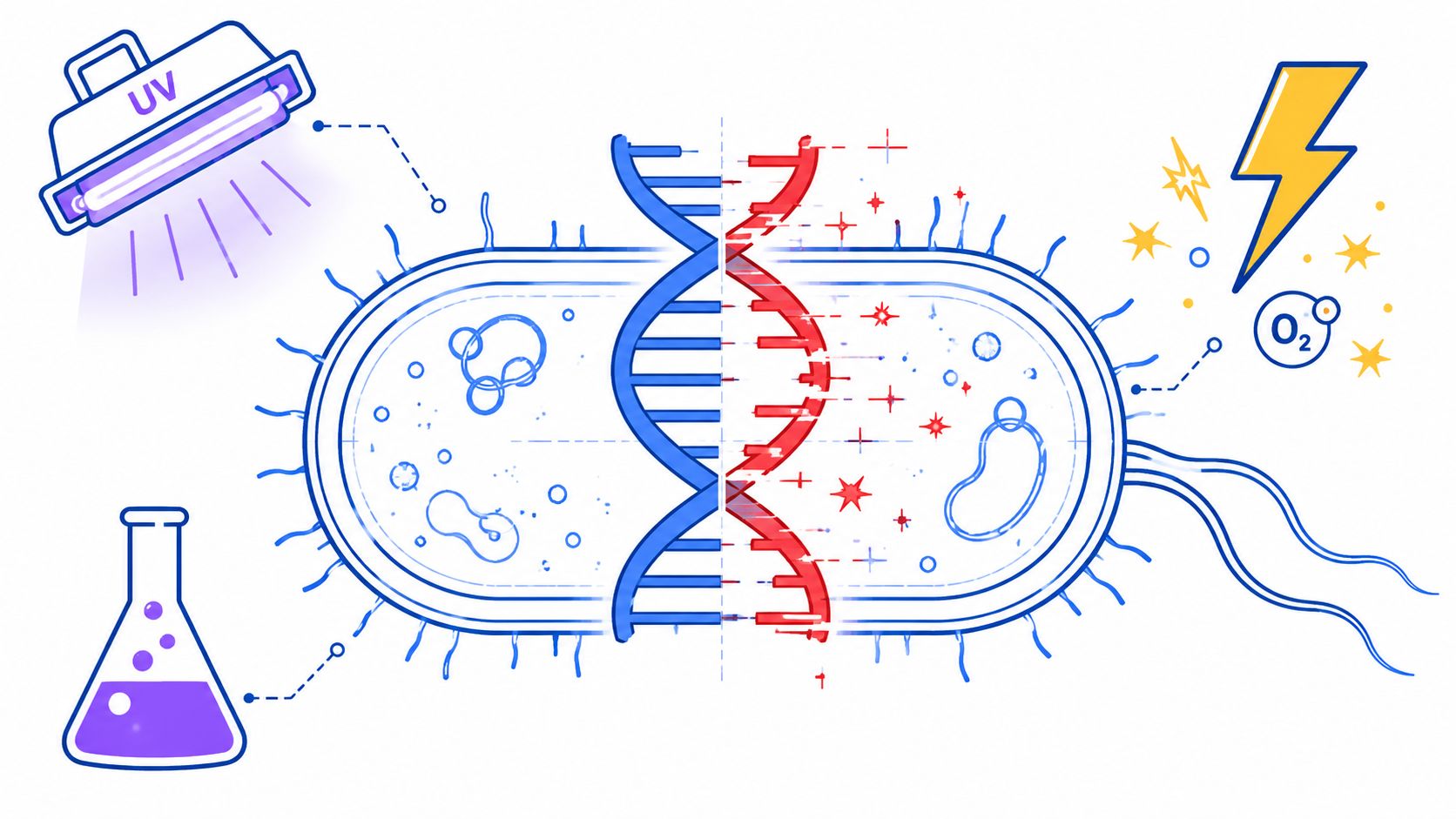
A useful way to think about the causes of mutations is this: life copies DNA constantly, and copying is never perfect. A landmark 2017 study found that 66 percent of cancer-driving mutations arise from random errors in DNA copying in human cells, a reminder that biological change often starts with ordinary replication rather than dramatic external exposure (Ludwig Cancer Research on random DNA copying errors). For infection control professionals, that same logic matters every day. Bacteria don't need intention to become harder to kill. They just need time, replication, and selection.
That becomes especially important with Pseudomonas aeruginosa, a wet-surface specialist that turns plumbing, drains, and equipment into long-term reservoirs. If you manage a clinic, gym, spa, school, or other high-traffic facility, understanding mutation isn't an academic exercise. It's part of understanding why some organisms persist after incomplete cleaning, why resistance keeps appearing, and why hygiene protocols can either limit spread or unintentionally help the toughest survivors dominate.
The Unseen Engine of Bacterial Evolution
Why mutation matters in the real world
Healthcare-associated infections affect millions of patients worldwide each year, and a share of that burden comes from bacteria that keep adapting under pressure. For infection control teams, mutation matters because it supplies the raw material for that adaptation. Most genetic changes in bacteria have little effect. A few alter survival in ways that become very visible on the floor, in the drain, or at the bedside.
A practical comparison helps. Mutation works like small copying defects in an instruction set that is reproduced at enormous speed. One typo in one copy may not matter. But if a microbe population is large, and the environment keeps filtering out the vulnerable cells, the rare useful typo can spread fast.
That is why wet reservoirs deserve so much attention. In sink drains, faucet aerators, and water-associated equipment, bacteria are not sitting still. They are multiplying, mixing, and facing repeated stress from cleaning agents, drying, nutrient limitation, and sometimes sublethal antimicrobial exposure. Each cycle creates another chance for a survivor to persist.
Pseudomonas aeruginosa shows this process clearly. It is an opportunistic pathogen that thrives in moist built environments and is well known for traits that make control difficult, including low outer membrane permeability, multidrug efflux systems, and biofilm formation, as described in the CDC overview of Pseudomonas aeruginosa in healthcare settings. Mutation does not create all of those baseline defenses from scratch. It modifies an already hard-to-remove organism, sometimes enough to improve antibiotic tolerance, disinfectant survival, or long-term persistence in plumbing.
Some of those changes occur on the chromosome. Others can be carried on mobile DNA such as bacterial plasmids that move resistance genes between cells. For a facility manager or clinician, the distinction matters less than the outcome. A strain that survives the local cleaning routine gets more opportunities to remain in circulation.
Where infection control teams encounter it
The highest-risk locations are usually the least dramatic ones. Any site that stays damp, collects organic residue, and is difficult to dry fully can become a small evolutionary workshop for bacteria.
Common examples include:
- Wet plumbing sites: sinks, drains, and faucet aerators
- Shared water-associated equipment: showers, water coolers, and hydrotherapy equipment
- High-traffic facilities: hospitals, gyms, and spas
Reviews of hospital water environments have repeatedly identified P. aeruginosa in sinks, drains, taps, and related plumbing components, supporting the view that these sites can act as persistent reservoirs for transmission (systematic review in Antimicrobial Resistance & Infection Control).
Practical rule: A surface that stays wet and is hard to dry completely often deserves more scrutiny than a visibly dirtier dry surface.
Who should pay attention
This is not only a laboratory concern.
Facility managers use this knowledge to set cleaning frequency, drainage maintenance, and equipment design standards. Healthcare workers use it to understand why splash zones, sink placement, and improper disposal practices can increase exposure risk. Environmental services teams use it to judge contact time and recognize that partial cleaning can leave behind the cells most likely to survive the next round.
The larger point is simple. Bacterial evolution is not separate from hygiene practice. It happens inside the environments people maintain every day, and weak control in wet zones can help the hardest survivors remain in play.
Understanding The Bacterial Blueprint
DNA as the instruction set
A bacterium's DNA is its working blueprint. It contains the instructions for cell structure, metabolism, movement, stress responses, and in some cases the machinery that helps it evade antibiotics or survive disinfectant pressure. If one part of that blueprint changes, the bacterium may behave differently.
That doesn't mean every genetic change is dramatic. Many are silent. But some alter a protein enough to change how the cell interacts with drugs, nutrients, or the environment.

What a mutation actually is
A mutation is a change in the DNA sequence. For non-specialists, the easiest analogy is a copying error in an instruction manual.
Here are the main patterns readers often confuse:
| Mutation type | Plain-language analogy | Why it matters |
|---|---|---|
| Point mutation | One letter changed in a word | May slightly alter a protein, or do nothing |
| Deletion | A letter or phrase removed | Can disrupt a gene's message |
| Insertion | Extra letters inserted | Can scramble how downstream instructions are read |
A point mutation is like changing one letter in a sentence. A deletion is like removing a word the technician needed. An insertion is like slipping extra text into the middle of a calibration note.
Genes, chromosomes, and plasmids
For infection control professionals, one distinction is especially useful. Not all bacterial DNA is organized the same way.
- Chromosomal DNA: This is the core instruction set that keeps the cell alive.
- Genes: These are individual instruction units within DNA.
- Nucleotides: These are the A, T, C, and G building blocks.
- Plasmids: These are small circles of extra DNA that can carry useful traits, including resistance-related ones.
If you'd like a practical explainer on extra-chromosomal DNA, this guide on what a bacterial plasmid is is worth reading.
A mutation is not a strategy. It's a change. Selection decides whether that change disappears or spreads.
Why this matters for harmful bacteria in facilities
When Pseudomonas aeruginosa picks up or develops a helpful change, the result may be subtle at first. Maybe it adheres better to a surface. Maybe a pump removes a drug more efficiently. Maybe stress responses improve survival inside a biofilm.
That's why the causes of mutations matter operationally. They shape the variation that cleaning and antibiotic use then act upon.
Spontaneous Mutations The Errors Within
Copying mistakes happen even without outside exposure
One of the biggest misconceptions in infection control is that mutations mainly happen because a bacterium was exposed to a harsh chemical or antibiotic. External triggers matter, but mutations also arise under routine growth conditions.
In bacteria like Escherichia coli, high-fidelity DNA polymerases make a mistake roughly once every 10^7–10^8 bases, and even after proofreading, the final error rate is about one mutation per billion bases copied (CancerQuest explanation of mutation rates). That means spontaneous errors are built into biology itself.

Two internal causes that confuse many readers
The first cause is replication error. DNA polymerase is the copying enzyme. It is very accurate, but not flawless. If it inserts the wrong base and repair systems miss it, that error becomes a permanent mutation after the next round of replication.
The second cause is spontaneous chemical change within DNA itself. Bases can shift into unusual states or undergo damage that changes how they pair. One well-known example is deamination of cytosine to uracil, which can create a mismatch that becomes a permanent change if repair doesn't correct it.
To make that less abstract, think of a photocopier and paper at the same time. Sometimes the machine misprints. Other times the paper itself is smudged before it enters the machine.
Why spontaneous mutation matters for resistance
These internal errors supply the raw material for adaptation. The mutation appears first. The selective pressure comes later.
That distinction matters when teams talk about “causing resistance.” An antibiotic or disinfectant usually doesn't instruct the bacterium to invent a trait on command. More often, it removes susceptible cells and leaves behind the rare variant that already has an advantage.
For readers who work with genotype and phenotype concepts in different disease settings, OMOPHub's phenotype guide is a useful reminder that a genetic change and its visible effect aren't the same thing. In bacteria, a tiny DNA difference may or may not translate into a detectable survival trait.
Small changes can have large consequences
Some mutations are single-base changes. Others involve extra DNA being added or lost. This explainer on an insertion mutation definition is helpful if you want a focused example of how adding material can disrupt a gene.
Internal mutation means this process doesn't stop when your environment looks clean. It only means selection pressure may be lower.
For E. coli, MRSA, and similar organisms, spontaneous mutation is one reason new variants keep appearing even in tightly controlled settings. The cleaner the environment, the fewer opportunities they should have to spread. But the source of variation never fully shuts off.
Environmental Mutagens The Triggers Without
External stress can scar bacterial DNA
Some mutations begin inside the cell during routine DNA copying. Others start when the environment hits the chromosome from the outside.
Environmental mutagens include ultraviolet light, oxidizing chemicals, and other agents that damage DNA bases, snap strands, or distort the double helix so the copying machinery reads it badly. A useful comparison is a paper chart that has been splashed, smudged, and torn before someone tries to photocopy it. The copier still runs, but the output is more likely to contain mistakes.
For infection control teams, that distinction matters because bacteria in healthcare settings do not experience stress in a neat laboratory way. They encounter disinfectants on bed rails, diluted residues in sink areas, UV devices with shadowed zones, drying on surfaces, and oxidative stress from host defenses. Each exposure can injure cells. Some die. Some survive with damaged DNA that must be repaired before the next round of growth.
Why partial exposure creates trouble
A fully effective cleaning or disinfection step removes the cells and ends the story for that surface. Partial exposure creates a different situation.
Under sublethal stress, bacteria can switch on DNA repair programs that are faster than they are accurate. In practical terms, the cell starts patching the blueprint during an emergency, more like a rushed maintenance crew restoring a damaged pipeline than a careful engineer following the original plan. That response can increase the chance that sequence changes remain after repair. Reviews of bacterial stress responses and mutagenesis in clinical settings describe how DNA damage, repair, and selection can interact during antibiotic exposure and other stresses (review of stress-induced mutagenesis and resistance evolution).
This matters on real surfaces and devices:
- Incomplete disinfection: surviving cells keep dividing after susceptible cells are removed.
- Repeated low-level chemical exposure: stressed cells may accumulate repair errors or favor variants that tolerate the agent better.
- Wet reservoirs and biofilms: drains, sink traps, and damp equipment protect bacteria from full contact with disinfectants.
- Poor UV deployment: shaded areas and irregular exposure leave pockets of living cells behind.
Those are operational failures, not evidence that cleaning itself is harmful. Good hygiene reduces transmission and cuts the number of bacterial replications taking place in the building. Fewer replications mean fewer chances for resistant variants to spread. The problem appears when protocols are inconsistent enough to stress bacteria without removing them.
Why the same genes keep showing up
Readers often hear that mutations are random, then wonder why similar resistance-associated changes appear again and again in pathogens such as MRSA or E. coli. The answer is that random does not mean equally likely at every position in the genome.
Mutation probability varies with local DNA sequence, replication timing, chromosome structure, and how often a region is transcribed or repaired. Some sites are easier to damage. Some are harder to repair accurately. Some genes are under such strong constraint that harmful changes disappear quickly, while other regions tolerate variation long enough for selection to act. Research in Science on mutation bias and genome organization helps explain why mutations are distributed unevenly rather than sprinkled uniformly across bacterial DNA (study on non-uniform mutation patterns across genomes).
For a facility manager or healthcare provider, that point has a practical edge. If the same adaptive trait keeps appearing under repeated stress, the organism is not planning ahead. The combination of exposure pattern, DNA repair, and genomic hotspots can make certain routes to survival more available than others. That is one reason a focused understanding of how bacteria develop antibiotic resistance is useful when designing cleaning protocols, device workflows, and surveillance plans.
Poorly applied stress does not just fail to clear contamination. It can help select from a pool of survivors whose DNA has already been altered.
How Bacteria Evolve Superbugs
The path from one survivor to many
A single surviving cell can become the seed of a much harder outbreak.
That is the core of superbug evolution. In a bacterial population on a bed rail, sink drain, ventilator surface, or wound dressing, cells are not perfectly identical in how they respond to stress. Some carry mutations that slightly change a drug target, alter membrane permeability, increase efflux, or improve survival inside a biofilm. Some also carry resistance genes picked up from other bacteria. Once antibiotic exposure or poorly executed disinfection removes the easier-to-kill cells, the survivors gain room to multiply.

Selection works like repeatedly sieving a mixed batch. Each round of antibiotic pressure, residue-level disinfectant exposure, drying stress, or nutrient limitation lets some cells fall away while a narrower group remains. Run that sieve enough times, and the population shifts. What started as a minority trait can become the dominant one in the room, on the device, or in the patient.
A practical story using familiar pathogens
Consider MRSA, or methicillin-resistant Staphylococcus aureus. In a broader S. aureus population, resistant cells survive beta-lactam pressure better than susceptible cells. If hand hygiene slips, high-touch surfaces are missed, or colonized patients are not contained effectively, those survivors spread to new hosts and new surfaces.
The same pattern appears with ESBL Escherichia coli, NDM-1 Klebsiella pneumoniae, and persistent Pseudomonas aeruginosa in wet systems. The molecular details differ, but the operational sequence is familiar to infection prevention teams:
- A bacterial population contains variation.
- Stress removes many susceptible cells.
- Survivors reproduce or persist.
- Transmission and repeated exposure increase the share of hard-to-control strains.
A focused explanation of how bacteria develop antibiotic resistance can help connect that biology to day-to-day control decisions.
Why resistance appears along repeatable paths
Resistance evolution is random in origin, but it is not random in outcome. Bacteria do not choose useful mutations. Selection keeps filtering the results.
A practical analogy is a lock-and-key system under constant tampering. Most random changes to the key make it worse or do nothing. A few slightly change the shape in a way that still lets the bacterium function while reducing antibiotic binding. Under drug pressure, those rare cells are the ones left standing. In organisms such as E. coli or S. aureus, repeated exposure can favor the same categories of solutions again and again, including target modification, enzyme production, reduced uptake, and better stress survival.
As noted earlier, mutation patterns are not spread evenly across the genome. That matters because some evolutionary routes are easier for bacteria to reach than others, and selection keeps rewarding the routes that preserve survival at the lowest biological cost.
What that means for commercial and healthcare environments
For facility managers and healthcare providers, mutation science is not abstract genetics. It is part of environmental control.
Sublethal pressure is one of the clearest examples. If disinfectant contact time is shortened, if surfaces stay partially soiled, if wet infrastructure is cleaned inconsistently, or if antibiotics are used in ways that leave surviving bacteria behind, the environment keeps favoring cells that tolerate stress better. Hygiene protocols do not cause bacteria to "try" to evolve. They shape which variants are removed and which variants get another chance to spread.
That is why the same practical failures produce the same practical problems.
- MRSA on shared-contact surfaces persists when high-touch cleaning is incomplete and colonized carriers keep reseeding the environment.
- E. coli in contamination-prone zones spreads when hand hygiene, toilet-area sanitation, and surface separation break down.
- Pseudomonas aeruginosa in sinks, drains, and wet equipment becomes chronic because biofilms protect survivors between cleaning cycles.
A superbug usually emerges from ordinary variation plus repeated selection. In infection control terms, every missed cleaning step, every poorly timed contact interval, and every avoidable transmission event can help turn a rare survivor into the strain that defines the next outbreak.
Detecting and Tracking Dangerous Mutations
How laboratories look for trouble
A resistant strain can look ordinary on a culture plate. The difference that matters may be a single gene, a small deletion, or a cluster of mutations that changes how the organism responds to antibiotics or survives in the environment.
That is why outbreak work depends on laboratory tools that read beyond appearance.
PCR works like a targeted barcode scanner. It checks for specific resistance genes or other known markers and can answer a focused question quickly. Whole genome sequencing reads far more of the organism's DNA, which lets laboratories compare isolates at much higher resolution and examine how closely related they are during transmission investigations (CDC overview of AMD and sequencing for outbreak detection).
For infection prevention teams, those results are practical. They help answer whether two patients likely share a transmission chain, whether the same environmental strain keeps returning after cleaning, and whether a treatment failure may reflect a resistance mechanism that routine testing did not fully explain.
Why Pseudomonas is hard to track and control
Pseudomonas aeruginosa creates a special problem because the lab is often tracking both the organism and the setting that helps it persist. The bacterium has low outer-membrane permeability, multiple efflux systems, and a strong ability to form biofilms. Together, those traits can limit antibiotic activity and help the organism remain attached to wet surfaces and device-associated material (NIH review of Pseudomonas aeruginosa pathogenesis and biofilm-related persistence).
Biofilm changes the investigation. A free-swimming cell is easier to remove and easier to culture as an isolated event. A biofilm is more like a thin, stubborn apartment block attached to a drain, aerator, or sink surface, with bacteria protected inside a shared matrix. If a facility keeps seeing positives from the same wet site, the question is often not "Was this area contaminated once?" but "What reservoir is continuously reseeding this area?"
That shifts the focus of tracking.
| Question | Why it matters |
|---|---|
| What organism is present | Confirms the hazard and narrows the response |
| What resistance traits it carries | Informs treatment choices and containment steps |
| Where matching strains are appearing | Helps trace spread through plumbing, rooms, equipment, or hands |
What facility teams should take from this
Facility leaders do not need an in-house sequencing lab to use this information well. They need to connect lab findings to what is happening on the floor.
- Recurring positives from sinks, drains, or wet equipment often point to persistent reservoirs, especially when the same strain pattern appears over time.
- Patient clusters with closely related isolates support a transmission investigation and can help narrow the search to shared rooms, devices, or workflows.
- Unexpected treatment failure can justify a closer look at resistance genes or newly emerged mutations.
- Mixed results after cleaning may reflect sampling time, biofilm disruption, or recolonization from plumbing rather than a simple pass-or-fail cleaning outcome.
The most useful mutation data does not stay in the lab report. It becomes more actionable when infection prevention staff, environmental services, microbiology teams, and facility managers compare genetic findings with cleaning logs, water-system maps, device movement, and patient location history. That is where mutation science stops being abstract and starts helping teams contain superbugs before a scattered signal becomes an outbreak.
Actionable Strategies for Infection Prevention
A single surviving bacterium can seed the next hard-to-treat population. That is the operational problem behind mutation in real facilities.
Mutations arise inside the cell, but whether those mutants spread depends heavily on the environment around them. In a hospital, long-term care unit, gym, or spa, moisture, surface contamination, incomplete disinfection, and antibiotic pressure can all act like a training ground for tougher strains. MRSA on shared touch points and E. coli or Pseudomonas aeruginosa in wet plumbing areas are practical examples. The mutation is the typo in the instruction manual. Poor control practices are what keep photocopying that typo until it becomes the version everyone has to deal with.
With P. aeruginosa, wet sites deserve special attention because the organism persists well in water-associated niches. Sink drains, faucet aerators, splash zones, shower areas, and hydrotherapy surfaces can become reservoirs over time, especially when biofilm is present, according to guidance and outbreak reports from the CDC's water management resources for healthcare settings.

What good control looks like
- Use the right disinfectant: Choose an EPA-registered product with label claims that match the organism risk and the setting.
- Respect dwell time: The surface has to stay visibly wet for the full contact time on the label. A quick wipe that dries too soon can leave survivors behind.
- Clean before disinfection when soil is present: Organic material works like a shield and can block the disinfectant from reaching bacteria.
- Target wet reservoirs: Drains, aerators, splash areas, and other water-associated sites need their own cleaning schedule and technique.
- Train for technique: Wipe pattern, surface coverage, and when staff change cloths all affect how much contamination is removed.
- Pair hygiene with antibiotic stewardship: Antibiotic use selects for resistant survivors. Environmental cleaning reduces chances for those survivors to spread.
The connection to superbugs is direct. Every missed surface, every under-treated drain, and every unnecessary antibiotic dose increases the chance that a rare mutant gains an advantage. Facility hygiene does not change bacterial genetics at the moment a mutation occurs. It changes which bacteria get repeated opportunities to persist, spread, and become the dominant strain in the building.
Who should be most concerned
Healthcare providers, environmental services leaders, janitorial supervisors, gym operators, spa managers, school administrators, and facility managers all share this risk. Any site where people gather, touch common surfaces, and use moisture-rich spaces can support the spread of resistant bacteria if control measures are inconsistent.
Main takeaway: You cannot prevent every mutation, but you can reduce the conditions that let mutated survivors take over.
A practical approach is to build protocols around validated surface cleaning and disinfection products, verified contact times, focused wet-area control, and regular staff training. Facilities that need dependable wiping and disinfection supplies can source them from specialized vendors, but the larger point is procedural consistency. The product matters. The method matters more.
Leave a Reply